
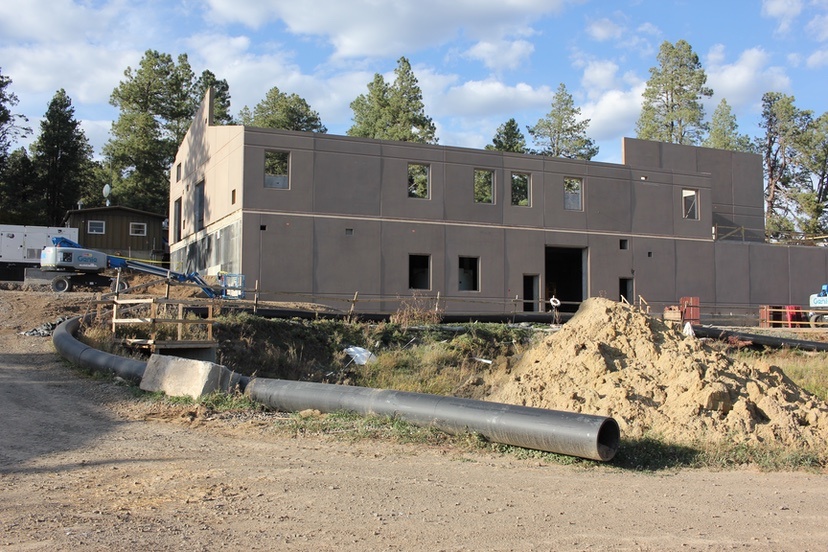
Photo: The Snowball Water Treatment Plant, north of downtown Pagosa Springs, under construction in October 2024.
Tomorrow in Part Five, we’ll be considering the ‘Interactive Community Forum’ hosted by the Archuleta County government on Tuesday.
But first, today, we wind up our discussion about informational black holes, as illustrated by certain social media conversations. News in Pagosa Springs has traditionally traveled largely by ‘word of mouth’… propelled by the rumor mill into the informational black hole.
I hit upon the phrase, “informational black hole”, while reading comments on a Pagosa-centric social media account, where local folks advertise free furniture, bake sales, personal achievements, lost pets… and occasionally, political questions. For example, why have Pagosa Area Water and Sanitation District (PAWSD) fees been increasing, and isn’t there something that can be done about it?
Disclosure: I currently serve as a volunteer Board member for PAWSD, but this editorial reflects only my own opinions, and not necessarily those of the PAWSD Board or PAWSD staff.
The essence of the online question:
I guess we voted to increase sales tax by 1% to fund water (I’m ignorant on this so help me out if I’m wrong.)
To my knowledge Pagosa has a fairly cheap lodging tax compared to other resort towns — I know these funds are tricky on how the money can be used but can we not increase the lodging tax for water infrastructure to provide relief for locals on usage and tap fees?
One of the comments came from Carl Young, who ran unsuccessfully for the PAWSD Board last year. His comments are in BOLD below, with my annotations to follow:
PAWSD takes our money, and sends it into a black hole. 7 points follow:
1) Unlike every other public body, PAWSD doesn’t publish monthly financial reports. Our money goes in every month and what happens with it is a mystery. Is spending on track, over budget or under budget?
This is partly true. Some local government entities — notably, the Town and the County — publish detailed monthly financial information. The County even publishes its expenditures in the local newspaper. The School District publishes a brief quarterly report. The Library District does not publish regular financial reports, nor does the Fire District. PAWSD also does not publish regular financial reports.
But the PAWSD Board went through the 2026 budget with a fine tooth comb, last fall, before approving it — and of course, the PAWSD staff is required to stay within the approved budget. The district’s financial condition and spending are audited by an independent auditing firm annually. Anyone can download the PAWSD 2026 Budget.
That said, I agree with Mr. Young that publication of a monthly financial summary is a good idea, and I recommend the PAWSD Board consider adding that document to its monthly agenda.
But to dismissively imply, on a public message board, that government agencies “take our money and send it into a black hole” is unnecessarily inflammatory. It’s no small matter that PAWSD consistently provides safe, clean, convenient drinking water to the community… and it’s certainly not a “mystery.”
2) PAWSD had an election in May for the first time in years. Turnout was dismal. I hope everyone who is complaining took the time to return their mail ballots. I lost by 34 votes.
Yes, Mr. Young did run for the PAWSD Board last May, and was defeated. Would PAWSD customers benefit from having a person who shares misinformation about water, serving on their water district Board? I doubt it.
3) PAWSD can add debt and raise your rates at any time without a vote of the people.
Actually, no. Every government in Colorado is limited in the amount of debt they can accrue, both by state law and by requirements developed by the banking industry. The PAWSD Board can, however, increase customer fees without a vote by the customers. In fact, every government in Archuleta County that collects fees can increase its fees without a vote of the people — and they often do so. PAWSD is no different.
4) Uptown residents pay PAWSD to treat the town’s sewage after it is pumped uphill. The rate charged to the town has remained flat while rates for Uptown residents go up and up.
Yet more misinformation. The Town residents, through the Pagosa Springs Sanitation Improvement District (PSSGID), pay PAWSD whatever it costs to treat their sewage. That rate has not remained flat. In 2020, Town sewer customers were paying $47 a month. They now pay $71 a month.
PAWSD uptown customers currently pay $50 a month.
Uptown residents do not pay to treat the Town’s sewage.
5) The PAWSD board says the town will make up the shortfall by paying an unknown amount of money at an unknown time.
What “shortfall” is Mr. Young talking about here? Does anyone know?
6) The new, $44 million water treatment plant for downtown will be piped to the uptown water supply sometime. No start nor finish dates are scheduled. And the plant depends on water from the West Fork of the San Juan.
Yes, PAWSD has been planning to replace the Snowball Water Treatment Plant for the past 20 years, and the new plant is nearly finished. Unfortunately, a (poorly-designed?) retaining wall is showing signs of failure, and will need to be replaced before the plant begins full operations. The engineering firm and the construction contractor will pay for the replacement wall.
This plant was not designed to serve “uptown”, but rather, to serve existing and future development in the downtown area. Nevertheless, PAWSD plans to connect Snowball to uptown water customers — at some point in the future — for redundancy and emergency use.
The Snowball plant does indeed depend on water from the West Fork — some of the cleanest water in the United States.
7) Water from Steven’s Reservoir will be piped into Hatcher sometime. No start nor finish dates are scheduled. To sum up, PAWSD hides its monthly spending and makes promises about our water future without committing to anything.
Stevens Reservoir was enlarged in 2011 to provide additional PAWSD water storage in case of drought. But previous PAWSD boards never authorized the pipeline necessary to deliver the stored water to the Hatcher Treatment Plant. That pipeline will travel across private property and involves private water rights, and negotiations are underway. No start or finish dates are scheduled. When built, this improvement will roughly triple the amount of raw water available at the Hatcher Plant, thus greatly increasing the community’s water security, especially uptown.
Government projects do not always unfold on a convenient schedule. Apparently, that fact drives certain people to post inflammatory and inaccurate information on social media message boards.
I hope today’s editorial helps explain my reference to “an informational black hole”.
Bill Hudson began sharing his opinions in the Pagosa Daily Post in 2004 and can't seem to break the habit. He claims that, in Pagosa Springs, opinions are like pickup trucks: everybody has one.