
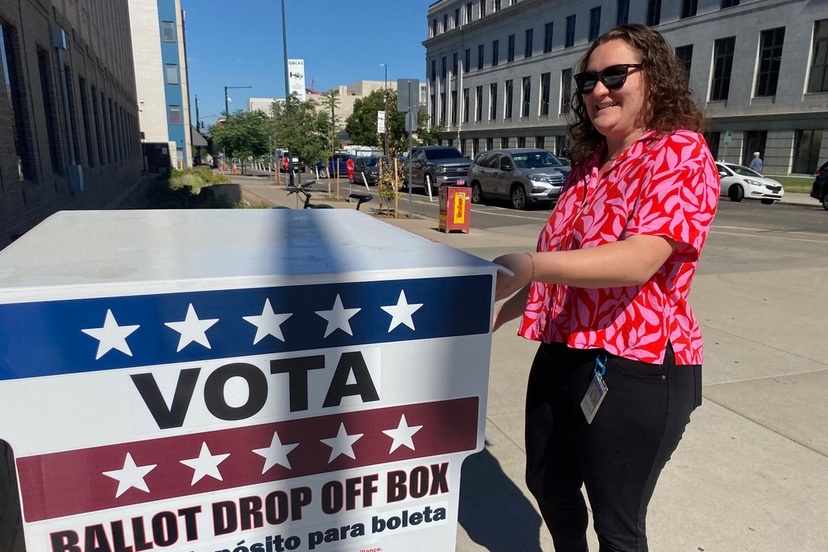
Photo: Annie Cioffi drops off a ballot outside the Denver Elections Division office on June 25, 2024, primary Election Day. (Quentin Young/Colorado Newsline)
This story by Lindsey Toomer appeared on Colorado Newsline on February 6, 2026
A bill introduced in the U.S. House would upend the administration of elections in states like Colorado that rely on mail ballots.
The Make Elections Great Again Act would ban universal voting by mail, which has been in place in Colorado since 2013. It would also require a photo ID to vote and proof of citizenship to register to vote in federal elections, and it would ban ranked choice voting. It would also restrict a person’s ability to collect and return ballots on behalf of other voters.
U.S. Rep. Bryan Steil, a Wisconsin Republican, introduced the bill in the House Friday. Less than a week later, President Donald Trump called for Republicans to “nationalize” voting in the U.S.
Republicans in Congress also continue to push the Safeguard American Voter Eligibility Act, which would require proof of citizenship for anyone registering to vote nationwide. It passed the House last year, and some Republicans tried to include the measure in the spending package Trump signed into law Tuesday.
Senate Minority Leader Chuck Schumer said the SAVE Act would impose “Jim Crow type laws to the entire country and is dead on arrival in the Senate.”
The MEGA Act would make it harder for citizens to vote, Colorado Secretary of State Jena Griswold, a Democrat, said. Voting by mail is the most secure way to run elections, because foreign adversaries cannot hack a mail ballot, she said. Colorado has universal mail ballots, meaning every voter automatically receives a ballot in the mail, and they can return it by mail or drop it off at a secure ballot drop box or polling location. Voters in the state also have the option to vote in person.
“Voters like mail ballots; in fact, 98.8% of Republican voters in Colorado chose to use their mail ballot last election,” Griswold said in a statement. “Trump and MAGA Republicans continue to try to disenfranchise Americans and intimidate states. They will fail, and Americans will have their voices heard.”
The MEGA Act would create a “centralized voter surveillance system” that would ultimately lead to a federal database with private information on voters, according to Aly Belknap, executive director of Colorado Common Cause, a nonprofit that works to defend democracy and voter rights.
The U.S. Department of Justice sued Griswold over her office’s refusal to provide the federal government with unredacted information from the state’s voter rolls. Belknap said the administration wants to force Colorado to comply and share sensitive voter information.
The possibilities of legal action the bill creates are alarming and go a step further than the SAVE Act, Belknap said. Individuals would have the power to sue election officials who register a voter without proof of citizenship, and the U.S. attorney general could sue states to force compliance with the requirements of the MEGA Act. Online voter registration, which Colorado offers, would not be possible with the bill’s citizenship verification requirement, Belknap said.
About 21 million Americans who are eligible voters lack proper documentation to prove they are U.S. citizens. Poor and working class people; people who have legally changed their name, particularly transgender people; and people of color are most likely to lack access to those documents, Belknap said.
“In a world where this legislation, this proof of citizenship requirement, were to take effect, it would disenfranchise millions of people,” Belknap said. “Millions of people would be turned away from the polls on Election Day. It would be just a national tragedy, honestly, in every single state.”
Colorado does not require a photo ID to vote. If voting in person, a voter needs to present a valid form of identification, which could include a Colorado driver’s license, a U.S. passport, a utility bill or bank statement that shows name and address dated within the prior 60 days, a Medicaid or Medicaid card or a U.S. birth certificate, among other options.
Voting by noncitizens in elections is extremely rare and already illegal.
Federal threats to state-run elections is part of the reason the Colorado Legislature passed the Colorado Voting Rights Act last year, Belknap said.
Democrats in Congress from Colorado defended the security of the state’s election system. U.S. Rep. Jason Crow, an Aurora Democrat, said Trump and Republicans want to sow doubt in elections.
“Their proposal is unconstitutional and an attempt to suppress the voices of voters,” Crow said in a statement. “Colorado’s voting system is transparent, strong, and fair, and I will fight any attempt from President Trump and his administration to have the federal government take over elections.”
U.S. Rep. Diana DeGette, a Denver Democrat, said the MEGA Act is “not serious policy” and that she would not support it.
“Donald Trump and Congressional Republicans are focused on doing everything possible to make it harder for people to vote in our country,” DeGette said in a statement. “We should be tearing down barriers to participate in our democracy, not putting up new ones.”
The MEGA Act “is built on lies and conspiracies designed to silence millions of voters,” U.S. Rep. Brittany Pettersen said in a statement on X.
Colorado Newsline is part of States Newsroom, a nonprofit news network supported by grants and a coalition of donors as a 501c(3) public charity. Colorado Newsline maintains editorial independence. Contact Editor Quentin Young for questions: info@coloradonewsline.com. You can support Newsline here.
Colorado Newsline is part of States Newsroom, a nonprofit news network supported by grants and a coalition of donors as a 501c(3) public charity. Colorado Newsline maintains editorial independence. Contact Editor Quentin Young for questions: info@coloradonewsline.com.