
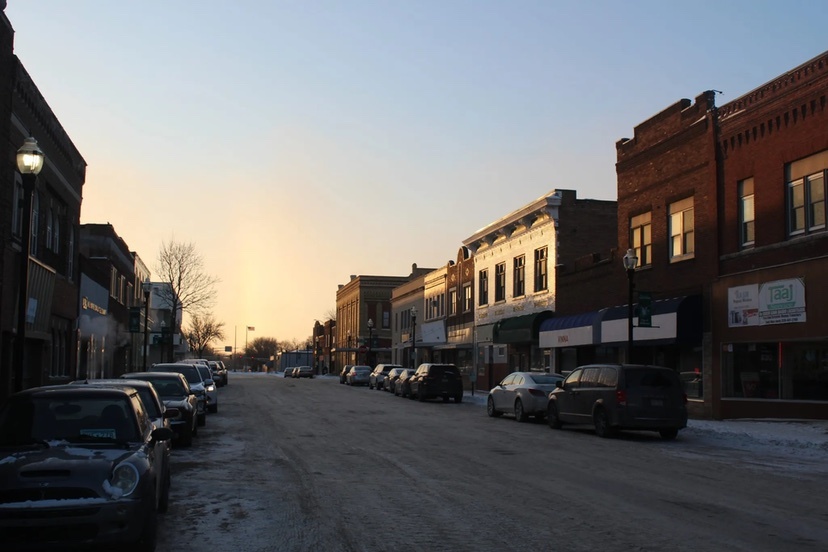
Photo: The sun sets in downtown Willmar on Saturday, January 24. (Photo by Betsy Froiland)
This story by Betsy Froiland appeared on The Daily Yonder on February 2, 2026. We are sharing it in two parts.
As a car rolled by outside, restaurant’s owner Willie Gonzalez looked up out the window to see who was behind the wheel. Others did the same.
“Out of the 35 years that I’ve been alive, I’ve never felt any sort of heat like this until right now,” a man at the table said.
Residents feared for the community’s children. Perla Ocampo, an 18-year-old college student, said her six-year-old niece is scared to go to school because her friends are missing. As a volunteer “lunch buddy” at the local elementary school, Ocampo has heard kids say they’re afraid they won’t see their parents again. She once walked home with a kid who was afraid of being taken by ICE.
“Kids are going to be living with that for the rest of their lives,” said a man at the table. “Like, ‘remember, mom, when we were younger and we were tucked away for months and months on end?’ That doesn’t feel like an American story to me.”
A mental health professional, Christina Vander Pol, talked about the cost of this psychological trauma, the cost of kids missing schoolwork, the cost of picking up the pieces after someone is taken. “We as community members are having to pick up that cost.”
Not just a psychological cost, the economic toll is also mounting. With people too afraid to leave their homes to work or shop, many local businesses – including Gonzalez’s and Juan’s – are taking a financial hit. A young woman who works at her parents’ restaurant said they had to close for two weeks because her parents are immigrants, and when they re-opened, they put cameras around the building, reduced their business to just pickups and deliveries, and lowered prices – both to incentivize business and make food more affordable for community members who may be struggling financially.
“This is not bringing wealth or security or a greater America to this town,” Vander Pol said. “It’s bringing devastation.”
Jennifer Lindquist, another resident at the table, also thinks about the cultural cost. Many of the town’s ethnic-specific grocery stores and restaurants have been forced to close their doors, while big-box corporations stay open. By default, the foods and cultures that remain are those that are protected by some level of privilege.
“Apparently we’re trying to make America greater, bigger, better,” Vander Pol said of the Trump administration’s purported goal. In reality, the ICE siege on Willmar is only making the town poorer, smaller, more afraid.

Residents are doing everything they can to minimize the damage to their community.
They are keeping watch around Willmar for ICE agents, whistles around their necks at the ready to alert neighbors to ICE activity.
They are picking up the pieces after ICE arrests a neighbor, contacting their family, returning their belongings, and arranging care for children and pets left behind.
And they are caring for their neighbors who are too afraid to leave their homes. Lindquist, a veteran community organizer, said that the community had mobilized in a big way, donating to food and hygiene product drives, helping deliver resources, and giving rides.
“When I look around at the people that I’m sharing space with and they’re out there bringing food, giving rides, I know I’m on the right side of this,” said Lindquist.
Juan and Lizbeth have started donating perishable foods from their grocery store, even driving to people’s houses to drop off food when they are too afraid to leave. Another resident started organizing raffles to donate raised funds to impacted families.
Residents are also showing their solidarity with neighbors in everyday interactions.“I find myself making eye contact more often than I used to,” said Vander Pol. She does it in the grocery store now, trying to signal to people that she is a safe person. “We need to be really intentional that we are standing alongside each other, and that we’re letting it be known through micro actions.”
“We’re finding out who we really are as neighbors,” Vander Pol said. “We’re not just businesspeople, partners, people driving past each other on the street. There is community inside this community that’s taking care of each other.”
Though the community has come together in many ways, the presence of ICE has also fractured the politically diverse town. Many residents had managed positive relationships with neighbors across party lines before the siege began. One man at the table talked about his good friend who is a Trump supporter: “I love the guy,” the man said. But when it comes to what ICE is doing in his community, the man said, “I’m not going to stay quiet. I love you enough to tell you that.”
While some cross-party relationships remain intact, others have devolved, particularly online, into political sparring about ICE.
The pro-ICE rhetoric that frustrates residents the most is the narrative that ICE is after “illegals” and “criminals.” Residents talked about the immigrants they know, people who had poured decades and thousands of dollars into obtaining citizenship under constantly changing rules, people who had no criminal record or nothing more than a couple traffic tickets, people who had come to this country to work hard for a better life.
“It’s not about illegal or legal anymore,” Lindquist said.

Many residents looked ahead to the future, thinking of ways to rebuild their community if and when ICE ended its targeted operation there.
Looking around the restaurant, a man at the table said, “they’ve been feeding people here for years.” Pointing to Gonzalez, he said, “to go to date night with my woman, I come here.” Pointing to Juan, the grocery store owner, he said “when I’m trying to grill out, that’s my people.”
When businesses open their doors again, the man said he hopes people flood back in. For now, the people around the table remain laser-focused on supporting their community and – especially for those unlikely to be targeted themselves – standing up against ICE and the government that sanctions it.
“I think about my childhood as a privileged white person from Willmar,” said Steve Vossen. “Being silent’s not an option anymore,” he said. “This is not the America or the humans we want to be.”
Looking at her daughter Adyssey, Brielle said, “When she has her own kids and they’re like, ‘what in the world happened?’ She can say, we were on the right side. We stood up.”
Julie Vossen-Henslin, another resident in the room, wondered aloud about how the community might recover from an experience like this.
Then, looking at her neighbors sitting around their big, makeshift table, she answered her own question, “it starts like this.”
This article first appeared on The Daily Yonder and is republished here under a Creative Commons Attribution-NoDerivatives 4.0 International License.

The Daily Yonder provides news, commentary, and analysis about and for rural America. They welcome photos, tips, observations, and links to stories about rural America. Reach them at news@dailyyonder.com