
As mentioned yesterday in Part One, the San Juan Water Conservation District (SJWCD) had scheduled a meeting for yesterday, Monday February 2, and one of the items on the agenda concerned a planned grant application to the U.S. Bureau of Reclamation (BOR) — the agency that, from the 1930s through the 1970s, funded massive water reservoir projects all across the arid American West, in an effort to accommodate agriculture and population growth in places where no intelligent person would ever imagine them based on natural water availability.
One of the first massive Reclamation projects was the Hoover Dam, which created Lake Mead, the largest reservoir in the U.S. in terms of storage capacity.
We’ll get back to the BOR later. And also, take a quick look at two Colorado Supreme Court rulings.
I attended Monday’s SJWCD board meeting, because I’d been hearing about a potential grant application to the BOR for several months.
I hoped to hear the Board discuss the grant, knowing that the SJWCD Board believes the public should know what their tax money is paying for.
Transparent government and so forth.
I didn’t understand why the BOR grant has been treated so secretively for the past few months.
Disclosure: I currently serve on the Pagosa Area Water and Sanitation District (PAWSD) Board of Directors, but this editorial reflects only my own opinions, and not necessarily the options of the PAWSD Board as a whole, or the PAWSD staff. PAWSD is currently in a lawsuit with SJWCD, related to the Running Iron Ranch and the proposed Dry Gulch Reservoir.
SJWCD had not included any information about this BOR grant in the emailed meeting packet.
Typically, when local governments are getting ready to apply for significant grant funding, open discussion and documentation is shared with the public prior to a decision. The SJWCD Board, specifically, believes the public should know what their tax money is paying for. Maybe I said that already?
Surprisingly enough, at Monday’s meeting, absolutely no information was shared about the size of the grant, what the grant would be used for, or whether tax money would be used to ‘match’ the grant. Two Board members were instructed to finish editing the grant documents and were authorized to submit the grant to BOR. No one on the Board suggested that information would be shared with the taxpayers.
When I asked if any information about the grant was going to be shared with the public at some point, Board member Randy Cooper responded:
“Yeah. When it’s a final submission, it will be put out on the [SJWCD] website.”
Does this mean information about a potentially expensive government project will not be released until after the grant is already submitted? It seems to be the intention to keep the grant ‘secret’ until then.
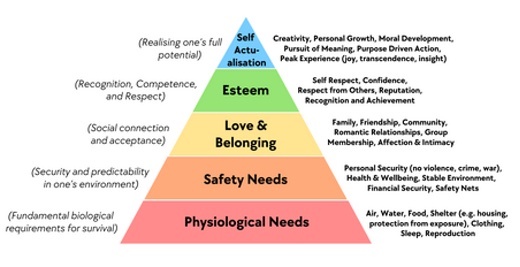
I’m thinking this morning of American psychologist Abraham Maslow’s “hierarchy of needs”, published in 1943 in in his article “A Theory of Human Motivation” in the journal Psychological Review.
According to Dr. Maslow’s original formulation, there are five sets of basic needs that are related to each other in the hierarchy of their ‘prepotency’ — their power, influence, predominance. Humans typically strive to fulfill the most basic needs first, and then, once those needs are met, will work to satisfy ‘less basic’ needs.
Obviously, one of the physiological needs is the need for water — along with air, food, shelter, sleep, and “reproduction”. (Dr. Maslow would have been understandably hesitant to use the phrase “sexual intercourse” in a respected journal in 1943.)
The theory is often illustrated with pyramid, with physiological needs at the base, and culminating at the top with desires for ‘self-actualization’…
My limited research into Dr. Maslow’s theory didn’t reveal anything about the human need to keep secrets.
But we certainly cannot question the need for water. A human being can last only about three days without water.
By this, we mean, “water to drink”. But a human can go for a very long time without water to run a washing machine. Traditional Native peoples living in the Arctic never washed their clothes all winter long. Nor did they bathe their dogs.
In 2003, the San Juan Water Conservation District (SJWCD) and Pagosa Area Water and Sanitation District (PAWSD) commissioned a report to tell them where, in Archuleta County, the next reservoir should be built. At the time, the community had six good-size reservoirs that could provide water for drinking, or washing clothes, or flushing toilets. Those reservoirs had been created during the 1970s by the developers of the Pagosa Lakes subdivisions, as recreational amenities and as water reservoirs.
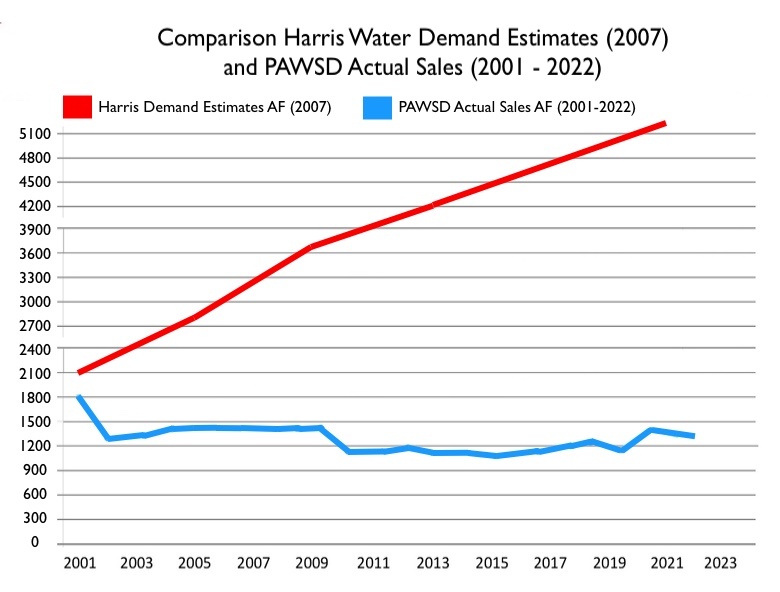
That 2003 report by water engineer Steve Harris predicted a PAWSD service area population of of 26,534 by the year 2025.
Actual population in the PAWSD area in 2024 was estimated (by PAWSD) at about 10,800. Less than half the population predicted by Mr. Harris.
Mr. Harris’ 2003 prediction, about the amount of water the community would need, completely missed the target. He predicted PAWSD would be providing 7,719 acre-feet of water annually by 2025.
PAWSD actually sold about 1,400 acre-feet of water in 2025. About one-sixth the amount of water predicted by Mr. Harris, and very close to the same amount sold in 2003.
The red line below shows Pagosa water demand as predicted by Steve Harris. The blue line shows actual PAWSD water sold.
The SJWCD Board unanimously believes that Pagosa Springs needs a large reservoir at Dry Gulch, covering much of the Running Iron Ranch and extending beyond the Ranch onto property SJWCD does not own.
The PAWSD Board unanimously believes the 2008 purchase of the Running Iron Ranch was a mistake and would like to get its customers out from under the remaining debt.
A community needs water. It’s a basic physiological need.
But… how much water do we need?
That was a question that PAWSD Board President Gene Tautges posed to the SJWCD Board on Monday.