
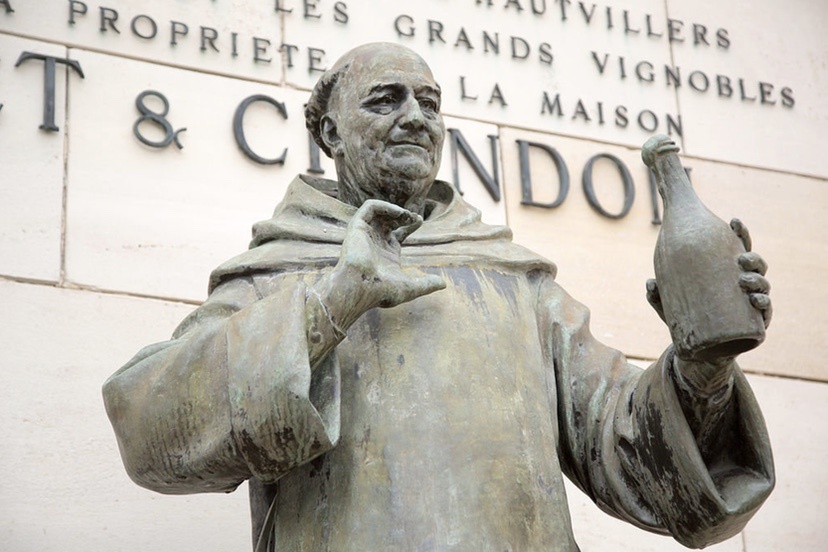
Photo: A statue Dom Pérignon (and bottle) on the Avenue de Champagne. Credit: Victor Grigas / CC BY-SA 4.0
“One must drink their champagne before Easter, before the wines become possessed by the Devil…”
— from an article by journalist Lucy Edwards, writing on ChampagneEveryDay.com, October 2023, quoting an adage often repeated by the monks living at Hautvillers Abbey, in the Champagne region of France.
Nothing says “celebration” like the popping of a champagne cork.
As was the tradition in our families, Darlene and I served champagne at our wedding, which may have been a mistake, considering what happened with my brother that evening. The Benedictine monks at Hautvillers Abbey well understood the relationship between champagne and Satanic possession.
But that’s a story for another day.
I will mention, however, that neither Darlene nor I, nor anyone in the wedding party, had to wear a mask during the champagne toast. And for that, we can thank King James I and his councilors, and some resourceful English glass-blowers during the 17th century.
(If I had a bottle of Dom Pérignon right now, I would pop a cork to those inventive bottle-makers. But I don’t, so a can of beer will have to suffice.)
In the early 1600s, the kingdom of England was in the grip of what may have been the world’s first energy crisis — sparked, as are all energy crises, by greed and ‘economic development’.
From a 2019 article by Jai Ubhi on AltasObscura.com:
Decades of population growth, rapid urbanization, countless foreign wars, and myriad voyages of discovery to the New World under the capricious Tudors decimated the country’s forests and its timber supply.
King James I was terrified. No trees for timber meant no ships for the navy, and no navy meant leaving the country wide open and undefended against England’s enemies — which, at this time, was pretty much all of Europe. This lack of timber was nothing short of an existential threat to England itself…
The King issued a proclamation in 1615 restricting the use of wood for anything but absolutely essential purposes. Especially, the proclamation forbade the burning of “timber, or wood, or any Fewell made of timber or wood” to “melt, make or causeth to be melted or made, any kind, form or fashion of Glass…whatsoever…”
The English were still learning how to spell. The King meant “any Fuel”.
But the English had considerable skill at making glass. The country’s glass-makers had been burning wood for centuries to produce the fearful heat needed to melt a mixture of potash and sand into glass.
Meanwhile, the London upper class were eagerly buying a new type of wine, made by adding sugar and molasses to existing fermented wines. This caused the wine to undergo a secondary fermentation and produced an effervescent, bubbling concoction suitable for celebrations. Or, if you were rich, a refreshing beverage at breakfast.
The process is known today as ‘méthode champenoise’ and, according to the French, was developed by a monk named Dom Pierre Pérignon, in 1693 or 1697, depending on whom you want to believe.
But don’t believe them, because ‘méthode champenoise’ was described in considerable detail, thirty years earlier, by English scholar Christoper Merrett. In 1662, he submitted an eight-page manuscript to the recently established Royal Society, outlining his formula for creating bottle-fermented sparkling wine.
The main problem with champagne — other than the Satanic possession problems — was the exploding bottles.
As the resident monks at Hautvillers Abbey would preach:
“One must drink their champagne before Easter, before the wines become possessed by the Devil.”
Why? The chilling winters induced a dormant state of fermentation in the wine, with the yeast remaining inactive until spring. It was this secondary fermentation that manifested as mysterious, and seemingly uncontrollable, effervescence. Come spring, everything — including yeast — began to come to life. One bottle would explode, and the whole cellar could go up in domino effect, sending flying glass everywhere.
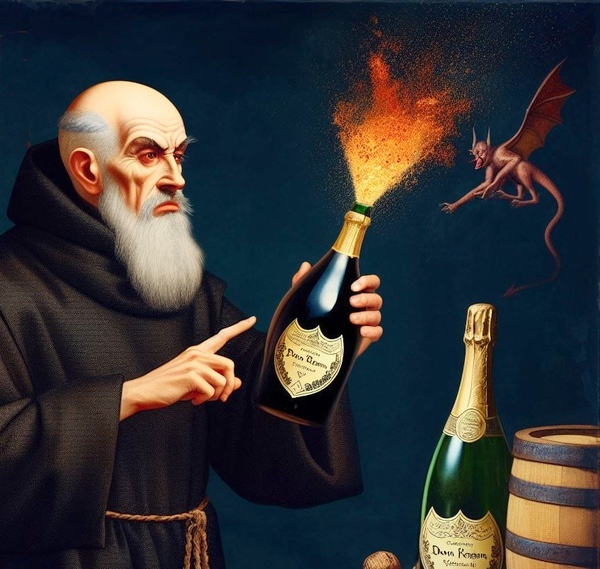
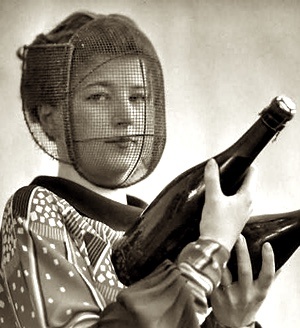
In order to enter a wine cellar safely, the French monks took to wearing masks.
No, not this type of mask:

Protective wire masks, like this:
Enter the English bottle-makers, forced — against their wills — to burn filthy coal in their furnaces. But low and behold, the coal furnaces burned much hotter than the old wood-fired furnaces. Yes, coal gave off disgusting fumes, but the higher temperatures created stronger, more durable, and thicker glass.
While European bottle-makers were still using wood, the champagne bottle as we know it was born in the coal furnaces of England.
Which was, of course, an economic blow to English wire-mask manufacturers. But like they say, one man’s ceiling is another man’s floor.
Champagne fermentation generates an incredible amount of pressure. From the AtlasObscura article:
In a standard bottle of sparkling wine today, the internal pressure is at around six times that of atmospheric pressure—three times that of a car tire. That’s the equivalent to more than five kilograms of weight pushing hard against every square centimeter of glass. Only an especially strong bottle could withstand this sort of pressure. Thankfully, England’s glass-makers were prepared.
In the 1920s, Dom Pérignon got his name assigned to a high-class champagne made by Moët et Chandon, and a statue was erected in his honor. Many people credit him with establishing the champagne industry. But I am going to give the credit to King James I, even though he had no idea what would ultimately result from his wood-burning prohibition. Typical politician.
Apparently, it took the French bottle-makers more than a century to learn how to make champagne bottles. In the meantime, the monks were importing suitable bottles from England.
Or wearing masks.
Underrated writer Louis Cannon grew up in the vast American West, although his ex-wife, given the slightest opportunity, will deny that he ever grew up at all. You can read more stories on his Substack account.