
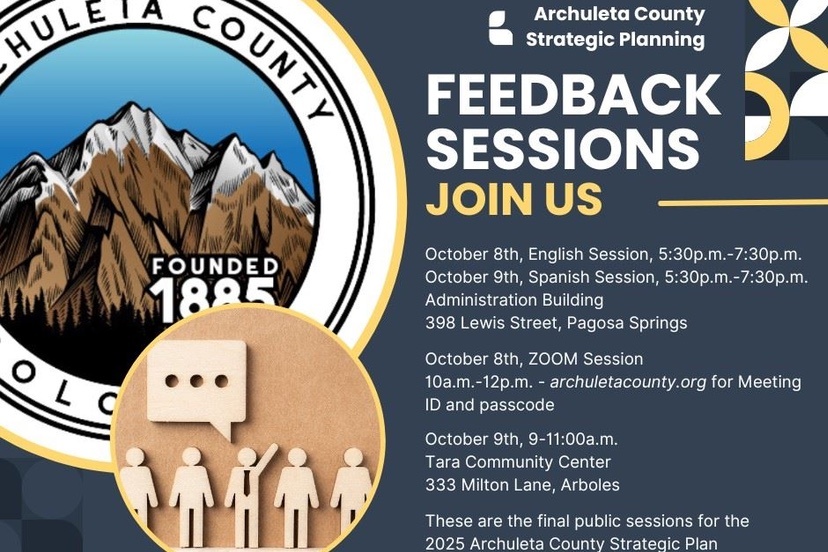
Archuleta County is currently finishing up a new “Strategic Planning” process, facilitated by a company called Civic* Possible. (The asterisk is part of their name.). The plan is aimed specifically at community needs over the next three years.
In order to develop this plan, the two consultants with Civic* Possible — Jason Schneider and Rachel Barra — were tasked with gathering input from the County staff, and from the larger Archuleta County community.
Four community “listening” sessions were held earlier this week, to include a “Spanish language” listening session on Wednesday afternoon. I attended both of the two of the English language sessions on Tuesday; a total of seven community members participated in those two sessions. Apparently, a much larger number of County staff participated in the input process. Of course, the staff is also very much a part of the community, but a part with particular personal interests in County operations and planning.
The community also had the option to take an online survey about Archuleta County’s current priorities (or lack thereof.) The online survey asked many of the same questions asked by the consultants during the face-to-face sessions, including a request that we try and prioritize the following items:
1. Which of the following strategic activities are most important for the County to focus on over the next three years?
- Strengthen Community Partnerships
- Affordable Cost of Living
- Build a Culture of Transparency
- Water Availability, Access, and Connectivity
- Champion a Unified Community-wide Vision
- Managing Growth for Quality of Life and Preservation of the Region
- Equitable Access to Quality Housing
- Economic Diversification
- Improve Communication with Community
- Expanding Community Facilities (recreation)
- Build and Manage a Comprehensive Capital Projects Plan
Some of these “strategic activities” have no business on the County’s actual work agenda, in my humble opinion. More about that in a moment.
Curiously, the word “Roads” does not appear on this list. But maybe that’s because roads are part of “a Comprehensive Capital Projects Plan”? A part of the same plan to build millions of dollars worth of new County facilities, perhaps… while allocating lesser amounts to road maintenance?
“Roads” were not an issue when scientist John Calhoun was studying the social dynamics of various rat and mice populations during the 1950s and 1960s. Rodents don’t need roads. They build their own nests. They live without any apparent government or system of taxation. But their society does generate “dominant” individuals who enforce general or specific territorial rules on the rest of the population.
Whether those “dominant” rodents are the most intelligent individuals, or the most generous individuals, or the most capable individuals, is open to debate. All we really know is, they are the “dominant” rodents.
We also understand from Dr. Calhoun’s research, that, given an enclosed living space and unlimited food and water, his rodent populations tended to reach a stable level and remain there, but the social impacts affected members differently. The privileges of the “high-status” males and females did not necessarily align with those experienced by “low-status” males and females. Curiously enough, these differences in status seemed to contribute to the stabilization of the total population, according to Dr. Calhoun.
Pagosa Springs is not an enclosed space with unlimited food and water. But we do have “dominant” individuals who are making decisions for the rest of us.
Here’s that list again, as presented to the citizens of Archuleta County by Civic* Possible.
1. Which of the following strategic activities are most important for the County to focus on over the next three years?
- Strengthen Community Partnerships
- Affordable Cost of Living
- Build a Culture of Transparency
- Water Availability, Access, and Connectivity
- Champion a Unified Community-wide Vision
- Managing Growth for Quality of Life and Preservation of the Region
- Equitable Access to Quality Housing
- Economic Diversification
- Improve Communication with Community
- Expanding Community Facilities (recreation)
- Build and Manage a Comprehensive Capital Projects Plan
Well, we have a couple of situations here that qualify as “crises”. And some others that are not even “County” responsibilities.
“Water Availability” is not a crisis in 2024, although we do have a segment of our population without centralized drinking water. But a separate special district, Pagosa Area Water and Sanitation District (PAWSD), handles the main part of that job. The provision of water has never been an Archuleta County government responsibility, so I don’t understand why it’s in this list?
Other things that are nice to consider, but certainly not crises:
- Strengthen Community Partnerships
- Build a Culture of Transparency
- Champion a Unified Community-wide Vision
- Economic Diversification
- Improve Communication with Community
- Expanding Community Facilities (recreation)
Here are the crises our community faces, which, if not addressed, will seriously affect our community’s continued viability:
- Affordable Cost of Living
- Managing Growth for Quality of Life and Preservation of the Region
- Equitable Access to Housing
- Develop and Implement a Viable Road Maintenance Plan
To suggest that County government can seriously influence the overall “Affordable Cost of Living” is a pretty wild idea, unless the BOCC were willing to champion a higher Minimum Wage — maybe $25 an hour? — as has been implemented in certain other communities. I don’t see that happening.
So we’re left with what might be three serious crises facing our community, that our County government can influence.
Growth. Housing. Roads.
Seems so simple to me. But do our current commissioners see these as crises? And more importantly, do they see them as crises that ought to be addressed over the next three years? As priorities?
We don’t have the time and money to address everything the community might desire.
Do we want to focus on the most serious issues? Because, there are indeed some serious issues.
If we don’t address the worst problems, the rest of it won’t matter much.
Bill Hudson began sharing his opinions in the Pagosa Daily Post in 2004 and can't seem to break the habit. He claims that, in Pagosa Springs, opinions are like pickup trucks: everybody has one.