
The cost of drinking water has increased significantly over the past two decades, for the customers of the Pagosa Area Water and Sanitation District (PAWSD), and indications are that the price will continue to increase. To keep up with inflation, for one thing. And also to maintain and upgrade water treatment facilities. The aging Snowball Treatment Plant is scheduled to be replaced within the next couple of years, at an estimated cost of perhaps $20 million.
PAWSD has also made a significant investment into fixing leaking water lines, which in the past were losing up to 40% of our treated water before it reached customer taps.
San Juan Water Conservancy District (SJWCD) had been focused, in the meantime, on finding money and partners to build an 11,000 acre-foot reservoir in the Dry Gulch Valley. One attempt to get some of the money from local taxpayers — a proposed mill levy increase — was rejected at the polls in 2017.
Recently, SJWCD has spent more of its time considering ways to improve its relationship with its voters, who are also its taxpayers.
(Disclosure: I serve as a volunteer on the SJWCD board of directors, but this editorial expresses my own opinions, which are not necessarily the opinions of the board as a whole.)
I’ve already mentioned the five key goals that the SJWCD board will be asking the communications managers at Carbondale-based Project Resource Studio to address over the coming months. Goal Number One, however, seems more likely to be addressed by an engineering firm like Wilson Water Group. That is, by someone with a good foundation in real-world mathematics.
1. Determining the water needs (agricultural, municipal, environmental, and recreational) of the District, and how the [Dry Gulch Reservoir] Project and other projects might meet those needs.
Real-world mathematics had not been a strong point among the various people who promoted the Dry Gulch Reservoir during the first decade of the 21st century. But maybe that didn’t feel too important… because no one was paying close attention?
On a Monday evening in February, 2009, several months before the Colorado Supreme Court rejected the real-world mathematics presented by PAWSD and SJWCD in an attempt to justify a future Dry Gulch Reservoir, a masterful communications manager named Sheila Berger (pronounced ‘Bear-zhay”) presented a series of slides that described a 19,000 acre-foot, $357 million reservoir project. The slide show, sponsored by PAWSD and SJWCD, began here:
You can download the entire 2009 slide show here.
Water is indeed Life. And the Dry Gulch Reservoir was designed to hold water. A great deal of water. More water than we could ever need, or want?
Ms. Berger presented a number of slides that purported to show real-world mathematical calculations. For example, one of the slides looked like this:
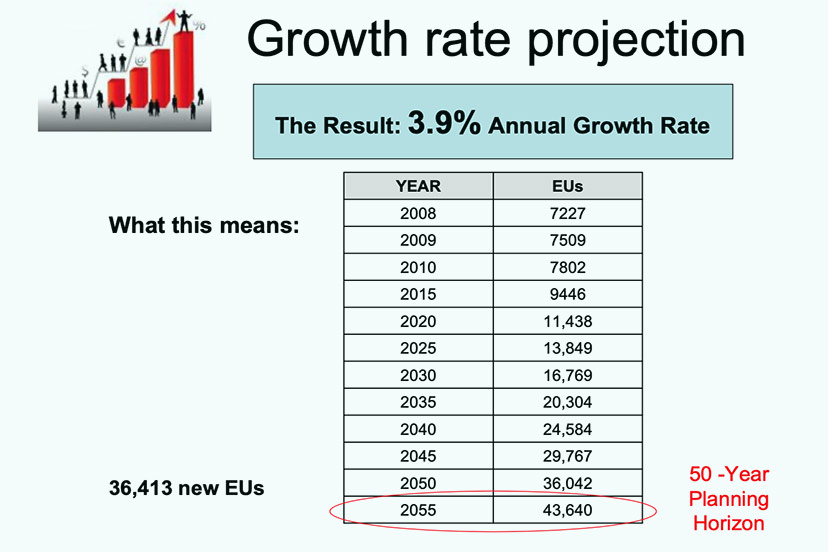
PAWSD communications manager Sheila Berger explained that the number of “EUs” in the PAWSD district would grow from 7,227 in 2008 to 43,640 in 2055. An “EU” is an “equivalent unit” — the amount of water used by a typical, one-family home. The math seemed to make sense — if you ignored the essential question, which should have been, “How much actual water does Pagosa Springs need?”
Hoping to assure us that the Dry Gulch Reservoir was a necessary project, Ms. Berger asked us to believe that PAWSD would have six times as many EUs in 2055 as it had in 2008, and that we would therefore need six times as much drinking water.
Just one little mathematical problem. (Which Ms. Berger did not address.) The amount of water PAWSD was selling to its customers in 2008, was less than what they were selling in 2001, even though the population had increased by 11% during that period. With very little encouragement from PAWSD or SJWCD, Pagosa had developed a ‘conservation mindset’. The fact that new homes were being built and hooking up to the water system, was not generating increased water demand… in a community like Pagosa Springs where — by one estimate — 50 percent of our newer houses were being built as ‘second homes’.
At any rate, the key number on the presentation slide shown above, was “3.9% Annual Growth Rate”… through 2055… implying that Archuleta County’s population would be six times larger in 2055 than it was in 2008.
One little mathematical problem, related to the real world. If you calculate the average population growth rate in Archuleta County over the past 20 years — since 2002 — it’s been about 1.0%. One-quarter the growth rate Ms. Berger wanted us to accept as realistic.
I agree with PAWSD and SJWCD that ‘Water is Life.” I don’t agree, however, that the Dry Gulch Project has ever been justified by real-world mathematics, that take all pertinent data into account.
Back in 2010, when PAWSD convened a “Water Supply Community Work Group” to help quantify local water demand and the need for future reservoir storage, the group uncovered some information that may not have been common knowledge: PAWSD had been treating about 1,800 acre-feet of water each year, but only about 1,150 acre-feet actually arrived at people’s faucets. About 40% of our water district’s treated water was apparently leaking out of our community’s 40-year-old water pipelines, never to be seen again.
This photo is not from Pagosa Springs. But it could be.

Instead of letting the customers know about the leakage problem, however, PAWSD and the San Juan Water Conservancy District were telling us that we had a serious need for more reservoir storage, and that we needed to buy the Running Iron Ranch as the site for a new multi-million-dollar water reservoir. The property was then purchased without any chance for the voters to participate in the decision to create $9 million of new PAWSD debt… while the leaks continued.
Fortunately, a new crop of volunteer directors have since been elected to the PAWSD board, and PAWSD now has an ongoing program to fix the leaks — and no plans, at the moment, to build a new reservoir.
To put that PAWSD leak repair project in perspective, if PAWSD reduced its treated water losses from 40% down to, say, an industry average of about 7%, that would mean that we already have more than enough water resources for a population of perhaps 20,000 people, based on current climate trends. That’s the approximate population the community’s “Growing Water Smart” task force recently projected for the year 2050.
Over the next year, Archuleta County taxpayers can probably expect to see an increase in informative stories, produced on behalf of the San Juan Water Conservancy District, by Carbondale-based Project Resource Studio.
What stories might we be told?
Bill Hudson began sharing his opinions in the Pagosa Daily Post in 2004 and can't seem to break the habit. He claims that, in Pagosa Springs, opinions are like pickup trucks: everybody has one.