
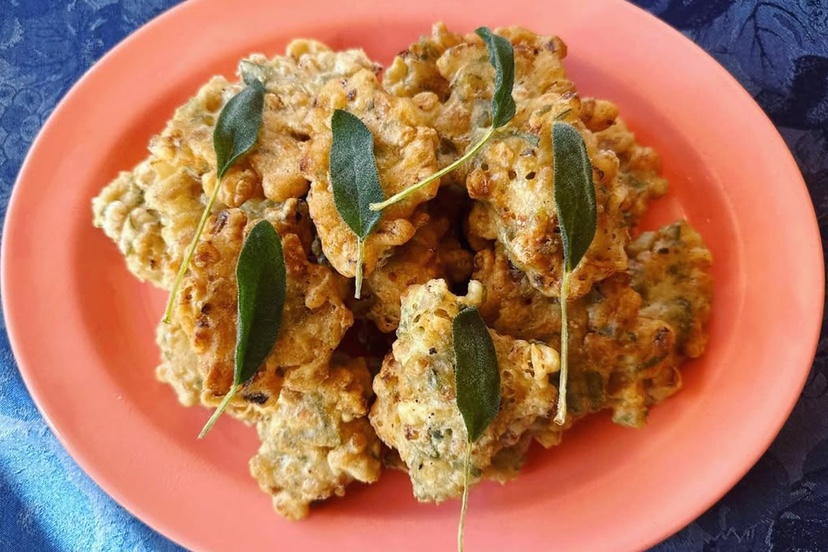
Golden white bean and sage fritters, dressed up for the holidays with sea salt and crispy fried sage. Photo by Rosa D. Chávez.
Who would have thought a few beans and some fried sage could earn a soak at our local hot springs?
A few years ago, I entered these white bean and sage fritters in the Three Sisters at Your Thanksgiving Table cooking contest and dinner, a fundraiser for the Geothermal Greenhouse Partnership in Pagosa Springs.
The recipe came from Deborah Madison’s cookbook, Local Flavors: Cooking and Eating from America’s Farmers’ Markets.
Much to my delight, the fritters won best appetizer. I took home two tickets to the hot springs and a bag of Bow & Arrow blue cornmeal.
What really wowed people was the crispy fried sage. Not a bad return on a few beans and a handful of leaves!
The Lunchroom Exchange
Some of you may remember Joy’s Natural Foods, well before Natural Grocers came to Pagosa.
Growing up, I regularly traded lunches with a friend who brought food from Joy’s. My lunch was often a bean burrito made with a homemade flour tortilla.
I was convinced I was getting the better end of the deal. Truth be told, I was a little embarrassed by my burrito. Somewhere along the way, I had come to associate it with being poor.
Damn, I wouldn’t trade that burrito today! In retrospect, my friend may have been the better negotiator.
In Good Company
In 1965, New Mexico made chile and pinto beans its official state vegetables. Now there’s a legislative decision I can get behind.
Southwestern Colorado has its own bean-growing history. Head west from Pagosa to Cortez, where Cortez Milling makes Blue Bird, White Rose, Red Rose and Valley Queen flours, and northwest toward Dove Creek, where pintos are just one of several beans grown in the region, alongside Anasazi, bolita and black beans. I explored these regional connections in a March column on food and agriculture.
For those who have called this region home for generations, some of this history may be familiar. For newer residents and visitors, it offers a glimpse into the agricultural traditions that continue to shape life here.
Long before Colorado and New Mexico became states, Ancestral Pueblo communities cultivated corn, beans and squash. Wheat arrived with Spanish colonization, adding to the region’s agricultural and culinary traditions. In northern New Mexico, acequias remain part of this living history, with neighbors sharing both the water and the responsibility of caring for it.
These days, I enjoy discovering different beans, from beautifully patterned heirlooms to creamy white cannellini. Preserving these varieties takes work, and farmers need to earn enough to keep growing them.
Fuel, fertilizer and equipment costs were weighing on Dove Creek growers this spring. Kyle Carhart, who grows pinto beans, wheat and sunflowers, told KSJD in April, “Everything is so expensive… you cannot afford to mess up.”
There’s room in my kitchen for an heirloom bean and a good old pinto, whether simmered in a Crock-Pot, prepared in a pressure cooker or warmed straight from a can.
What’s for Dinner?
Beans provide plant protein, iron and B vitamins, including folate. According to a federal guide to food sources of fiber, half a cup of cooked pinto beans provides nearly eight grams of dietary fiber.
A bag of dried beans can stretch a grocery budget. But the price on the shelf doesn’t account for the cost of keeping the stove going, the time spent cooking or the dishes waiting afterward.
A pot of beans simmering on a winter afternoon is a lovely thing. So is opening a can after a long day at work, warming a tortilla and having dinner ready in minutes.
And sometimes the best thing about dinner is that somebody else made it.
For the holidays, I’ll happily spend a little extra time making these fritters. They make a lovely vegan appetizer, especially eaten warm with something festive to sip and people whose company you enjoy. Canned beans make preparation simpler.
As for that homemade bean burrito, I might just be the one asking to trade these days.
¡Buen provecho!
White Bean and Sage Fritters
Inspired by fritters Deborah Madison enjoyed in Badalucco, a village in Liguria, Italy, these golden, crispy fritters pair creamy cannellini beans with fresh sage.
Serves: 6–10 as an appetizer
Total time: Approximately 65–75 minutes using canned beans, including 30 minutes for the batter to rest. Allow additional time for dried beans.
Ingredients
1 cup dried cannellini beans or 2½–3 cups cooked cannellini beans (approximately two 15-ounce cans, drained)
1 garlic clove, finely minced
¼ cup chopped fresh culinary sage, plus whole leaves for cooking the dried beans and garnishing
Extra-virgin olive oil
Sea salt, to taste (plus 1½ teaspoons if preparing dried beans)
1½ cups all-purpose flour
1–1½ cups sparkling mineral water
1 white onion, very finely diced
Preparation
1. Prepare the beans
If using canned beans, drain and rinse well.
If using dried beans, soak for at least five hours or overnight. Discard the soaking water, cover with fresh water and boil vigorously for at least 30 minutes.
Reduce to a simmer and add the garlic, a few whole sage leaves, one tablespoon of olive oil and 1½ teaspoons of salt. Cook until completely tender, approximately 1½ hours or longer at higher elevations.
Keep the beans in their cooking liquid until needed, then drain well. Refrigerate promptly if preparing ahead.
For food safety, never cook raw, dried cannellini beans solely in a slow cooker. Adequate boiling destroys naturally occurring lectins. Canned beans are already fully cooked.
2. Make the batter
Place the flour in a mixing bowl. Gradually stir in one cup of sparkling mineral water, adding more as needed to form a thick paste.
Fold in the drained beans, onion and chopped sage. If using canned beans, add the minced garlic. Season lightly with sea salt, accounting for any salt added during cooking.
Cover and let rest for 30 minutes. The batter should be pliable but not runny, holding together when dropped from a spoon.
3. Fry the fritters
Preheat the oven to 250°F to keep the fritters warm.
Heat approximately ½ inch of olive oil in a heavy skillet over medium-high heat to about 350°F.
Fry a small spoonful of batter to test the consistency. If it spreads excessively, stir a little more flour into the batter.
Working in batches without overcrowding the skillet, fry until golden on both sides and cooked through, approximately 1½–2 minutes per side, depending on size.
Drain on paper towels and keep warm on an ovenproof platter.
4. Fry the sage
Thoroughly dry the whole sage leaves before carefully adding them to the hot oil. Fry briefly until crisp, taking care not to burn them. Drain on paper towels.
5. Serve
Arrange the warm fritters on your favorite platter, grind a little sea salt over them and top each with a crispy fried sage leaf.
And whatever you do, don’t skip the fried sage!
Recipe adapted from Deborah Madison’s Local Flavors: Cooking and Eating from America’s Farmers’ Markets (Ten Speed Press).
Madison acknowledges a preparation method from Fred Plotkin’s Recipes from Paradise: Life and Food on the Italian Riviera. This adaptation includes a canned-bean variation for convenience.
Rosa D. Chávez writes about food, culture, land, labor, history, health and everyday life in the borderlands of southern Colorado and northern New Mexico.