

Community presentation in Pagosa Springs by Smart Growth America, 2017.
It’s been clear to everyone, since the first public hearing on the proposed ‘Ponderosa Mountain’ subdivision back in September, that the neighboring property owners are almost unanimously opposed to the project. But the project is within the Pagosa Springs municipal boundaries, and the neighboring property owners live just outside those boundaries. The neighbors have limited powers to influence the Town government’s decision whether or not to allow the project… and the Town government is not obliged to seriously consider the neighbors’ objections.
There are philosophical differences behind this conflict. How much weigh should community leaders give to objections from neighbors, relative to the weigh given to assumed community benefits? What degree of compromise between these two desires is appropriate?
If I purchase 10 acres of property for my own private use, how much control should I be allowed over the uses on the property next door? As it currently stands, my ability to influence the development next door is almost entirely defined by rules written down in the Town Land Use and Development Code, or by the Archuleta County Land Use Regulations. Typically, folks pay no attention whatsoever to these rules, until they want to develop their own property in a new way, or until their neighbor proposes a development of some type.
Folks living in the unincorporated Alpha Rock Ridge subdivisions are almost completely at the mercy of municipal officials who have their own ideas about financially-sound development.
Financially-sound development rules, as promoted by national organizations like Smart Growth America and Strong Towns, are based on the idea that towns can grow in ways that enhance the community’s overall wealth. But that many American cities and towns have been growing in the opposite direction… in a direction that ultimately drains the community of its financial (and social) wealth.
That financially-damaging direction typically goes by the name: “sprawl”. It’s the general direction in which Archuleta County has been growing for the past 50 years.
Obviously, the Archuleta County Board of County Commissioners didn’t understand the financial dangers of sprawl development when they approved subdivision after subdivision between the late 1960s and the late 1990s. We are now stuck with those decisions, and the social damage is most obvious in terms of 320 miles of poorly maintained roads, inefficient public transportation, overextended law enforcement, lengthy school bus routes, and, more recently, skyrocketing home prices.
During a study of Pagosa Springs in 2017, Smart Growth America summarized the same problems… noting that the burden “usually falls on taxpayers”…

In their report on the Pagosa Springs community, Smart Growth America summarized the strain placed on businesses and governments by our current “sprawl” development style. They analyzed the financial cost of sprawl and what it might cost the community if the same pattern were to continue into the future. The picture was not a pretty one, when comparing our current development style to development alternatives that make use of existing infrastructure and that encourage people to live, work, and play in more compact neighborhoods.
According to Smart Growth America’s calculations, the Pagosa Springs community will wind up $78 million in debt by 2037 if we continue our ostentatious, sprawling growth pattern. But we can end up in a much better financial situation by limiting ‘greenfield’ development, and by directing growth into areas that already have roads, utilities, and other infrastructure.
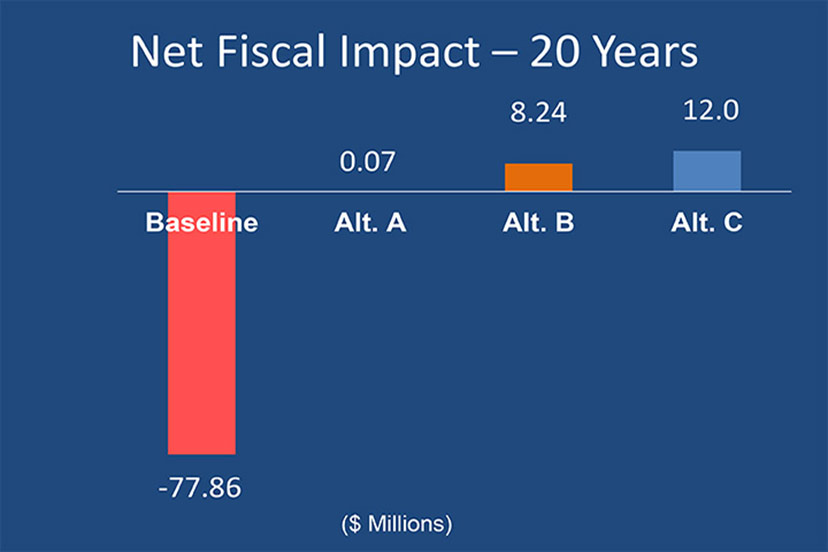
There are different ways to grow a town. By making use of existing infrastructure and by encouraging denser and more sensible development — more families per square mile — our community could actually grow its wealth, rather than going further into debt.
Or so we are told.
This graphic above, suggesting four possible future scenarios for Pagosa Springs, was never presented publicly at any of the four public hearing conducted thus far on the proposed ‘Ponderosa Mountain’ subdivision. If it had been, perhaps the neighbors would have better understood the Town Planning Department’s philosophy around housing and development.
When the ‘Ponderosa Mountain’ Planned Development Agreement (PDA) was first heard by the Town Planning Commission in September, the agreement zoned the residential phases of the project at ‘R-22″.
22 units per acre. The highest density zoning currently allowed within the town limits. Basically, it allows up to a four-unit apartment building on a standard downtown lot.
I currently live downtown in just such a zoning district and find it pleasant and neighborly. Apparently, Modern Community Builders LLC were comfortable with that zoning density, but the Planning Commission — after listening to the the Alpha Rock Ridge neighbors — determined that R-22 was too high a density, and amended the PDA to zone the residential phases at “R-12”. So, at most, a duplex on a standard town lot.
The commission basically cut the allowable housing density in half.
So let’s consider a previously-shared comment by Mayor Shari Pierce at the November 17 Town Council public hearing, where the Council voted 5-2 to approve a Planned Development Agreement (PDA) between the Town and Modern Community Builders LLC.
“I feel that this developer and our staff have worked together with the rules that we have in place right now, and even though we might desire something different — a different commercial component or more affordable housing — our rules don’t require that. So I don’t think we can deny it. I think what we have to do is follow our rules…”
As we just noted, the Town Planning Commission considered R-22 zoning, and voted to amend the zoning to R-12.
They could make this rather drastic amendment because — contrary to Mayor Pierce’s statement — the Planned Development Agreement does not “follow our rules.” A Planned Development Agreement is a tool for rewriting the rules — you might even say, “for ignoring the rules” — to suit one particular Developer, and to suit the desires of the Town Planning Department (for higher density, for example, and for ‘attainable housing’…)
The Town Council was under no obligation, defined by any “rules”, to approve the negotiated Ponderosa Mountain PDA.
Contrary to the Mayor’s statement, the Town Council had complete freedom to amend or deny the PDA.
Did the Planning Department not make that clear on November 17?
Read Part Four… on Friday. Have a pleasant holiday celebration tomorrow…
Bill Hudson began sharing his opinions in the Pagosa Daily Post in 2004 and can't seem to break the habit. He claims that, in Pagosa Springs, opinions are like pickup trucks: everybody has one.