
As noted on Friday in Part Four, the Pagosa Area Water and Sanitation District (PAWSD) Board of Directors will hold a public meeting tonight at 4pm at the PAWSD offices, 100 Lyn Ave. Part of the meeting will likely be an executive session, with doors closed to the public.
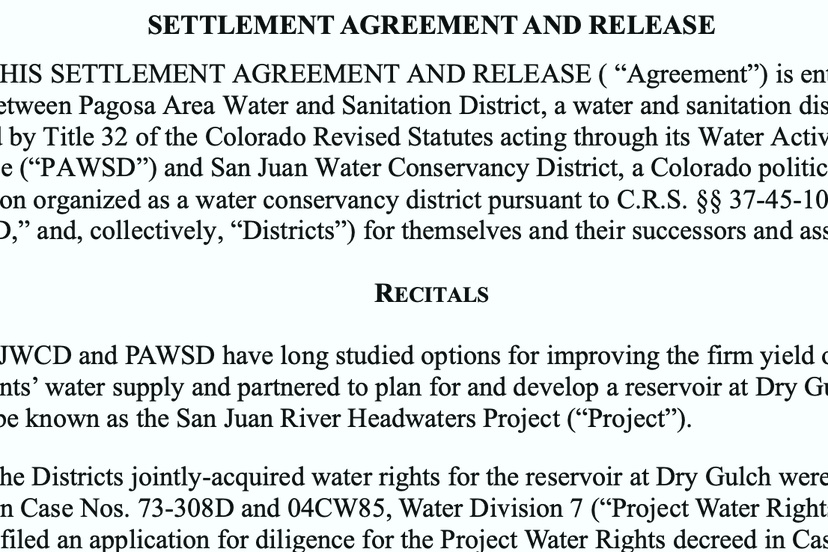
Under consideration will be a proposed agreement with the San Juan Water Conservancy District (SJWCD) aimed at resolving an ongoing and expensive legal dispute between the two water districts — who jointly own a 660-acre parcel two miles north of downtown Pagosa Springs. Since at least 2003, SJWCD has been hoping to see a very large reservoir constructed on the Running Iron Ranch. Initially, the reservoir was going to be funded by PAWSD customers, and measured 32,000 acre-feet. Enough water to serve PAWSD water customers for 20 years, without a drop of rain falling.
Since 2012, when PAWSD pulled the project from its long-range planning, SJWCD has been promoting a smaller 11,000 acre-foot reservoir to be funded by “someone”. There’s no way SJWCD could build such a massive multi-million-dollar project with their current tax revenues, which total around $170,000 a year.
11,000 acre-feet stored in a reservoir would be enough water to serve PAWSD customers for 7 years without a drop of water falling. But the mysterious “someone” willing to fund the reservoir construction and ongoing operations has yet to come forward.
Two years ago, the PAWSD Board filed a lawsuit, hoping to clarify PAWSD’s right to sell the 660-acre Ranch “at its sole discretion” — as stated in a 2026 agreement signed by SJWCD. SJWCD contends that PAWSD does not have the right to sell the Ranch until 2036. The court case is presently “on hold” pending a potential agreement between PAWSD and SJWCD.
SJWCD approved and signed the agreement on November 6. The PAWSD Board will consider the agreement tonight.
Disclosure: I currently serve as a volunteer member of the PAWSD Board of Directors, but this editorial series reflects only my own opinions and not necessarily the opinions of the PAWSD Board and staff.
There’s an interesting twist to the story, however.
In 2024, a prospective purchaser, Zipper Valley Ranch, made an offer to SJWCD. Zipper Valley offered to buy the Ranch for approximately $10 million — essentially paying off PAWSD customers’ remaining loan obligations from the 2008 Ranch purchase — and give SJWCD and PAWSD an easement on the Ranch for a future reservoir. SJWCD would need to make progress in the reservoir construction within a certain time period. Lack of progress would eventually result in the easement going away.
The SJWCD Board unanimously rejected the Zipper Valley proposal, refusing to even communicate with the first potential partner to approach them since 2003.
But Zipper Valley Ranch, represented by PAWSD customer Trey Fricke, still has essentially the same offer on the table — with PAWSD. Like the PAWSD Board, Mr. Fricke believes an 11,000 acre-foot reservoir is “too much water” and has offered to assist PAWSD with designing a smaller reservoir — perhaps 3,000 acre-feet — for the middle of the Ranch. This would be about twice the size of the largest existing PAWSD reservoir, Stevens Reservoir.
Discussions about this publicly-owned Ranch, and about the massive public infrastructure investment being proposed by SJWCD, have been going on for two years behind closed doors. Normally, government boards in Colorado must discuss issues and vote on decisions in open public session. But government discussions about real estate, and discussions about lawsuits, are permitted to happen behind closed doors, and for two years, the PAWSD and SJWCD boards have indeed held their Running Iron Ranch discussions exclusively in “executive sessions”, out of public hearing.
When the SJWCD Board voted to accept a new agreement on November 6, they released a “public statement” (shared in Part Four). But the statement did not explain what the agreement said. To date, neither board has made an effort to explain to the public what has been proposed and what it might accomplish.
Nevertheless, the public has been paying for all the legal fees and staff effort that has gone into this dispute for the past two years. Does the public have a right to make its desires known, based on full information about how their taxes are being spent? That’s problematic when the public has been prevented from hearing the discussions and from learning the details of a proposed multi-million-dollar agreement.
Tonight’s PAWSD Board meeting might be the first opportunity for the public to hear a vigorous discussion about what is being proposed.
You can download the proposed agreement here, and you can also find it on the SJWCD website.
The PAWSD Board consists of five members: President Gene Tautges, Vice President & Treasurer Alex Boehmer, Secretary Bill Hudson and Board members Glenn Walsh and Bruce Jones. If three or more of the PAWSD Board members vote to sign the agreement, SJWCD will have a little over a year to demonstrate that they can fully assume full financial responsibility for the approximately $10 million remaining to be paid on the CWCB loan and grant.
Some PAWSD Board members have expressed doubts that SJWCD is capable of reaching that goal, considering the lack of progress on the Dry Gulch Reservoir since 2003.
Here’s where the interesting twist comes into play. Zipper Valley Ranch is still interested in purchasing the Running Iron Ranch and in dedicating an easement for a reservoir in the middle of the Ranch.
The PAWSD Board, tonight, could…
1. Choose to approve the agreement as written.
2. Conclude that PAWSD customers would be better served by a modified agreement, and send an improved agreement to SJWCD for their consideration.
3. Look at past history and note that SJWCD has been spending taxpayer money on planning this reservoir project since 2003, and is still no closer to building it than they were in 2003 — and realize that Zipper Valley Ranch LLC is a much more likely candidate to actually get a reservoir built for the community.
What will the PAWSD Board decide?
And will they fully explain their decision to the taxpayers?
Read Part Six… tomorrow…
Bill Hudson began sharing his opinions in the Pagosa Daily Post in 2004 and can't seem to break the habit. He claims that, in Pagosa Springs, opinions are like pickup trucks: everybody has one.