

Earlier this week, Pagosa realtor Mike Heraty shared a hopeful essay here in the Daily Post, noting how people in this rural Colorado town consistently step up to help one another during hard times.
During and following a devastating flood, for example.
He tempts us to imagine Pagosa Springs, in the near future, even more vibrant and attractive than before.
I’m tempted, meanwhile, to share a curious story about predicting the future, taking a somewhat more global view.
Clarissa and I moved from Juneau, Alaska, to Pagosa Springs, Colorado. in 1993, but we made occasional visits back to Juneau, and during one such visit, I had coffee with an old friend, John Ingalls. John had a small manufacturing business in Juneau, and during our conversation, John discussed the exodus of U.S. manufacturing industries to locations in Asia — especially, to China — and how that translocation of manufacturing resources might affect the American economy over the long run.
He spoke about his own determination to continue manufacturing his products locally, despite the temptation to ‘off-shore’ the manufacturing process.
As he spoke, I was suddenly struck with a realization that the Chinese were going to see a steady improvement in their standard of living — and at the same time, Americans were going to experience a decline in their standard of living.
This thought hit me like punch in the face. In a world where national economies were inextricably linked by global trade, I abruptly saw that an ‘increase’ in one place can result in a ‘decrease’ in another place, and that China’s gradual ascent as a ‘developed nation’ would be balanced by the America’s slow but inevitable descent, until the two economies came into “balance”.
As the Chinese people moved ‘up’ in the world, Americans would find themselves moving ‘down’.
This sudden thought struck me as frighteningly truthful — and made me shiver. I realized my children and I were going to witness the decline of the American standard of living. It can’t be helped… a tiny voice whispered.
No doubt, some people will no be tempted to reject this prediction — perhaps vigorously — as ugly nonsense. They will note that, in recent history, improvements in the American standard of living — as measured, for example, in the size of a typical residential home, or in the number of vehicles owned by a typical family, or in the number of hours worked per month, or in numerous other measures — did not prevent other countries from seeing similar improvements.
Bu the relationship between China and the U.S. has been somewhat unique since the 1970s, when American companies realized the profitability of having their products manufactured in China instead of domestically in the U.S. The relationship is also unique politically, with China being the most populous country with a Communist economy, and the U.S. with one of the largest populations living in a Capitalist economy.
How has that played out?
Here’s a chart from an article on the University of Southern California US-China Institute website:
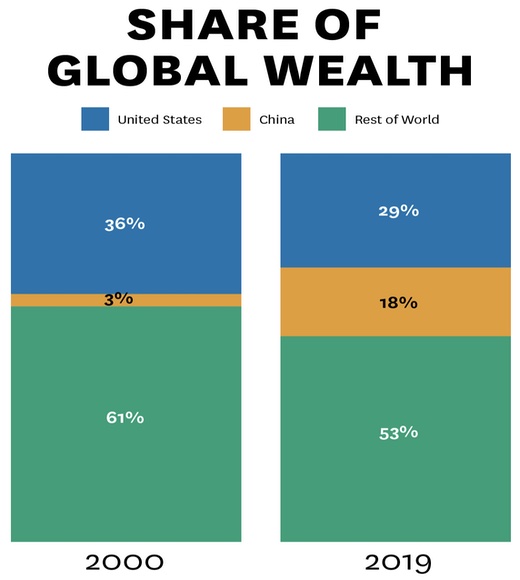
In just 19 years, the world has seen a massive re-distribution of global wealth, and China has been one of the primary beneficiaries of that shift.
Has this shift had an effect on local economies… as the standard of living improves in the world’s most populous Communist country?
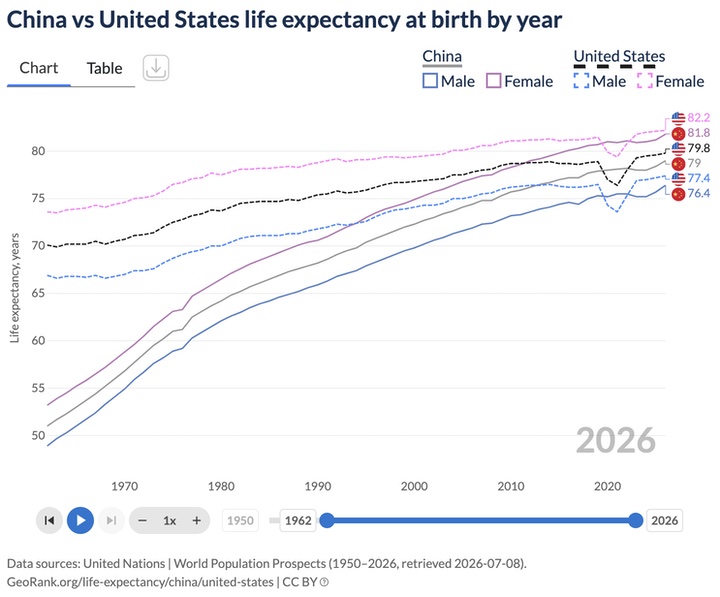
One measure of “standard of living” could be “life expectancy”, and in this measure (according to the United Nations) we can see a dramatic increase in China since 1962, and a less dramatic increase in the U.S. Among females, the difference is now practically insignificant.
Another measure for comparing the U.S. and China could be “home ownership”. The websites I’ve researched claim that more than 90% of Chinese households own their own home — which might be a house, or it might be a condo in a Beijing high-rise. And one report states that 80% of those homes are owned mortgage-free.
Currently in the U.S., only about 65% of households own their home… and about 40% of those homes are mortgage-free.
Of course, no one can prove that steady improvements in China’s standard of living are helping to bring about a decline in our standard of living here in the U.S.
Especially, we can’t say for sure, that China’s success, on the opposite side of the globe, has influenced the economic problems in small-town Pagosa Springs. But we also can’t say for sure, that there’s no connection at all.
One interesting evolution has been taking place in both America and China since the start of the 21st century.
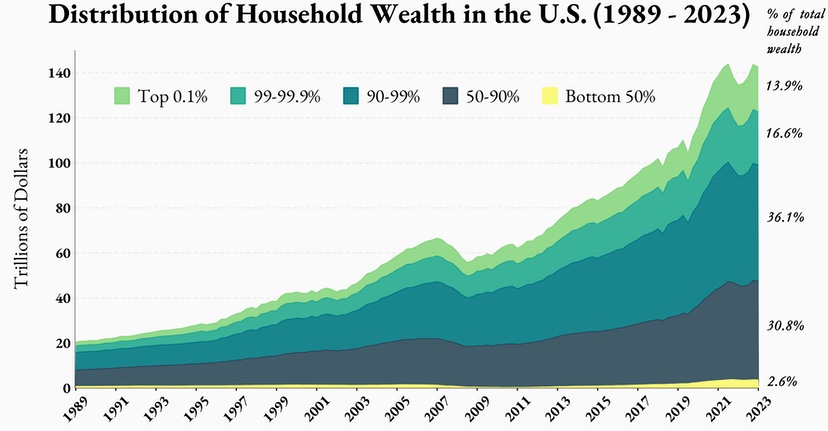
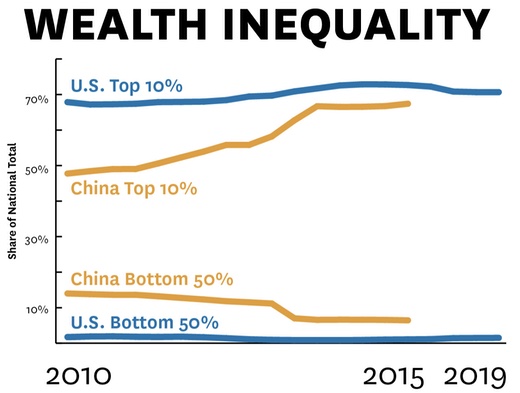
Wealth inequality has been growing in both countries, regardless of their different political ideologies.
According to the Federal Reserve, the richest 1% of American families — about 3.4 million people — hold about 31% of the nation’s wealth. The top 10% hold about 67% of the nation’s wealth. (As of 2023)
The 50% of American families at the lower end of the wealth gap — about 170 million people — hold about 2.6% of the nation’s wealth.
China has seen a similarly-growing disparity between the wealthiest and poorest citizens, in percentages…
…according to USC US-China Institute:
As much as we might wish to deny it, Pagosa Springs has seen a similar ‘rising inequality’ effect, and at least part of that effect dates from about 2004, when the Archuleta County government began seeking federal funding to dramatically expand the County airport runway — to accommodate private jets. That government investment ran to about $16.6 million, according to the “Economic Impact Study” published by the County Airport Advisory Commission.
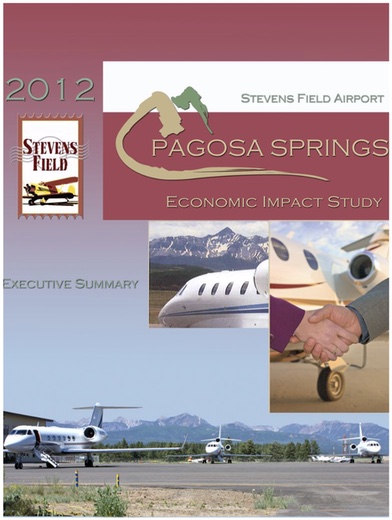
You might notice that all the photos on the cover of this official County report feature private jets.
Read Part Four… tomorrow…
Bill Hudson began sharing his opinions in the Pagosa Daily Post in 2004 and can't seem to break the habit. He claims that, in Pagosa Springs, opinions are like pickup trucks: everybody has one.