
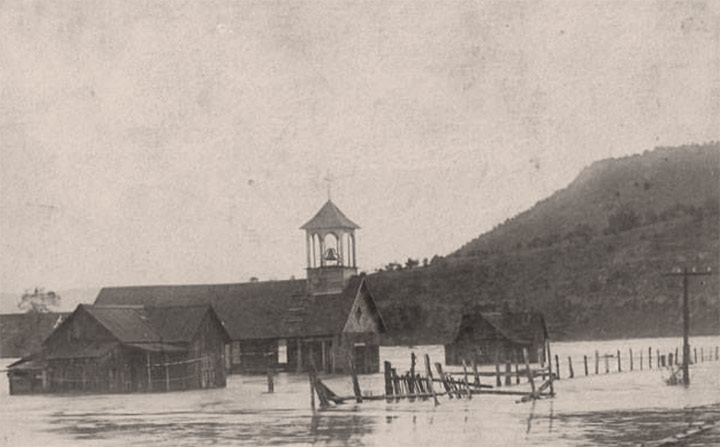
The 1911 Flood in Pagosa Springs.
There aren’t many good things to say about a 100-year flood event in a small rural town in southern Colorado, but at least it allowed me to forget, temporarily, about all the other horrible things happening in the world.
I will not bother to list all the horrible things I forgot about temporarily, but rest assured: there are a lot of them. Some more horrible than others.
Since we all want to look on the bright side of things (as my mother taught me) it’s even better when you can have two 100-year flood events a week apart. Even some of the horrible things you neglected to forget about during the first flood, fly right out of your mind when the second flood arrives.
We had that experience here in Pagosa Springs recently. Two 100-year flood events, back-to-back. The emergency repairs we did following the first flood were completely washed away by the second flood.
Could we learn something from that?
When I was a kid, I found it amusing to purposely step on ant hills, and then sit back and watch the ants frantically digging themselves out of the rubble to make emergency repairs. Presumably, they had no way of knowing that I could easily step on the ant hill a second time, and ruin all their hard work.
I discontinued stepping on ant hills when I became an adult, and I’m sorry now that I did it as a kid, even though it was highly entertaining to watch the emergency response.
It appeared that the ants willingly put aside everything they’d been doing — storing food, tending to the Queen, moving eggs from one chamber to another, and anything else ants normally occupy themselves with — to focus on repairing their hill. As far as I could tell, the hill design fulfilled a couple of important purposes. It raised the entrance to the colony above “flood level” and it allowed the ants to simply throw their construction trash down the hill where it was out of the way.
Could we learn something from that?
I noticed, walking through the riverfront Hermosa Street neighborhood after the flood, that several of the more recent homes have been constructed on higher foundations, and although they may have had flood water in their yards, the houses themselves seemed to have weathered the flooding San Juan River without obvious damage.
I have no idea if those houses have basements. If they do, then their basements were definitely flooded. Which brings me back to my point. If the only entrance to your colony is at the top of a hill, then you’re chances of getting flooded are minimized.
And you have a convenient place to throw your construction trash.
The prophets of doom that build the climate models for the UN’s Intergovernmental Panel on Climate Change (IPCC) have made it pretty clear that the same places that suffer drought — as a result of climate change — will be the same places that suffer historic floods. How that makes any sense, I have no idea, but that’s what they tell us. So it’s quite possible, taking into account the recent tendency by Pagosa Springs and southwestern Colorado to experience one drought after another, that we should also look forward to one flood after another.
Considering that we had two flood events in 2025 and two flood events in 2026, it appears likely that the IPCC climate scientists are not completely crazy and maybe we should expect “100-year floods” to become the new normal.
The reason it’s called a “100-year flood” is because the last flood event of this magnitude to hit Pagosa Springs was in 1911. If the IPCC is correct, we should start calling them “Every-year floods”.
According to John M. Motter’s description of the 1911 flood event, in his book Pagosa Country, The First Fifty Years, that historic flood occurred on October 5, and shortly afterwards the Pagosa Spring SUN editor wrote:
The people of Pagosa Springs and Archuleta County are of a class who can stare calamity in the face and smile. A class of people who will not bow to discouragement. A class who will go ahead with the battle of life with renewed energy. With this class of people, the ruined homes will soon rise from their present state, and will be built up to the same standard that they were before the flood…
I cannot say with any certainty that the ambitious ants I watched as a kid, repairing their damaged ant hill, were staring calamity in the face and smiling. But I can say that the SUN editor’s description of the citizens of Pagosa, as they went ahead in 1911, battling life with renewed energy, reminds me of those ants.
Underrated writer Louis Cannon grew up in the vast American West, although his ex-wife, given the slightest opportunity, will deny that he ever grew up at all. You can read more stories on his Substack account.