
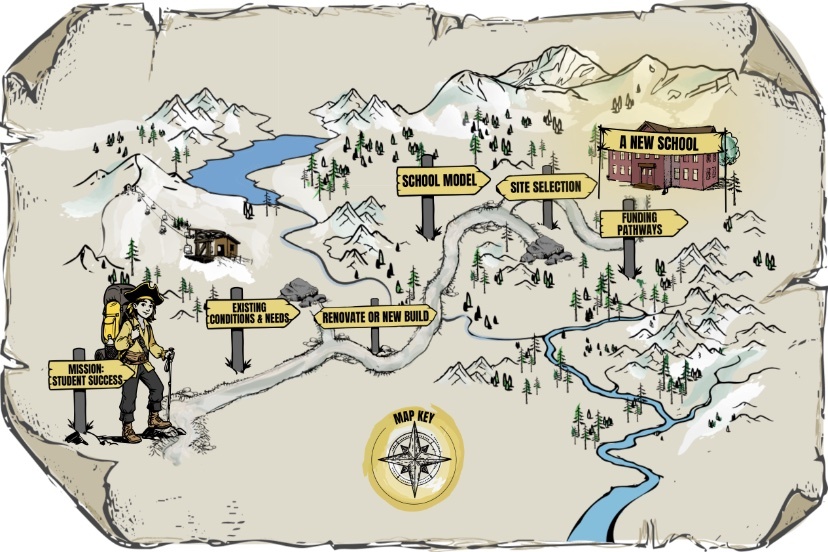
Image: An interactive online map currently found on the Archuleta School District website, titled “ASD Facilities Journey: Explore Our Interactive Map”
I find myself in an awkward position, this election season. And I’m thinking about hats.
I wear a number of hats, here in my little hometown of Pagosa Springs.
For example, I write op-ed articles about political issues for the Pagosa Daily Post, in the interests of encouraging a well-informed electorate, because governments do not always provide unbiased and transparent information. My opinions occasionally get me in hot water with local leaders, but generally speaking, we’re willing to “agree to disagree” here in Pagosa.
I also serve as a volunteer board member for Pagosa Area Water and Sanitation District (PAWSD)… and for Pagosa Peak Open School (PPOS)… and for the Aspen Village Master Association (AVMA)… and for the non-profit Pagosa Housing Partners (PHP). These boards occasionally have interests that conflict with one another, and sometimes with the Daily Post.
I’m also one of approximately 11,680 registered voters in Archuleta County, many of whom — like me — pay property taxes to fund various local governments.
Due to the substantial increase in home prices during the COVID-generated influx of real estate investors between 2020 and 2022, many of us saw our property taxes increase by 30%-50%. That increase benefited some local government districts — the Fire District, the Library District, the San Juan Water Conservancy District, etc — but due to the way Colorado law works, that increase did not substantially increase the available funding for Archuleta School District. The state government simply reduced its matching contribution to ASD as local property owners contributed more.
Thinking about the various hats I wear, I found myself recalling, fondly, a children’s picture book entitled Caps For Sale, written and illustrated by Esphyr Slobodkina, and first published in 1940.
A bedtime story often requested by my kids, when they were young.

It’s a simple but illuminating story based on a folk tale that originated — I suppose — in Africa or southern Asia, since it involves a troupe of monkeys and their well-known propensity to imitate one another, and also other primates (such as humans).
A peddler of hats (who does not appear to be particularly African or South Asian) is headed to a village to hawk his wares, but along the way, he decides to take a nap under a tree, with all his caps balanced on his head.

When he wakes under the tree, all of his caps have disappeared, save his own cap. Looking up into the tree, he sees that a troupe of mischievous monkeys are happily wearing his hats.
The peddler tries in vain to get the monkeys to surrender the caps, and begins by scolding the monkeys and shaking his finger at them.
The monkeys simply imitate his scolding behavior, screeching and shaking their fingers.
What else would the monkeys do? They’re monkeys.

Then he stamps his foot in anger (and gets imitated) and then he jumps up and down (and again gets imitated.)
Finally, in utter frustration, he angrily throws his cap to the ground. The monkeys of course also throw their caps to the ground.
The peddler, surprised but delighted, picks up the caps and proceeds on to his village destination, crying “Caps for sale!”
We are exposed, in this election season, to efforts by various groups to sell political candidates and ballot measures. And being the primates that we are, there’s a natural tendency to imitate the other primates around us. But we probably prefer to view ourselves as independent thinkers, influenced more by rational considerations than by how our neighbor might be voting.
As we rationally consider a proposal from the ASD Board of Education — to put our community $156.5 million in bonded debt to help fund a new PreK-8 school facility on Vista Boulevard, and facility upgrades at Pagosa Peak Open School — we presumably think about our own personal circumstances, and about the existing facilities that currently serve our school district staff and students.
We might also consider the circumstances of our neighbors and local businesses, who will also be affected by our decision.
Thinking rationally, we know that spending $156.5 million for a new facility might provide a more enjoyable and educationally effective learning environment, when compared to our current (functional but less-than-perfect) school buildings.
But it might not, in fact, be better. We don’t really know.
What will the building look like, and what will it include? We’ve not yet seen a design.
Will the new building have to be constructed cheaply due to rising construction costs? We don’t know.
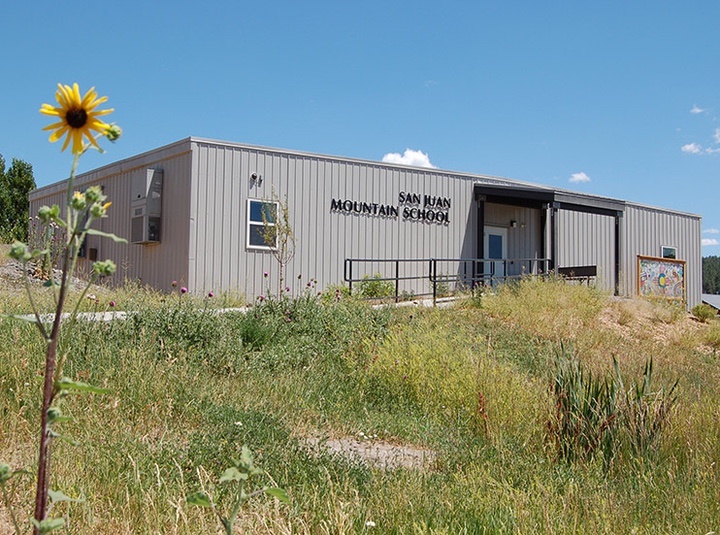
Here’s an example of the kind of low quality construction ASD recently chose for its San Juan Mountain School — which I hear is already experiencing space issues.
During School Board deliberations this year, members of the public argued that students will be negatively affected by losing access to certain extramural amenities — library, parks, trails, river, after school offerings — available to them in the current downtown locations. That’s quite likely.
Will the cost of this new debt have a negative effect on the budgets of local families and businesses? We don’t know, but we might assume so.
The facility has not yet been designed, nor have construction bids been received, nor do we have a clear idea, yet, of the financing costs. In my personal case, I calculated my additional property tax burden at $512 a year. (You can check my math in Part Three.) The number provided by ASD staff was more like $350 a year.
Both of these numbers are inaccurate, because — as stated — we don’t know everything yet about what the debt would cost, or what quality of new facility it would finance, or what BEST grant amount ASD will apply for next year.
Please remember that commercial properties in Colorado pay a tax rate four times the residential rate, so the property tax impacts on our local businesses might be considerably greater than on homeowners.
What other information might we hear from the “Vote Yes” campaign committee, that could be “inaccurate”? We don’t know.
We have a much better idea, meanwhile, about the cost of known, necessary repairs to our existing school buildings. That estimate — about $1.7 million annually — was calculated by ASD staff last month.
I’ve been arguing for 18 months that Archuleta County voters would support a dedicated tax increase to fund known, necessary repairs to existing buildings…
…and that they will be unlikely to approve a $156.5 million debt burden for a new facility they’ve never seen a design for.
If the community were asked, instead, to approve a mill levy increase to pay for ongoing repairs and upgrades to our existing (functioning) facilities, we wouldn’t have to create a massive new debt burden and thus spend half the money on interest payments. Every dollar could be spent directly on improvements, and much of the work could be done by local contractors, thus keeping the money in the community.
So many reasons why the current ballot measure might be the worst possible approach to better facilities.