

Other comments from the [School Board] were made about the lack of information, or misinformation, amongst the community.
— from an article by reporter Clayton Chaney in the September 3, 2026 Pagosa Springs SUN.
Our community — like every community — occasionally suffers from a lack of information, and from misinformation. And the difference between “the lack of information” and “misinformation” is not always clear.
The weekly Pagosa Springs SUN arrived on Thursday, featuring the headline: “ASD ballot measure will ask voters to approve $79.9 million bond”.
The ballot measure language was approved on September 1 by the Archuleta School District (ASD) Board of Education. Sadly, the article by reporter Clayton Chaney did not mention the actual debt burden that the community would incur.
$156.5 million.
That’s the cost to the community’s property owners when you include the interest payments to prospective bond holders — and it’s the repayment cost that appears in the ballot language approved by the School Board last week …
SHALL ARCHULETA COUNTY SCHOOL DISTRICT NO. 50JT DEBT BE INCREASED BY UP TO $79,900,000, WITH A REPAYMENT COST OF UP TO $156,500,000…
Mr. Chaney also failed to mention that a (small) portion of the bond would be used for facility upgrades at Pagosa Peak Open School. Just goes to show, you can’t always believe what you read in the paper. Sometimes a “lack of information” feels the same as “misinformation”.
In one sense, the question that Archuleta School District will be placing on the November 3 ballot is very simple. “Do we want to increase our property tax debt burden by $156.5 million to help fund a new PreK-8 school facility on Vista Boulevard, and for facility upgrades at Pagosa Peak Open School?”
We, the voters, will have a simple choice. Yes or No.
It didn’t have to be this way.
Earlier this year, during a public discussion between the ASD Board of Education and their campaign advisors, Board member Amanda Schick noted that the community’s taxpayers might prefer a smaller tax increase to fund repairs and upgrades to our existing school buildings.
She asked the campaign advisors if ASD could put two different proposals on the same election ballot… one, authorizing $156.5 million in bonded debt for a new PreK-8 facility… and another (less expensive) option to fund necessary repairs and desired upgrades to the existing school buildings.
Could ASD allow the voters to pick which tax increase they prefer?
The consultants responded that this was a terrible idea, because the voters would pick the less expensive option.
Based on that advice, we will have only one option on the ballot. $156.5 million in bonded debt obligations: yes or no.
But while the ballot question will be fairly simple, the whole ASD facilities question is quite complicated. Even the process by which the District would create the bonded debt is complicated, and requires the services of attorneys and bond counselors and financial advisors. As mentioned yesterday in Part Two, ASD is asking for this property tax increase without having any actual architectural design, without actual bids from any construction companies, and without yet winning the necessary state grant needed to fully fund the project.
We will be voting ‘Yes’ or ‘No’ on something we’ve never seen a design for, and on something for which we have no definite construction cost estimate, and on something that does not as yet have the necessary grant funding, and on something that has, as yet, no defined interest rate for the bonded debt.
As mentioned: sometimes “lack of information” feels the same as “misinformation”.
It didn’t have to be this way.
I currently serve on the Pagosa Area Water and Sanitation District (PAWSD) board of directors, and I had the impression that our new water treatment plant on Snowball Road was going to cost around $20 million. When the financial dust settled, the facility ended up costing more than $40 million, funded mainly by massive new debt.
PAWSD didn’t need to ask its customers for permission to build a $40 million water treatment plant, because the District is able to increase monthly fees whenever needed, by a simple board vote, and anyone in the District who wants PAWSD water at their home or business has to pay those fees. No ‘Yes or No’ election is necessary.
A school district, by contrast, must go to the voters if they wish to increase district debt.
Considering that this is the largest government bond issue ever proposed in Archuleta County, some folks will be wondering what it would cost them, personally. But of course, when a voter chooses ‘Yes’… they are also choosing ‘Yes’ for every other property owner and commercial business in the school district. So, we might be thinking about ourselves, personally, and what we can afford. But this is not just a personal decision.
We might also think about the children who attend our public schools, and the staff who work there, and the conditions in our existing facilities.
We might also think about our neighbors and our local businesses, knowing that, if we vote ‘Yes’, we are also placing a financial burden on their shoulders.
It’s a balancing act, like many decisions in life.
As mentioned previously in this editorial series, a recent press release from ASD communications manager Kelsy Been gave the estimated tax increase as:
…approximately $5.15 per month for every $100,000 of a home’s actual value…
Is that an accurate estimate? When I asked ASD staff how that estimate was calculated, I was told…
The short version is that there are a number of ways to structure the debt… all of which play a role in determining the impact on property taxes. That leaves us with a range of possible rates/100K/month. The $5.15 is the midpoint of that range…
Governments occasionally get their numbers wrong — as we all do — so I did a bit of estimating on my own. You can check my math.
If you visit the Archuleta County website, you can download the 2025 Abstract of Assessment and Levy of Taxes.. According to that tax document, ASD receives property taxes through two separate mill levies:
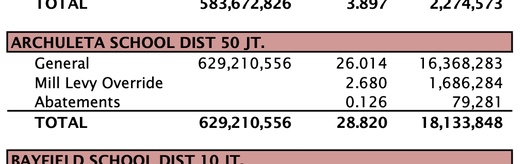
The “General” mill levy of 26.014 mills generated about $16.4 million for the District in 2025.
The “Mill Levy Override” mill levy of 2.680 mills generated about $1.7 million in 2025.
If you want to know exactly how much you, personally, paid in school district property tax for 2025, you can review your tax bill, and see the amount you paid to ASD broken out.
In my personal case, my house and property is valued at $682,000. An absolutely crazy valuation, in my humble opinion, considering we bought the house for $128,000.
My 2025 property taxes totaled $2,813. Of that amount, 49% went to Archuleta School District. (Your percentage will vary depending on what government districts you happen to live in.) So I paid $1,385 to ASD, which includes the “General” mill levy and the “Mill Levy Override”.
Approximately how much more would I pay if voters approve a $156 million bonded debt in November? The ballot language approved last Tuesday states:
…AND SHALL DISTRICT TAXES BE INCREASED BY UP TO $6,700,000 ANNUALLY TO REPAY THIS DEBT…
In 2025, ASD collected $18.1 million from a total mill levy of 28.8.
“$6.7 million” is 37% of “$18.1 million”. So, according to my pocket calculator, I would — if the proposed bonded debt is approved by voters — personally pay an additional property tax of:
$1,385 x 0.37 = $512 per year, additional tax.
My potential ASD property tax would total $1,897. In my particular case, that’s a sizable portion of my annual income, since I live basically on Social Security.

Of course, this is only a rough estimate.
If I compare that number (“$512 per year” from my pocket calculator) to the number suggested by ASD communications manager Kelsy Been (“approximately $5.15 per month for every $100,000 of a home’s actual value…”)
…her number suggests:
$5.15 x 12 months x (my property value of $682,000 divided by $100,000) = $351 per year, additional tax.
Obviously, Ms. Been and I have come up with different numbers. I have no idea why her number is considerably lower than mine. Perhaps the ASD staff can explain that difference at some point.
And please remember that commercial properties in Colorado pay a tax rate four times the residential rate, so the property tax impacts on our local businesses might be considerably greater than on homeowners.
Bill Hudson began sharing his opinions in the Pagosa Daily Post in 2004 and can't seem to break the habit. He claims that, in Pagosa Springs, opinions are like pickup trucks: everybody has one.