
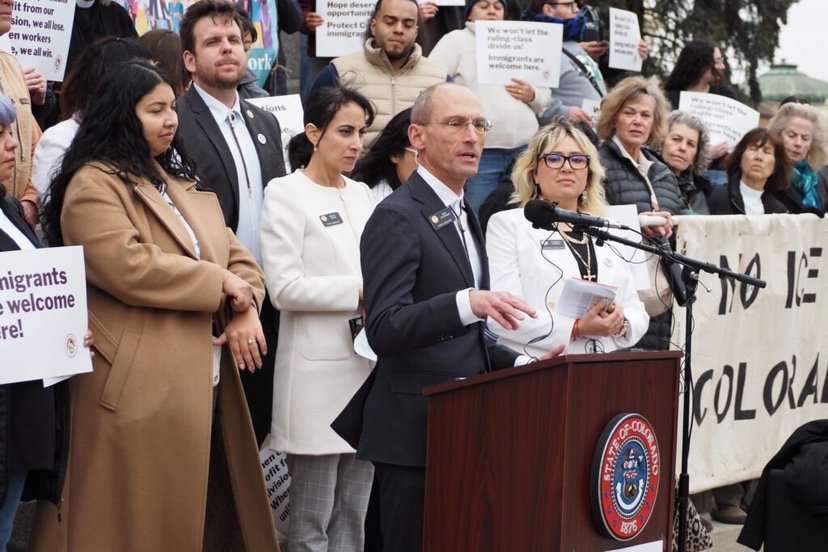
Photo: Colorado state Sen. Mike Weissman, a Democrat, speaks at a February news conference about immigration enforcement-related bills at the Colorado Capitol. Democratic lawmakers nationwide proposed nearly 250 bills this year in statehouses seeking to limit federal immigration enforcement efforts. (Photo by Sara Wilson/Colorado Newsline)
This story by Kevin Hardy appeared on Colorado Newsline on August 14, 2026.
Democratic lawmakers proposed nearly 250 bills in state capitols this year seeking to limit federal immigration efforts as they sought to push back against what they view as federal government overreach.
In a new report tallying 2026 action, State Futures, a nonprofit coordinating hundreds of Democratic lawmakers across the states, tracked 242 pieces of such legislation introduced across 32 states. About a fifth of them passed. Most of the measures address the ramped up immigration enforcement efforts that have defined President Donald Trump’s second term.
Some of those bills have faced Republican opposition and White House challenges. But Democratic governors have also raised concerns and even vetoed some measures, saying they supported their aims, but worried they could have unintended consequences and invite litigation.
The bills sought to ban the masking of immigration officers, protect against immigration enforcement in sensitive places such as schools and hospitals and enact new zoning regulations on private detention facilities, among other issues.
State Futures said 53 bills passed in 17 states this year, though several were vetoed or still await action from governors. Many of those bills face legal review as courts weigh the limits of state authority to regulate federal action.
But lawmakers say those numbers underscore the left’s growing embrace of federalism — the division of power between federal and state governments — that has gained traction during the second Trump presidency.
In Colorado, lawmakers this year expanded the health department’s authority to inspect immigration detention facilities and required compliance with state health and safety standards and reporting rules. That law is currently being challenged by a private prison operator as state officials demand more access and information regarding at least one tuberculosis case among detainees.
Colorado state Sen. Mike Weissman, one of the sponsors of that measure, said he’s worked with Democratic colleagues across conservative and liberal states more than ever before to oppose federal government efforts.
“We all talk because we all have the same concerns,” he said, “and that is to protect the basic freedoms of our people from an absolutely out-of-control federal regime.”
Rhode Island state Sen. Tiara Mack said many Democrats, including herself, have been wary of championing states’ rights, an ideology that evokes odious memories of slavery and segregation. But she said constituents are demanding action from state leaders to oppose the White House’s hardline immigration arrest and deportation efforts.
“This new landscape requires legislators to really own the narrative and own the reality that federalism is something that we can use as a tool to strengthen protections for our state,” she said, “and we have to work with states across the country.”
Mack is a co-chair of State Futures’ federal response working group that shares legislative ideas with state lawmakers across the country. This year, she was among those sponsoring Rhode Island legislation that seeks to protect people from immigration arrests while attending court proceedings. Signed into law in June, that law says violators of the protections can be held in contempt of court and can face a lawsuit from those arrested without a judicial order or warrant.
Virginia Democratic Gov. Abigail Spanberger vetoed a similar bill that would have prohibited immigration enforcement in courthouses, schools and hospitals. In her veto message, the governor said she appreciated the intention of the bill but worried it would put security guards and law enforcement in the “untenable position” of choosing whether to break federal or state law.
Another Delaware measure is currently awaiting action from Democratic Gov. Matt Meyer.
Mack said lawmakers are increasingly coordinating across state lines, learning from legislative wins and failures in other capitols. As an example, she pointed to a California law aimed at banning federal and state agents from wearing masks.
A judge blocked that law earlier this year because it exempted state law enforcement, saying it therefore discriminated against federal agents. A similar proposal in Rhode Island, which was held in committee this session, seeks to stop all law enforcement officers from concealing their identity.
Oregon Democratic Gov. Tina Kotek signed eight laws this April seeking to defend immigrant rights. Those laws protect against enforcement efforts in schools and hospitals, ensure individuals’ data remains confidential from the feds and allow people to sue the federal government for violating the law.
This story was updated with the number of bills that passed as of August 13. Stateline reporter Kevin Hardy can be reached at khardy@stateline.org.
This story was originally produced by Stateline, which is part of States Newsroom, a nonprofit news network which includes Colorado Newsline, and is supported by grants and a coalition of donors as a 501c(3) public charity.
Colorado Newsline is part of States Newsroom, a nonprofit news network supported by grants and a coalition of donors as a 501c(3) public charity. Colorado Newsline maintains editorial independence. Contact Editor Quentin Young for questions: info@coloradonewsline.com.