
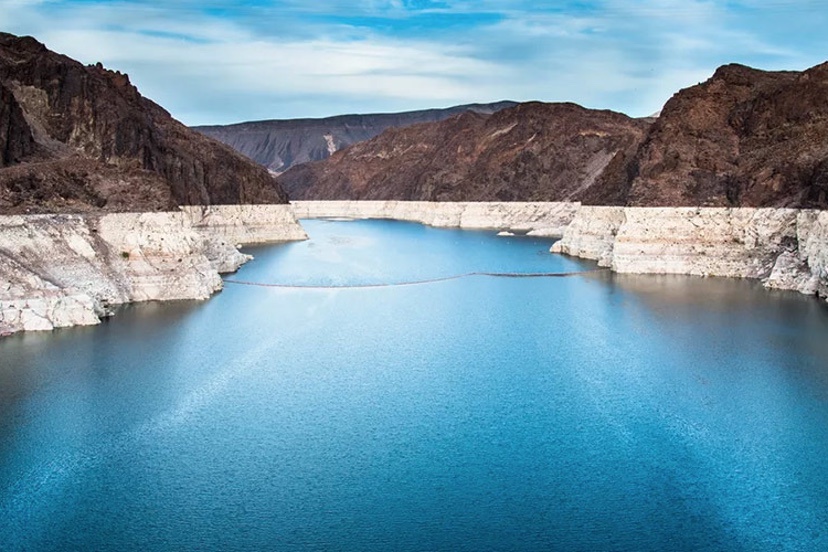
The news media has a duty to warn us about changes in the world, but sometimes uses words like “plummeted” to describe a situation that evolved over a period of 30 years.
Lake Mead, the largest reservoir in the United States, has plummeted to its lowest water level since it was filled some 90 years ago, another sign of the crisis plaguing the Colorado River system…
…”It’s extremely significant and extremely concerning. You have three-quarters of the population of the Colorado River Basin, some 30 million people, who are directly impacted by risks to Lake Mead,” said J.B. Hamby, chairman of the Colorado River Board of California and a board member of the Imperial Irrigation District, the largest user of the river’s water…
We can’t tell, yet, if this is the “new normal” or “a temporary setback.” Historically speaking, the American West has been through many cycles of drought.
From AZCentral.com, August 8, 2026.
Lake Mead’s water levels reached a new low, August 7, a record that is likely to fall repeatedly in coming months as the government holds back water upstream to protect Glen Canyon Dam this summer.
The Colorado River water, now filling Lake Mead to just 27% of capacity, fell to a surface elevation of 1,040.5 feet above sea level, its lowest point since July 28, 2022. The water hasn’t dipped so low since April of 1937, when the reservoir was still filling scarcely a year after crews put the finishing touches on the 726-foot-high [Hoover Dam].
Lake Mead’s combined storage with Lake Powell, the large pool sitting upstream of Grand Canyon, is also at an all-time low. The crisis has built over more than a quarter-century of regional warming and declining mountain snows that have shrunk a river that once flowed at least 15 million acre-feet a year to one that averages closer to 12 million in this century…
From TIME magazine, August 10, 2026:
…Seven U.S. states — Arizona, California, Colorado, Nevada, New Mexico, Utah and Wyoming — Native American tribes, as well as two Mexican states, turn to the Colorado River Basin, not only for drinking water supply, but for agriculture, industry, and hydropower production.
The dwindling supply at Lake Mead puts hydropower at risk as the latest figures show it’s not far from the 1,035-ft operational threshold: when elevation drops to this level, some turbines at Hoover Dam will have to shut down, and its generation capacity would drop by 70%. A July 2026 forecast from the Bureau of Reclamation shows that Lake Mead water levels could come close to that threshold in the next few months and could fall below that by spring next year…
From the song ‘Big Yellow Taxi’ by Joni Mitchell, 1970:
Don’t it always seem to go, that you don’t know what you’ve got ’til it’s gone?
Although the cycles of fluctuating climate in the American West — well documented over the past 200 years — an excess of water in the Colorado River has sometimes been been as damaging as a lack of water. Some scientists have calculated that some of the ‘megadroughts’ in the Southwest, between 900 AD and 1300 AD, were just as severe as the ongoing drought during the 21st century, and may have caused the displacement or extinction of Native American tribes.
Of course, no large reservoirs existed during those earlier times. Nor did the water-hungry agricultural corporations that have been largely responsible for draining Lake Mead and Lake Powell.
The reservoir system has worked reasonably well for 90 years — in the case of Lake Mead — and for 60 years — in the case of Lake Powell.
But you can’t get blood from a turnip, and you can’t get water from a reservoir that that is drained dry.
There’s an interesting story connected to this predicament, however.
While operating in a desert with a shrinking water supply, the Southern Nevada Water Authority (SNWA) has helped bring about a reduction in southern Nevada’s total water consumption, even as the population has grown significantly. Its service area includes the growing city of Las Vegas.
How was this managed? According to GroundwaterWorld.org:
Cash for Grass — SNWA pays homeowners and businesses to remove ornamental turf and replace it with desert landscaping. The program has removed over 200 million square feet of grass since 2000. In 2022, Nevada banned certain types of non-functional turf entirely — the first state to do so.
Indoor water recycling — Nearly all water used indoors in the Las Vegas Valley is collected, treated, and returned to Lake Mead through the wash system. This “return flow credit” system means that indoor water use is essentially recycled. Every gallon that goes down a drain in a Las Vegas home is eventually returned to the reservoir.
Outdoor water restrictions — Time-of-day watering limits, seasonal restrictions, and strict enforcement with water waste penalties.
Tiered pricing — Water rates escalate sharply for high-volume users, creating a financial incentive for conservation.
The result: per capita water use in southern Nevada dropped from about 314 gallons per day, in 2002, to approximately 110 gallons per day — a 65% reduction. Total consumption decreased by roughly 26% over that period, even as the population grew by nearly 800,000 people.
Unfortunately for Lake Mead, this water conservation effort has not been a silver bullet, because the lion’s share of the reservoir water goes to corporate agriculture in California and Arizona. At the moment, it appears that Lake Mead will cease generating hydroelectricity within the next couple of years.
Bill Hudson began sharing his opinions in the Pagosa Daily Post in 2004 and can't seem to break the habit. He claims that, in Pagosa Springs, opinions are like pickup trucks: everybody has one.