
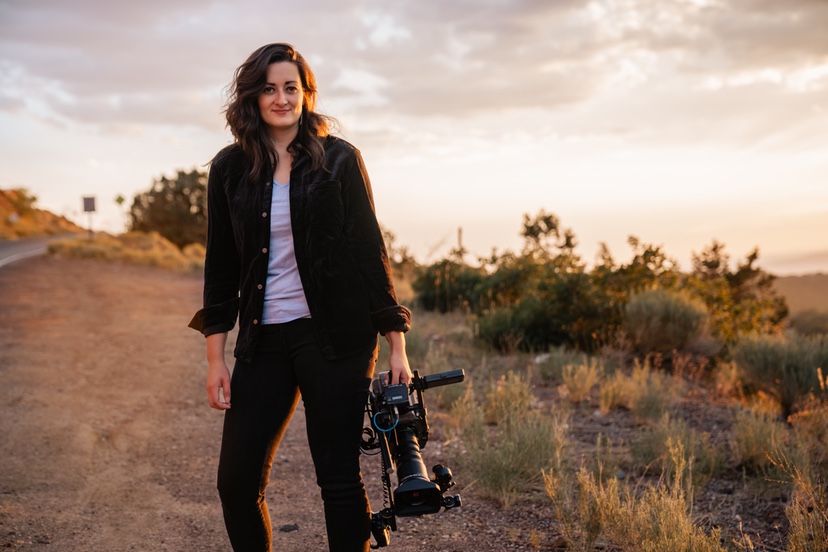
Photo: Documentary filmmaker Hillary Bachelder. (Photo by Hayley Harper)
This interview by Bea Portela appeared in The Daily Yonder in July 31, 2026. This interview first appeared in Path Finders, an email newsletter from the Daily Yonder. Each week, Path Finders features a Q&A with a rural thinker, creator, or doer. We are sharing it in two parts.
Hillary Bachelder is a director, cinematographer, and editor based in Taos, New Mexico. Her latest documentary, titled “burn, scar,” follows a community through the aftermath of the 2022 Hermits Peak-Calf Canyon wildfire. The fire was accidentally started by the U.S. Forest Service and became the largest in New Mexico’s history.
Enjoy our conversation about auspicious timing, building trust, environmental libertarianism, and glimmers of hope in climate adaptation.
This conversation has been edited for length and clarity.
The Daily Yonder: Could you set up what the film is about?
Hillary Bachelder: In 2022, the U.S. Forest Service was doing a prescribed burn in the mountains of northern New Mexico, and it escaped its control lines and turned into the largest wildfire in New Mexico’s state history. It was close to 342,000 acres, and hundreds of people lost homes and had their ranches and their livelihoods impacted. The film follows members of the Forest Service as they are trying to move forward from this horrific tragedy and families who lost everything in the fire. It then takes a historical step back to look at the hundred-plus year history of the relationship and dynamic between the rural communities of northern New Mexico, the Forest Service, and the federal government here. The film tries to hold all of that and ask how we as a community move forward.
DY: How did the story find you, and how did you find the story?
HB: It’s an unexpected entry point for me. I had only moved to Taos in the fall of 2021 or late summer. I decided to take this climate class through The Santa Fe Watershed Association about different climate issues and how they impacted New Mexico specifically. I had just moved to this place and I was like, “Oh, I should learn a thing or two.” In early April of 2022, they did a field trip with this guy, Dennis from the Santa Fe National Forest. He took us to look at prescribed burn treatment areas they had just done and to talk through the importance of prescribed fire. I had a ton of questions because I didn’t grow up in a place where I had a relationship to wildfire at all. I bugged the heck out of him for a couple hours, and we had a little bit of a rapport. Within days of that meeting, the Hermit’s Peak Calf Canyon fire happened.
That ended up being Dennis, who is the main character in the film. So the week before the fire happened, I was walking around with all of this information about prescribed fire and how important it was as a tool for forest management. And then the greatest prescribed fire disaster in human history, as Dennis puts it in the film, happened just days later, so I was very primed to tell the story and started poking around.
The Forest Service, after this happened, really shut down to the media. They had to go on the defensive that summer and all the rest of that year. There was so much turnover in leadership on the Santa Fe National Forest. If I hadn’t had that existing relationship with Dennis, I don’t think I would have gotten the access that I needed.
DY: I read somewhere that you grew up in a small town in Maine. Would you characterize that upbringing as rural, and either way, how did your upbringing and sense of place inform how you were connecting with the rural communities you were reporting on, as you were a newcomer yourself to the northern New Mexico area?
HB: I grew up in Farmingdale, Maine, it had 2,000 people. We weren’t that far from Portland, so it’s a different flavor of rural. But the thing that really translated was an environmental libertarianism streak. There are a lot of folks in Maine, and a lot of folks in New Mexico who don’t have trust in the federal government and these large systems that they feel like they can’t touch and don’t really know. But they also have a really strong lived connection to the land. There is a political ideological tension there. But it was something that as soon as I landed in New Mexico, I was like, oh, I get this, I think I can talk to people from a base level of understanding of what this means.

DY: Especially in the early part of the film, you were often filming people at some of the lowest points of their life. Their home had been destroyed, they had to sell off their cattle, the acequias weren’t running, and people couldn’t produce hay. How did you think about building trust?
HB: The way that I like to tell stories is through unfolding vérité. It’s not the budget-conscious strategy that’s attractive to distributors who want you to be able to say where the story is going to go and how it’s going to end, on day one. I never know that.
I always plan for these stories to take place over a few years, because I think that’s how long I had to keep showing up to build that trust. Everyone starts at a different level of openness and vulnerability. I did a lot of showing up without the camera throughout the whole process. I met people initially and would go back to their homes, sit down with them, and talk about what I could see the film growing into and where it could go. I was also listening to a lot of their stories and meeting whoever they wanted me to meet. It was a long process. I don’t think there’s a shortcut to building trust.
I really wanted to be with them for other moments that weren’t just “bare your soul in the worst days of your life.” I want to make sure I’m seeing you with your family. I want to make sure I’m seeing some of the happy and beautiful and peaceful times in your life as well. Some of those make it into the film, and some of them don’t. But I think part of the process is them understanding what kind of things I’m asking to be with them in and film for. If it was just “call me every time there’s a tragedy, and I’ll come by,” we wouldn’t have had the relationship that I have with them.
DY: I loved that the film followed the community as it lived through the aftermath of the fire over the course of four years. I’m sure if you had filmed for another year, there would have been new sides to this already multi-dimensional story. How did you decide when it was the right time to end the filming?
HB: I think a big marker for us was 2025. We see a real shift when Trump comes into office and there are significant layoffs within the Forest Service. That created a different dynamic. A big thing that we’re exploring across the two sides of the story is this trust and power dynamic. For a hundred-plus years, the Forest Service has always held that power, and they wonder perpetually why they can’t build trust when they’re not super willing to cede power. This was a moment where that power dynamic didn’t totally reverse, but it was being chipped away. The relationship that communities had with the Forest Service and the federal agencies felt different. It was not a repetition of the version of the dynamic that we had seen for decades leading up to this. That felt like part of an ending.
So much of the story just continues to be unresolved. There are still thousands of people who haven’t received their compensation from the government after having their houses burned, their acequias ruined. The Forest Service is still struggling to put good fire on the land and have the buy-in from the community that they need. There was just something about the dynamic in 2025 that felt like this is an interesting and important note to close out on.