

One of my friends showed me her dumbphone the other day.
A dumbphone is like a smartphone, but dumber. A dumbphone is a cellphone that’s missing features normally found on a smartphone. Some dumbphones do only one thing: make and receive phone calls. Others might be a bit fancier and allow text messaging and email. Some might include a maps feature.
And an alarm clock, of course. Can anyone live a modern life without an alarm clock?
The main idea, as I understand it, is to disconnect as fully as possible from the Internet and AI. A common accessory is an iPod, for listening to music without needing an Internet connection, and a compact point&shoot camera.
It’s something of a fad to post a photo of your minimalist EDC — Every Day Carry — on websites like r/dumbphones.
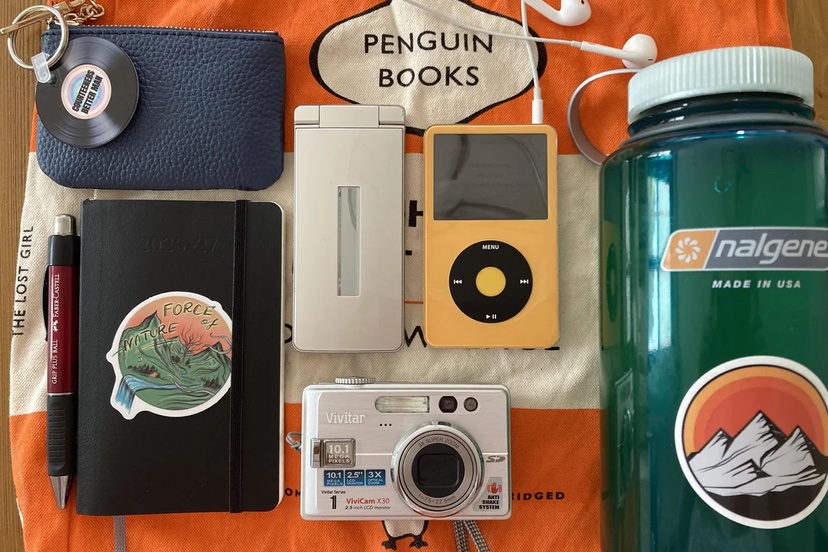
We might note that lipstick is also going out of style, in terms of EDC.
This movement away from smartphones, and ultimately, from computers (and lipstick), is reportedly being driven mainly by teens and younger adults.
They’ve had enough of the tech-dependent world we older folks have created. Sure, they’re young and don’t know any better, but can we blame them?
Earlier this year, Meta CEO Mark Zuckerberg of Meta laid out a vision of a future in which AI “Friends” outnumber our human companions.
You’ll be scrolling through your feed, and there will be content that maybe looks like a Reel to start, but you can talk to it, or interact with it, and it talks back, or it changes what it’s doing. …That’s all going to be AI.
And that just might work, if by “working” they mean “keeping enough users hooked on the platform to generate a profit.” Because it’s all about profit and seeing how rich they can become.
But generative AI images and chatbot “friends” simply blur the line between reality and misinformation. Which we can do for ourselves, thank you kindly.
If AI generated misinformation is everywhere, it will probably make it that much easier to say, “to hell with it” and just opt out all together. Most of us dislike being lied to constantly.
Okay, some of us really enjoy being lied to. Makes us feel important, that someone would misrepresent reality to try and keep us happy.
But I suspect most of us will ultimately want a dumbphone.
Back in 1811, textile workers in England began destroying newly-invented machines that were doing the types of weaving and textile manufacturing formerly done by humans. These new inventions produced textiles faster and cheaper and could be operated by less-skilled, lower-wage workers.
The protesting workers were called “Luddites”. The name came from a legendary weaver named “Ned Ludd”, whose name was used as a pseudonym in threatening letters by the movement’s members.
Historian Eric Hobsbawm called the Luddite machine wrecking, “collective bargaining by riot”. Sporadic protests continued, in various towns, through about 1817. An agricultural variant of Luddism occurred during the widespread Swing Riots of 1830 in southern and eastern England, centering on breaking threshing machines.
But the textile machines generated profits. Did we already mention profits? I think we did.
Last month, several dozen people gathered in New York for a “Luddite Renaissance” rally. The Luddite Club, a nonprofit founded by a team of “former screenagers” in Brooklyn, has reportedly expanded to more than 20 chapters at high schools and colleges across the U.S.
According to a manifesto drawn up by the Second Luddite Congress (April 1996):
Neo-Luddism is “a leaderless movement of passive resistance to consumerism and the increasingly bizarre and frightening technologies of the Computer Age”.
The neo-Luddites who are buying dumbphones are not ‘anti-technology’ but ‘anti-exploitation’. They grew up with smartphones and they know all too well how enticing (and overwhelming) the technology can be.
If you’re phone is simple and basic enough, you can get by without having machines lie to you.
You can have your friends and loved ones tell you lies, and that can be enough.
Underrated writer Louis Cannon grew up in the vast American West, although his ex-wife, given the slightest opportunity, will deny that he ever grew up at all. You can read more stories on his Substack account.