

A brief paper issued this past Monday by scientists Jack Schmidt, Anne Castle, John Fleck, Eric Kuhn, Kathryn Sorensen, and Katherine Tara indicates a new “low” total in the two largest water reservoirs on the Colorado River.
On Sunday, July 12, the surface of Lake Powell was 3524.32 feet above sea level, and the surface of Lake Mead was at 1042.77 ft.7 These elevations equated to 5,505,869 and 7,169,640 acre feet, respectively, of live storage in the two reservoirs. The combined total live storage of these reservoirs was 12,675,509 acre-feet.
The last time the combined total live storage in Lake Powell and Lake Mead was this small was May 23, 1957, during construction of Glen Canyon Dam when the entire amount of 12,668,000 acre-feet was stored in Lake Mead (Fig. 1). It was not until March 1963 that the river diversion tunnels at Glen Canyon Dam were closed, and Lake Powell began to fill.
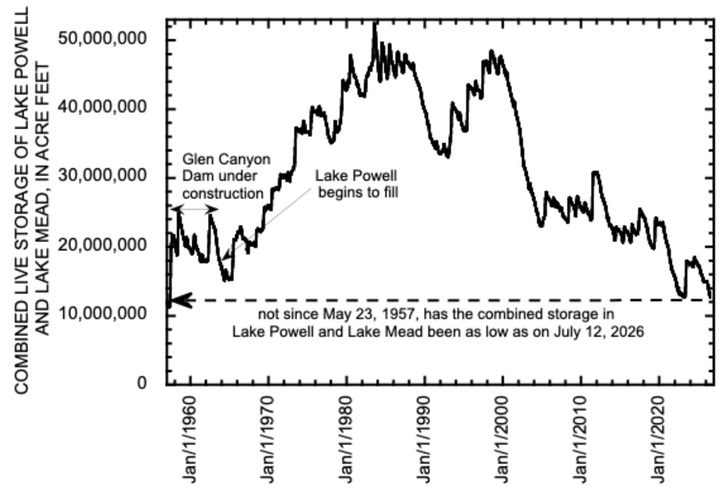
The unprecedented low in combined storage in Lake Powell and Lake Mead on July 12 broke the previous record low of 12,677,161 acre-feet that was set on March 14, 2023.
Since March 2026, the combined storage in Lake Powell and Lake Mead has been depleted approximately 16,000 acre-feet/day, except during May when the depletion rate was 11,000 acre-feet/day and snowmelt runoff from the Rocky Mountains and supplemental releases from Flaming Gorge Reservoir were flowing into Lake Powell.
During winter, water use in the Lower Basin and releases from Lake Mead were much less, and the depletion of combined storage was only approximately 6,500 aacre-feet/day in February and 2,600 aacre-feet/day in January.
To read the full paper, go here
Allen Best publishes the e-journal Big Pivots, which chronicles the energy transition in Colorado and beyond.