
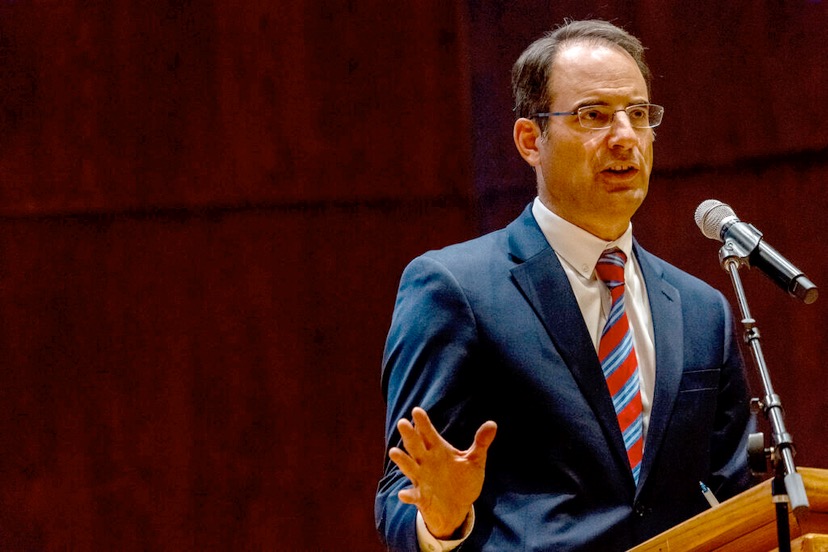
What a couple of disorienting days. First, an event in a brewpub in Aurora that included a one-on-one conversation with Phil Weiser, quite possibly the next governor of Colorado.
Then, on Monday morning, an event in Thornton in a quasi-fundraiser for Gabe Evans in his re-election bid to the U.S. Congress. He was accompanied by Energy Secretary Chris Wright. (And sitting between them was Duane Highley, the CEO of Tri-State Geneation and Transmission Association).
Everything about the two events was different. Everything.
Weiser was on the podium with a youngish guy named Adam Met, a musician with the band AJR (playing Red Rocks both Monday and Tuesday night). Met is also a climate activist who founded the youth-tilting organization called Planet Reimagined, which seems to have firm legs.
Both Weiser and Met said a lot, (and I plan to have a story shortly, about the event, before voting ends tonight). Met had been talking about why he believes Weiser is a good listener. Weiser responded with a statement he attributed to Roy Romer, a former governor of Colorado who is now 97 and has been the honorary chair of Weiser’s campaign.
We all know this to be true in our experience in life. It’s also a core tenant of the scientific method. Even the most fervently held scientific truths are only provisional.
We think we understand gravity pretty well but…
Einstein’s theory of relativity? Well, a pretty good theory but…
All the time we are learning new things.
And, by the way, that goes for climate change, too. A very, very good theory that explains so much of what we are seeing and measuring. But, is it absolute? Nope.
Ain’t no absolutes in science. And “all truth is partial,” said Weiser, as he had written in a post in 2025.
At an event in May, Weiser had bucked calls for a ban on new data centers in Colorado. There are places like Hayden and Craig, which will lose their coal plants at some point, that could use data centers paired with geothermal, said Weiser. He said so again on Sunday.
Where should the guardrails be placed… well, there’s lot to work out. What Weiser did say was that he was planning to begin work early with Sen. Cathy Kipp to create a bill that contained the necessary guardrails and could get across the legislative finish line. I probed him about the nuances of some of that — such as state vs. local authority in siting.
He conceded that he does not have all the answers but pledged to have the necessary conversations.
Nuance was entirely lacking on Monday morning in Thornton. The event was basically designed to turn out the vote — and funds, too — for Gabe Evans. Evans, a former police officer who had an office a few blocks from Big Pivots in Arvada, comes from Fort Lupton, in the heart of the Wattenberg oil and gas field. Then a state legislator, he was elected to Congress in a 2024 squeaker.
Early in his term, Evans spent time touring a solar farm. He spoke the language of moderation. But now, he reads the Trump administration gospel that all fossil fuels are wonderful. Period. As for renewables, they’re nice — but not the stuff of grownups.
If your audience is unknowledgeable, you can get away with a lot of selective use of facts. One small example. A speaker — I forget which one, because Wright and Evans spoke from the same playbook — talked about the rising costs of electricity.
‘Tis true. Electricity costs have started rising in Colorado and elsewhere. But compared to other sectors of the economy? And why? I have read some evidence that the larger story is underinvestment in delivery infrastructure in the last several decades.
Details like that are bothersome in simple narratives. And then there is a whole different dimension. If climate change isn’t real, just an invented or at least greatly exaggerated narrative, then why could we possibly want to reinvent energy? Costs of climate change don’t count.
To be clear, Wright has conceded climate change caused by greenhouse gases. He just doesn’t think it will be a problem for another century. Some might question what he sees what all of us in Colorado are seeing this week — and just a few days after big rainstorms.
Geothermal is one area where a Chris Wright and ardent Democrats might overlap. Liberty, the oil and gas company that Wright founded and operated before becoming energy secretary, bought stock in Fervo, the company making news in Utah with its enhanced geothermal (electricity production). At Holy Cross Energy, Bryan Hannegan, an ardent proponent of decarbonization, sees enhanced geothermal being part of the mix. Down in Durango, Chris Hansen thinks so, too. Hansen is currently a cooperative CEO, not a politician. But as a state legislator a few years ago, he crafted many important bills in Colorado’s energy transition.
As for Duane Highley’s appearance on this panel, it’s hard to figure. He is, to his credit, flexible. I saw him on a Sierra Club event during the COVID lockdown. Last October he was in Breckenridge at the Mountain Towns climate event. Was his appearance on this panel an effort to lobby the energy secretary?
In the Q&A with press afterward, I asked Chris Wright about Tri-State’s grievance with the Department of Energy orders to keep Craig No. 1, the coal unit, operating. Tri-State and Platte River Power Authority, a co-owner, said in a lawsuit that they have no resource adequacy needs to keep the coal unit operating, so it’s unfair for them to bear the costs of keeping this coal unit available.
To Wright I posed this question: Was their co-appearance at this event evidence that Tri-State and DOE had settled their differences?
Wright wanted to answer my question about cost-allocation by talking about the dire need for coal generation to meet peak demands. I had to follow up, to prod him to an answer to my question. “We’re working on it,” he said.
I also got in a second question about nuclear. Wright had talked about visiting Idaho National Laboratory to review the significant progress, as he described it, of two small modular reactors.
“Do you have any idea how soon this nuclear technology might become cost-competitive?” I asked.
He talked about the need to prove the technology and then scale it. “Relatively soon,” he said.
Xcel in the past has said 2035, although others — including people with degrees in nuclear engineering — see a longer, and in some cases much longer, timeline.
On Sunday, at the shopping mall in Aurora where the brewpub was located, I noticed a tall guy loitering close by, who I suspected was security. When I asked Weiser how long he had had security at his events, he told me that he had been assigned it as long as he was a declared candidate, a matter of state law.
At the Monday morning event, there were protesters just beyond the property of the Doubletree Hotel where the event was held. They held hand-made signs: “Gabe Evans Must Go.” And “1 Term Gabe.”
I had signed up to attend the event last week but did not get the location until Sunday morning. Once there, no liquids were allowed into the room. I was identified as “press” and ordered to remain in the back of the room. At one point, as I moved around a bit to get photos without the speakers having microphones coming out of their noses, a security guard — big and burly — told me I had to stay at the very, very back of the room.
In short, security was tight and verged on authoritarian. Maybe that much muscle is needed for a cabinet secretary in the Trump administration, but I will say that it was sort of unsettling to think we can’t have civil conversations.
Footnote about ashes: On Sunday, after our interview outdoors with Attorney General Weiser, my companion looked at her notebook page, gritty with ashes after just a half-hour of being open. There were particles of ash. On Monday morning when we returned to my car after listening to Energy Secretary Wright, there were ashes on it. In Pueblo and in Grand Junction, Basalt and Alamosa I am sure the ashes are far thicker, the sky very, very weird.
Allen Best publishes the e-journal Big Pivots, which chronicles the energy transition in Colorado and beyond.