
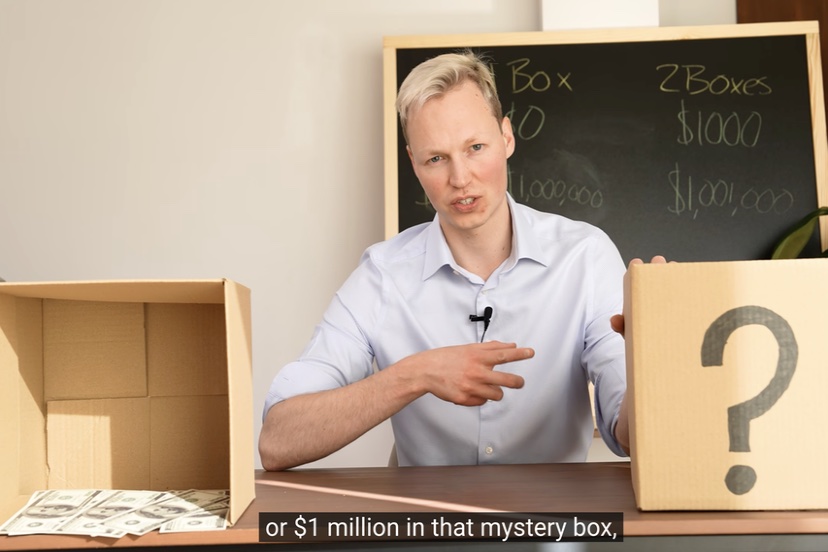
A while back, a smart guy named William Newcomb proposed a meaningless paradox that has since proved entertaining to smart people who love math and logic.
Veritasium posted a video about this meaningless proposition on YouTube (see below), thinking that smart people in search of harmless entertainment (like me, for example) would watch the whole 25-minute video, and expose ourselves to several YouTube advertisers as punishment.
Veritasium labeled their video: “This Paradox Splits Smart People 50/50”.
Here’s the setup. You’ve been invited to enter a room, in which you will find two boxes. You are informed that Box 1 contains $1,000.
Box 2 — thoughtfully labeled with a question mark — might be empty, or it might contain $1 million.
You make the acquaintance of a supercomputer wearing a purple bow tie. Apparently, you are naked and have blue hair, but maybe this doesn’t matter to supercomputers.
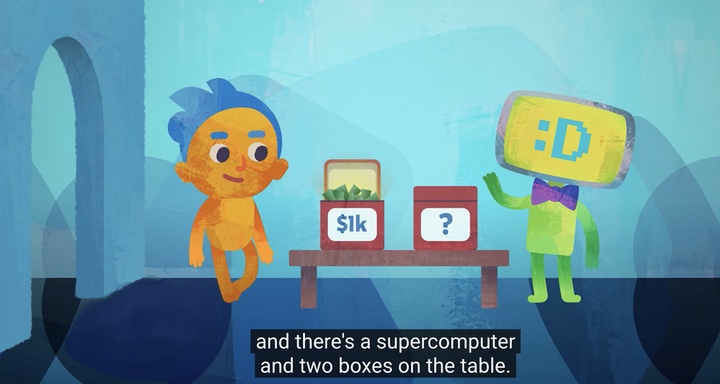
You learn that, before you even entered the room, the supercomputer — presumably, artificially intelligent — made a prediction about you. This particular machine makes correct predictions about people nearly 100% of the time, and based on that prediction about your behavior, the machine either left Box 2 empty, or filled it with $1 million.
You have this information, and understand that you are now allowed to take possession of both Box 1 and Box 2 … or only Box 2, the box that is either empty or filled with lots of money.
If the machine predicted that you would take both boxes, then it left Box 2 empty.
If the machine predicted that you would take only Box 2, then it filled Box 2 with $1 million.
The prediction and the filling (or non-filling) of Box 2 happened before you entered the room.
So… do you take both boxes? Or do you take only Box 2?
The decision about what’s in the boxes has already been made. So, what’s your pick? (No, you’re not allowed to peek in Box 2.)
I will give you 30 seconds to make your decision.
,,,
The 25-minute Veritasium video documents some very smart people arguing over the two choices. Roughly half of the people surveyed took both boxes. The other half took only Box 2. So whatever you decided, you have plenty of company.
As suggested, this is a meaningless exercise. You will never be invited to enter a room containing these two boxes. An super computer capable of infallibly predicting an individual human’s behavior does not exist. You probably don’t have blue hair.
Nevertheless, the paradox proved entertaining for a large number of people. In 2016, when the Guardian newspaper surveyed about 32,000 people, 53.5% said they would take only Box 2. About 46.5% said they would take both boxes.
Here’s the simple math.
If you take both boxes, you will take home either $1,000 or $1,001,000, depending on what the computer predicted about you.
If you take only Box 2, you will take home either $1,000,000 or nothing, depending on what the computer predicted.
If the computer predicted that you would take only Box 2, and so filled it with $1 million… and you in fact take both boxes… then the computer was wrong and you are $1,000 richer than if you had taken only Box 2.
But the computer is almost never wrong! Suggesting that — if you take both boxes — then Box 2 will be empty. Right?
One essential element of this paradox is “you”. This is not just some random naked man with blue hair, making a theoretical decision about his wealth options. This is “you yourself” and the money will go into your own wallet. You might need a really big wallet. Or it might still be empty.
Another essential element is a supercomputer that makes nearly infallible predictions. You have the opportunity, on the table right in front of you, to prove a supercomputer “wrong”. Is that opportunity worth more that $1 million? Maybe so.
What this paradox really tells us about human nature, however, is not who is right and who is wrong, but who is willing to spend their limited time on earth thinking about (and perhaps, arguing about) a meaningless paradox.
From what little I know about human nature, I predict that Person 1 will take both boxes, if you ask them on Monday… but will take only Box 2, if you ask them on Tuesday.
In either case, Person 1 will believe they picked the right option.
You don’t need a supercomputer to predict that outcome.
Underrated writer Louis Cannon grew up in the vast American West, although his ex-wife, given the slightest opportunity, will deny that he ever grew up at all. You can read more stories on his Substack account.