
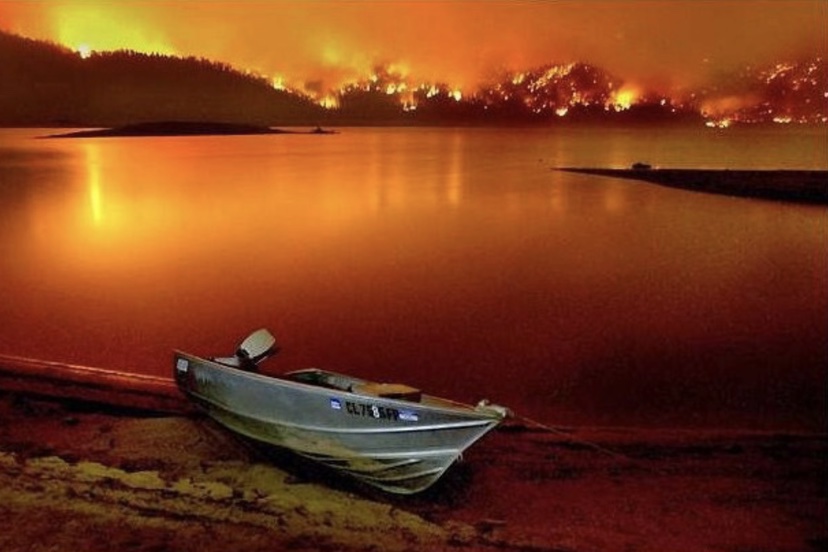
Photo: The Missionary Ridge Fire near Durango began on June 9, 2002, and by the time it was contained, had burned more than 70,000 acres, destroyed 56 homes and outbuildings, and resulted in one firefighter fatality.
We posted a brief article last week about four upcoming ‘Community Conversation’ events, where the community can hear about, and ask questions about, three possible tax increase measures that may — or may not — appear on the Archuleta County ballots in November.
None of the proposed tax increases, however, are aimed at addressing wildfire danger.
Of course, wildfire is only one of the many issues facing Pagosa Springs in 2026. Some of the issues are completely out of our control.
Gas prices, for example. The Colorado state budget. The incarceration of people who have fled violence in other countries and sought safety and employment in the U.S.
Those are not local issues.
Preparing for wildfire is partly a local issue… but only partly. Some aspects of this issue are outside our control, while some are left up to our local governments and organizations and property owners.
During a work session on Tuesday, April 21, the representative for Wildfire Adapted Partnership, local resident Bill Trimarco, spoke to the Archuleta Board of County Commissioners about the Colorado Wildfire Resiliency Code (CWRC) recently adopted by the commissioners. Archuleta County will begin enforcing the CWRC on July 1.
The code establishes new building requirements defined by the state government, intended to make new and remodeled buildings more resistant to wildfire. The state-established code provides, however, two pathways by which property owners can be exempted from the building requirements.
Wildfire Adapted Partnership is a 501c3 nonprofit organization dedicated to helping homeowners understand their wildfire risk and what they can do to reduce that risk. Their staff assists wildfire mitigation efforts through funding and education in Archuleta, Dolores, La Plata, Montezuma, and San Juan Counties.
They work closely with a variety of partners including the Colorado State Forest Service, United States Forest Service, Bureau of Land Management, Offices of Emergency Management, and local fire protection districts, to educate and assist folks with wildfire mitigation.
They were also responsible for guiding the 2026 update to Archuleta County’s Community Wide Protection Plan, which helps promote community preparedness and wildfire mitigation strategies in the county. You can view that update here.
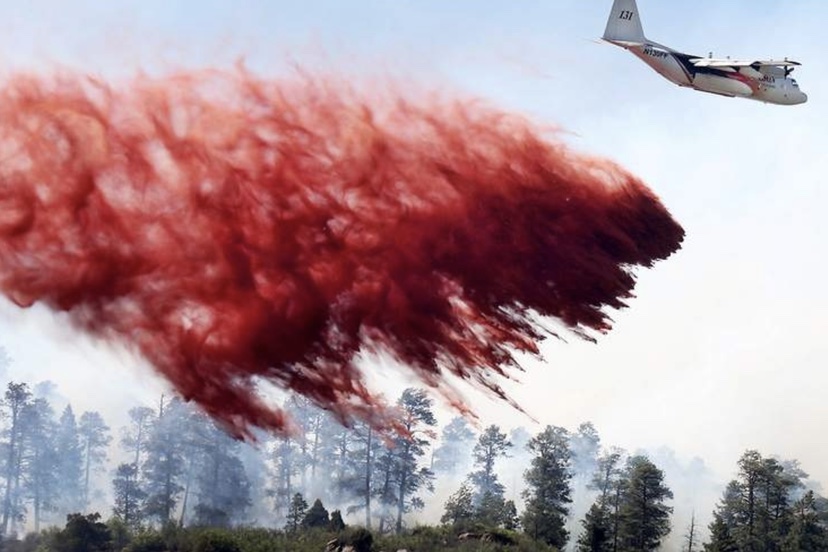
As Mr. Trimarco reminded the commissioners, wildfire is no longer viewed by forest managers as a totally negative event. It’s well understood that in the American West, our forests are adapted to occasional wildfire events — and in fact, depend on occasional wildfire or overall forest health. The main problems we face have to do with property owners building residences within the forest, or adjacent to the forest, and with government allowing that to occur.
Mr. Trimarco:
“Forest fires are always going to happen. Yes, our forests are out of whack, and the fires are bigger now than what they used to be. People are working on that.”
“People working on that” presumably refers to forest thinning, prescribed burns, and other fire mitigation efforts.
Mr. Trimarco:
“But when the real damage happens is when the fire from the forest moves into any developed areas. That’s where we’re having the loss of life, the loss of property and infrastructure… So basically, we need to look at where the problems is. We can’t stop the forest fires, but we can stop them from taking our homes.”
I forgive anyone who questions this claim — that we can stop wildfires from taking our homes. Because, given the wrong conditions, wildfires will almost inevitably take our homes. We do not have to live in or even near a forest, in order for wildfire to destroy entire neighborhoods. Witness, for example, the destruction of entire neighborhoods during the 2021 Marshall Fire near Boulder, Colorado… and during the wildfires in Los Angeles County in 2025. These were not neighborhoods located within forests, but were, rather, suburban neighborhoods surrounded by concrete and asphalt streets. The fuel feeding those fires didn’t come from trees in a forest; the fuel was the homes themselves.
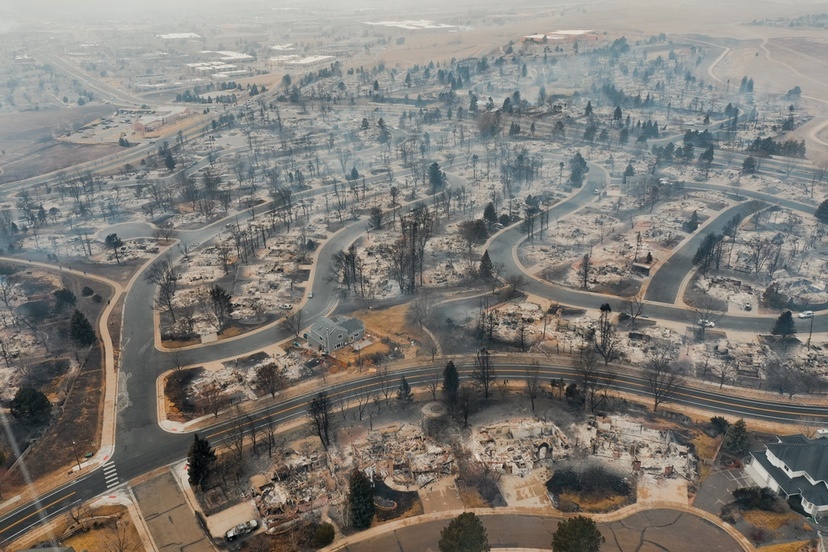
Minimizing the fuels in the forest — that’s one approach to the wildfire problem. Minimizing the fuels in our buildings is another approach, and maybe the better approach.
Growing up, I occasionally heard the proverb: “People who live in glass houses shouldn’t throw stones.”
A appropriate proverb for the American West in 2026 might be: “People who live in flammable landscapes shouldn’t build wooden houses.”
A year after the Marshall Fire, ProPublica reporter Jennifer Oldham posted an article entitled: “Wildfires in Colorado Are Growing More Unpredictable. Officials Have Ignored the Warnings.” From her article:
On December 30, 2021, more than 35,000 people in Superior and Louisville, as well as unincorporated Boulder County, fled the fire — some so quickly they left barefoot and without their pets. Firefighters abandoned miles of hose in neighborhood driveways to escape.
The Marshall Fire, the most destructive in Colorado history, killed two people and incinerated 1,084 residences and seven businesses within hours. Financial losses are expected to top $2 billion.
The blaze showed that Colorado and much of the West face a fire threat unlike anything they have seen. No longer is the danger limited to homes adjacent to forests. Urban areas are threatened, too.
But the homes and businesses built within the WUI — the Wildland-Urban-Interface, where forest meets human habitation — are particularly at risk. And that includes nearly all the neighborhoods in Archuleta County. The number of new homes built in Colorado’s WUI more than doubled between 1990 and 2020. Nationwide, the WUI is growing by 2 million acres a year. According to a June report from the U.S. Fire Administration, homes in 70,000 communities — worth a total of $1.3 trillion — are now threatened by wildland fires.
After the 2012 Waldo Canyon Fire destroyed several Colorado Springs neighborhoods, fire experts urged Colorado lawmakers to design a model building code that communities in high-risk areas could enact.
From Ms. Oldham’s ProPublica article:
Such [model building] codes have been scientifically proven to reduce risk for residents and rescuers and to increase the odds structures will withstand a blaze by requiring fire-resistant materials on siding, roofs, decks and fences, along with mesh-covered vents that prevent embers from entering.
But lawmakers bowed to pressure from building and real estate lobbyists as well as municipal officials who demanded local control over private property.
Colorado remained one of only eight states without a minimum construction standard for homes, and the lack of uniform regulations cost the Centennial State millions in federal grant money. But the leaders in many local jurisdictions, such as Archuleta County, have consistently objected to the tendency among the state legislators to impose “unfunded mandates” on communities.
Finally, last year, Colorado created the Colorado Wildfire Resiliency Code (CWRC) and demanded that cities, towns and counties adopt the code by April 1, 2026. We’ve discussed the CWRC previously here in the Daily Post.
So… are we stuck with the CWRC?
Is there no way to escape the regulations?
And… do we really want to escape… from scientifically-supported regulations that make the whole community safer?