
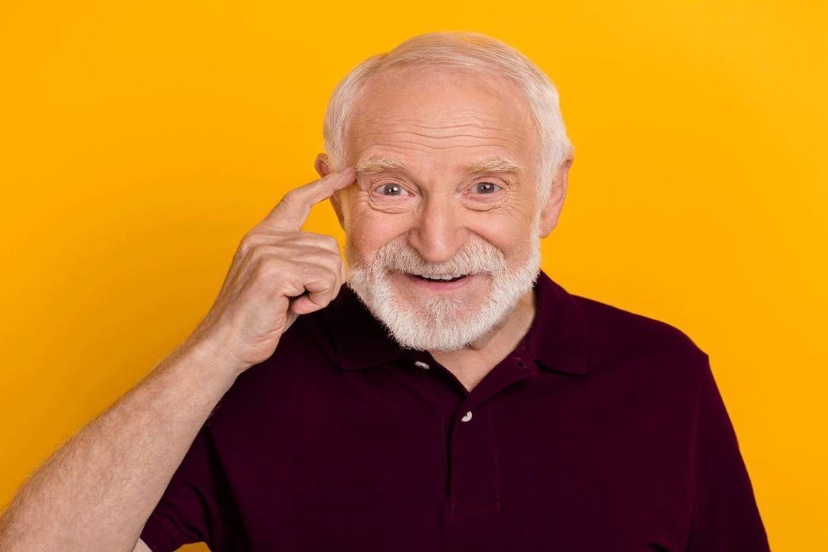
My assumption has always been that I would get ‘better’ as I got older.
That statement needs to be qualified, of course.
For instance, I know that I’m not getting ‘stronger’ as I get older. When I was 25, I could do 50 pushups without breaking a sweat. These days, I’m already sweating before I even do the first pushup. I can still do 50 pushups, but I have to parcel them out over an entire month.
And for another instance, my memory doesn’t seem to be improving. Quite the opposite. I often find myself approaching an old friend in City Market and realize that I can’t remember their name. So I quickly duck down a different aisle. I then spend the next few hours trying to remember their name, and I often succeed.
Of course, it’s totally too late by then.
And there are certainly other performance aspects that have seen modest decline, but which cannot be openly discussed in a family-friendly news website.
But I really believed I would eventually be able to grow a full beard, at some point. Didn’t happen.
I also believed I would get smarter as I got older. As I learned from my mistakes. Which have been plentiful. Don’t worry, I’m not going recount them here, but wouldn’t it make sense if I got some kind of benefit from all the things I did wrong?
As it turns out, there are different types of intelligence, as I learned from reading a scientific report on “peak intelligence”.
From ScienceDirect.com, December 2025:
Fluid intelligence, which peaks near age 20 and declines materially across adulthood, is often regarded as the most critical cognitive ability for predicting important life outcomes. Yet, human achievement in domains such as career success tends to peak much later, typically between the ages of 55 and 60…
Apparently, there’s a thing that psychologists call “fluid intelligence”. You get it, and then, you lose it. Easy come, easy go.
But there’s also a thing called “crystallized intelligence”. Which peaks somewhere around age 60.
Fluid intelligence involves mental processes that depend only minimally on prior learning, while crystallized intelligence depends on years of collected information and trial-and-error.
In a corporate environment, fluid intelligence may predict a person’s capacity to work well in “environments characterized by complexity, uncertainty, and ambiguity.” Situations where experience cannot help you predict about the likely outcome. Like, in a marriage.
A person might think, “Well, after 30 years of marriage, you ought to be able to predict the outcome.” A person would be wrong.
Wikipedia presented the following description of how fluid intelligence and crystallized intelligence might approach the same problem.
“There are 100 patients in a hospital. Some (an even number) are one-legged but wearing shoes. One-half of the remainder are barefooted. How many shoes are being worn?”
A person with more crystallized intelligence that this writer might work out the solution using algebra.
Let x = number of one-legged patients (x is even). Those wear 1 shoe each → x shoes. Remainder = 100 − x. One-half of the remainder are barefooted, so the other half wear two shoes each. Number wearing two shoes = (100 − x)/2 → shoes from them = 2 * (100 − x)/2 = 100 − x. Total shoes = x + (100 − x) = 100.
So 100 shoes are being worn.
I’m personally surprised that the number of one-legged patients in the hospital is “an even number”. I’ve been in hospitals on numerous occasions, and I don’t remember ever seeing more than one single one-legged person, at most. A hospital with two… or four… or six… one-legged patients, strikes me as slightly preposterous.
And that’s coming from a person at the peak of his crystallized intelligence. Or at least, near the peak.
It’s quite possible that the algebraic equation shown above is accurate, and that, in this preposterous example, 100 shoes are being worn. It’s been more than 40 years since I did any algebra, so I won’t weigh in on that question.
What might not be immediately clear, however, to a young person still struggling through life while relying only on fluid intelligence, is that this algebraic equation doesn’t work if “x” is not an even number.
Since a real hospital would probably have at most one person with only one leg, that would leave 99 patients with two legs. “One-half the remainder are barefooted” would mean 49 1/2 two-legged patients who are barefoot, and 49 1/2 two-legged patients wearing shoes.
Even a guy like me, whose fluid intelligence peaked near the age of 20, can tell you that’s not possible. You can’t have half a patient.
Nevertheless, this whole discussion about fluid and crystallized intelligence is going to be moot, once we get Artificial General Intelligence.
They say AGI is just around the corner… once we build 100 more humongous data centers, draining our electricity, and driving up our electric bills.
I’d like to know how old the people were, who dreamed up this AGI disaster.
Underrated writer Louis Cannon grew up in the vast American West, although his ex-wife, given the slightest opportunity, will deny that he ever grew up at all. You can read more stories on his Substack account.