
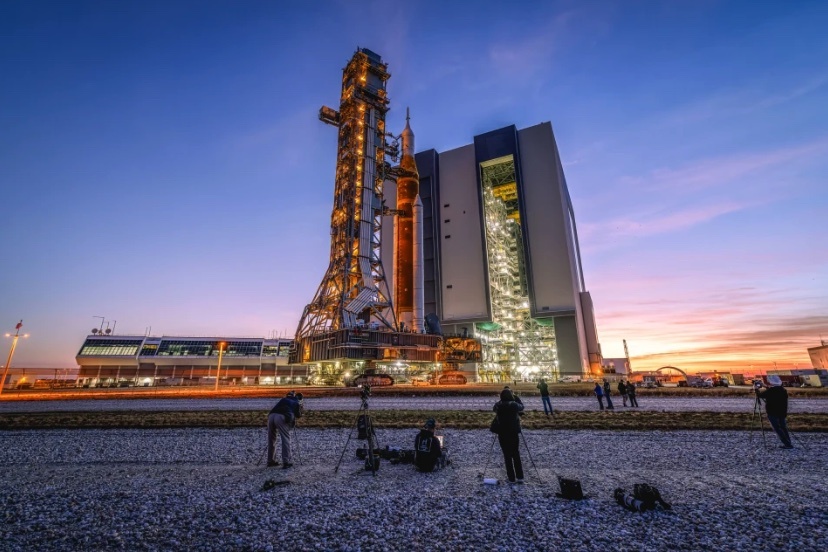
Back in February, NASA published this gorgeous photo of the Artemis II Space Launch System rocket on their website, with the space capsule Orion perched on top.
There’s nothing quite as breathtaking as an 11 million pound rocket standing proudly erect, eagerly waiting to inject itself into the void of outer space — with a magnificent sunset in the background.
I would have liked to be one of the photographers who were there, taking photos at this moment. But that’s neither here nor there, because I didn’t have anyone to watch my cat.
In Greek mythology, Artemis was the daughter of Zeus and Leto, and twin sister of Apollo. The twins were the result of some extramarital hanky-panky, and in retaliation, Zeus’s wife Hera forbade Leto from giving birth anywhere on solid land. Only the tiny Greek island of Delos allowed her to give birth to her children.
Reportedly, Artemis was born first and then proceeded to assist Leto in the birth of her twin brother, Apollo.
As we all know, NASA’s Apollo missions flew to the moon 50 years ago. Now, Artemis finally gets her turn. That’s the thanks you get for helping your brother get born.
From the NASA website:
The upcoming mission, known as Artemis II, will mark the first time that NASA’s Space Launch System rocket and Orion spacecraft carry people. It will be the system’s second spaceflight, following an uncrewed mission around the moon, Artemis I, in 2022.
When the crew members — NASA astronauts Reid Wiseman, Christina Koch and Victor Glover and Canadian astronaut Jeremy Hansen — swing around the moon, they could reach a distance farther from Earth than any humans have gone before…
It’s probably nothing to get too worked up over, but when I read that announcement, and came upon the phrase, “…they could reach a distance farther from Earth…” I thought to myself, why would NASA use the word “could” when they really ought to use the word “will”?
…they will reach a distance farther from Earth than any humans have gone before…
That’s how I would have phrased it.
“Could reach” seems a bit… tentative?
But maybe that’s how space travel feels these days…. “could”… and “might possibly”… and “if all goes well”…
We’re talking here about Artemis II. The voyage with people onboard.
Artemis I made the trip, remotely controlled, without a human crew and made it home safely. So we have that as encouragement.
Artemis I was originally scheduled to take off in 2017, but various delays — such as a failed test of the rocket engines — delayed the so-call “wet dress rehearsal” (WDR) until April 2022. But after a series of minor problems (a mobile launcher pressurization problem; problems with the gaseous nitrogen supply; liquid oxygen temperatures; a vent valve stuck in a closed position; a little problem with a helium check valve; a leak in the tail service umbilical plate; a hydrogen leak…) the April WDR was stopped without being completed.
But almost all the testing had been done. So we have that as encouragement.
I once had a old Buick station wagon that leaked oil. We just kept adding oil. It would have cost more than the car was worth to fix the leak. But I doubt the folks at NASA have that kind of mentality. Also, the taxpayers are footing the bill, so money is no object. And plus, how do you add oil in outer space?
As noted, the Artemis I mission delivered the space capsule Orion to the moon and back, successfully and hardly worse for wear… except the little missing piece of the heat shield that keeps the capsule from burning up during reentry.
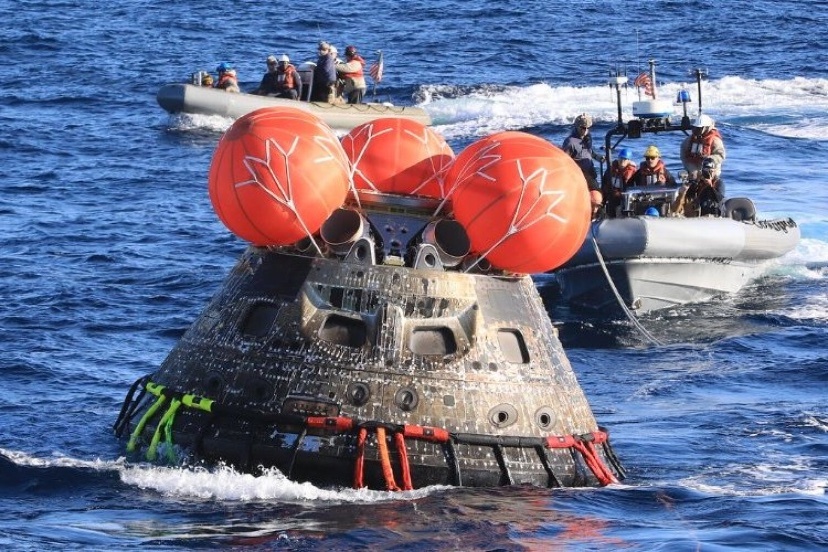
The Artemis II flight, with a human crew, was originally planned for some time between 2019 and 2021, but was rescheduled for various reasons, until 2023. Next I heard, the launch had been moved to September 2025. But the launch was again delayed due to engineering investigations into issues with the life support system and heat shield.
Life support systems and heat shields being rather important.
Then it sounded like maybe a February launch…?
From the NASA website:
Following a successful wet dress rehearsal on February 21, teams identified an issue preventing helium from flowing to the rocket’s upper stage, prompting a return to the Vehicle Assembly Building (VAB) where the issue was repaired.
“Successful rehearsal” doesn’t mean what it used to, I guess.
Now the tests, and repairs, have been done, and the launch date is set for April 1.
I hope NASA is aware that April 1 is April Fools Day.
So far I haven’t said much about the mythical giant Orion, after whom the main spacecraft carrying the astronauts has been named. A handsome guy, apparently, who regularly got himself into romantic trouble. In one version of his story, he rudely violated a nymph named Opis, for which crime he was executed by Artemis.
Up until that point, he and Artemis had been hunting buddies. Goes to show, you never know how these stories will turn out.
Underrated writer Louis Cannon grew up in the vast American West, although his ex-wife, given the slightest opportunity, will deny that he ever grew up at all. You can read more stories on his Substack account.