
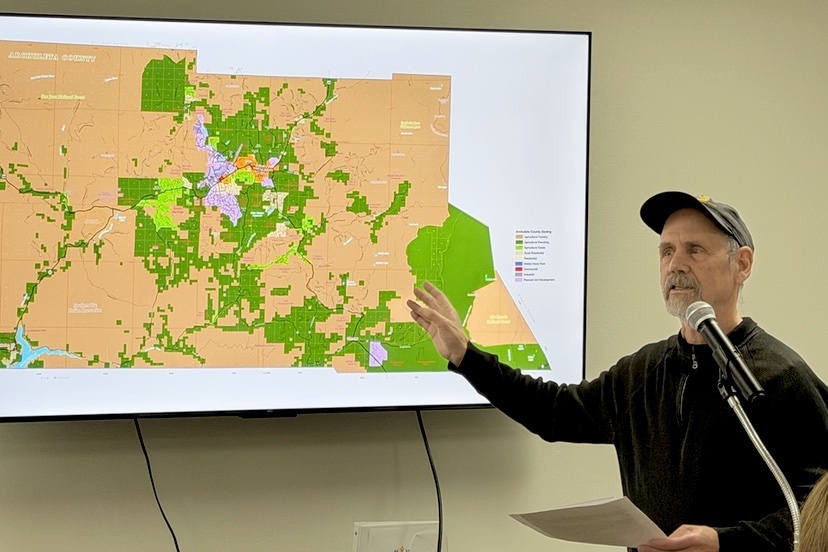
Photo: Daily Post editor Bill Hudson, presenting to the League of Women Voters, February 24, 2026. Photo courtesy Cathleen Giovannini.
Over the weekend, I learned that the President would be delivering a ‘State of the Union’ speech on Tuesday evening, but I didn’t have any particular inclination to watch it. I’ve heard the President’s speeches before, and they all sound pretty much the same.
“America has become great once again, and is getting greater with each passing day, thanks to Me, Your President.” The rest of us are merely along for the ride.
But even if I’d been inclined to watch the speech, I would have missed the first hour anyway, because I had helped organize a panel discussion about Pagosa’s housing crisis for the League of Women Voters of Archuleta County — also scheduled for Tuesday evening.
I had the honor of introducing this community-wide issue, ahead of the panelists — including Emily Lashbrooke with the Pagosa Springs Community Development Corporation (PSCDC), Leah Ballard with Habitat for Humanity of Archuleta County, Archuleta County Commissioner Veronica Medina, and Pam Moore of Durango-based HomesFund.
Apparently, most of the local LWV members were home watching the President’s speech, because the attendance at our housing presentation was relatively light. Actually, very light.
While preparing for Tuesday night, I’d had coffee with LWV housing committee member Ellynn Ragone, and she’d made a comment about the curious fact that we have both a Town government and a County government… making laws and collecting taxes and doing all the other things governments do… even though we are really “one community”. We all drive on the same roads, shop at the same stores, attend the same churches, ski at the same ski area, watch the same Fourth of July parade…
Wouldn’t it make more sense to have one, single, unified local government?
Not the first time I’ve heard that question asked.
And it’s not a dumb question. A couple of Colorado communities operate as consolidated city-and-county governments: Denver and Broomfield. But the political maneuvering required to consolidate the incorporated ‘Town of Pagosa Springs’ and unincorporated ‘Archuleta County’ into a single government is quite complicated, with no guarantee of success.
Nevertheless, the Town and County do cooperate closely, on occasion. For example, the two governments collaborated last year on a Regional Housing Needs Assessment (HNA), researched and written by ECO Northwest (based in Portland, Oregon) and Western Spaces LLC (based in Salida, Colorado.) This analysis of our local housing situation was required by SB24-174, signed into law by Governor Jared Polis in 2024.
I’d brought along a series of PowerPoint slides to share at Tuesday’s LWV presentation, and my first slide included two quotes taken from the HNA.
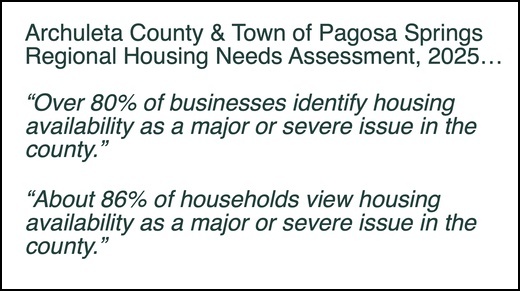
Although nearly all the data included in the 2025 Regional Housing Needs Assessment was pulled from federal and state data sources, these two quotes came from a survey of local residents and business owners. The survey wanted “opinions” from local folks, who were reporting — basically — their gut feelings about how our community is faring.
Widely shared guy feelings, that our community is in a dire situation.
It’s not only our “incorporated town” that’s in this mess. The entire community, as divided as it may feel sometimes, shares the same concern. Housing availability is a critical issue.
Here’s the second PowerPoint slide I shared on Tuesday during my introductory comments, again taken from the HNA. It’s worth a look:
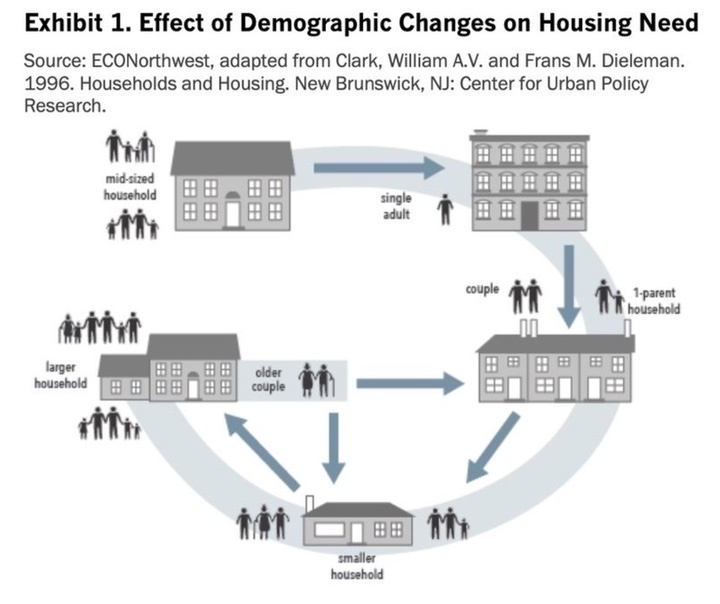
This graphic portrays what we might call, “The American Housing Dream.” The young single adult leaves home and finds housing in a college dorm or apartment building. Soon, that adult has transitioned to a two-person household — found a partner, or perhaps become a single parent with one child — and moved into a condo or town home. As the family grows, it moves into a small “starter home”, and then later into a larger, more comfortable house.
Some years after the kids have left home, the older couple may want to downsize to a condo or apartment, or perhaps move in with their adult children.
If this “Dream” were anything close to reality, then we would be facing a very different situation in Archuleta County.
But this is not how the housing market actually works in 2026.
Not here in Pagosa, and from what I can tell, not in most communities.
Thus, my third PowerPoint slide.
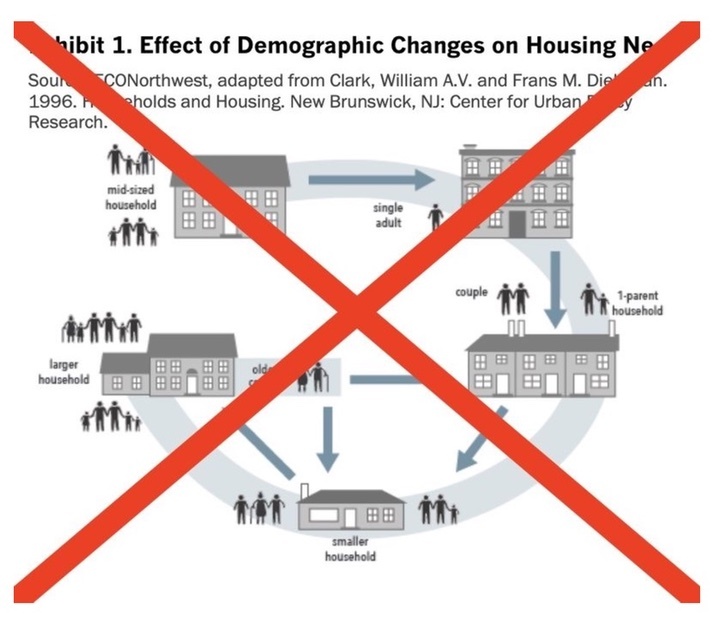
If you read the 112-page Regional Housing Needs Assessment (which you can download here) or even if you just flip through it, you can discern that things are not “going according to plan” in Pagosa Springs — where housing is concerned.
This mismatch is partly due to the overall American economy and culture, and partly due to the way housing is controlled — and limited — by local regulations.
And partly due to decisions by local residents, property associations, and businesses.
Here’s some population data included in the HNA, extracted from State Demographers Office statistics:
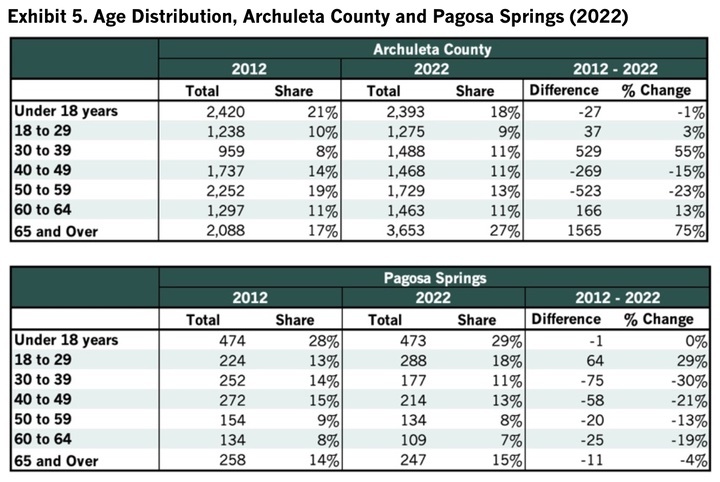
Here we see a couple of weird population patterns that unfolded between 2012 (basically the end of the Great Recession in Pagosa) and 2022 (basically the tail end of the COVID crisis and the community’s temporary growth spurt that occurred during that crisis). The top chart shows the changes in Archuleta County; the bottom chart shows the changes in the town.
In unincorporated Archuleta County, the age groups that saw significant increases were 30-39-year-olds (presumably willing to work at low-paid jobs?) which grew by 55%… and people over 65 (presumably retired?) which grew by 75%.
People with considerable job and life experience, and older children — ages 40-59 — left the county.
Within the incorporated town, every adult age group saw a decline in population, except very young adults age 18-29. (Moving in with their parents?)
Bill Hudson began sharing his opinions in the Pagosa Daily Post in 2004 and can't seem to break the habit. He claims that, in Pagosa Springs, opinions are like pickup trucks: everybody has one.