
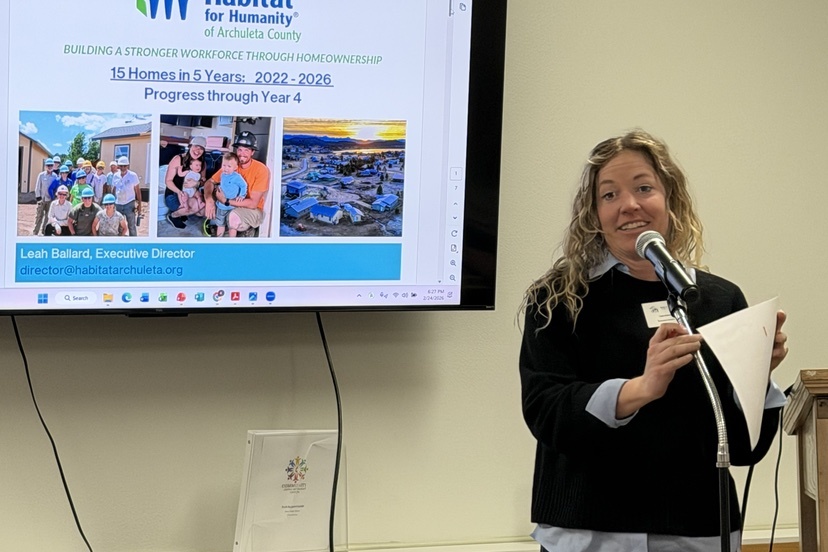
Photo: Leah Ballard, executive director at Habitat for Humanity of Archuleta County, shares information at last Tuesday’s League of Women Voters meeting about her organization’s expanded effort to build 15 affordable homes in just 5 years. Photo by Cathleen Giovannini.
As I mentioned in Part One, I missed President Trump’s ‘State of the Union’ speech on Tuesday evening. I was participating that evening in a presentation about the housing crisis in Archuleta County hosted by the League of Women Voters (LWV) of Archuleta County. The event was held, appropriately enough, at Community United Methodist Church. Appropriately, because our community is very much “united” in an agreement that housing is a severe problem in Pagosa Springs.
Which doesn’t necessarily mean we are “united” in agreeing how to address the problem. But we agree that there’s a problem.
I had the privilege of introducing the topic with some PowerPoint slides, illustrating a few of the factors contributing to the crisis.
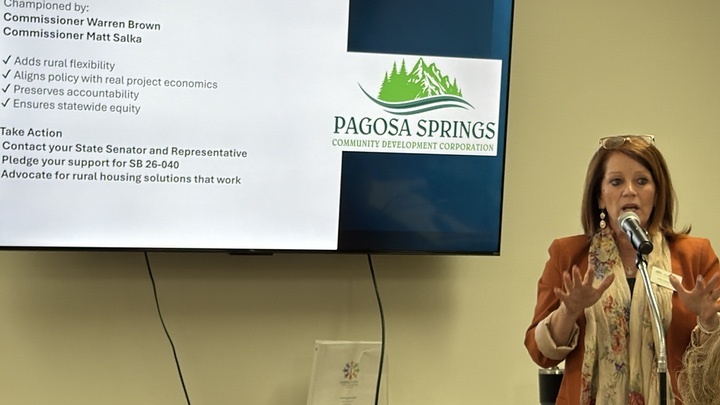
Next up with her slides was Emily Lashbrooke, executive director of the non-profit Pagosa Springs Community Development Corporation, more affectionately known as the CDC. A couple of years ago, the CDC — guided by a volunteer board of directors — received a donation from the Archuleta Board of County Commissioners of 35 vacant “tax lien” parcels in the Trails and Chris Mountain subdivisions west of town, and they set out to build 35 single family homes. With the help of state grants, the CDC also funded infrastructure improvements to those two subdivisions.
Lack of infrastructure — in particular, roads and electricity — had been a key reason why the previous property owners had neglected (forgotten? refused?) to pay the property taxes on those parcels.
Ms. Lashbrooke summarized the difficulties the CDC has faced, finding qualified buyers interested and able to purchase the first 10 homes completed in 2024, and her involvement in promoting changes to the Colorado law that directs the disbursement of Proposition 123 funding for affordable housing projects. She noted that she was headed to Denver this week to testify in favor of SB26-040, a bill that could alter the disbursement criteria for grants from the Colorado Department of Local Affairs, and possibly make it easier for rural communities to find qualified buyers.
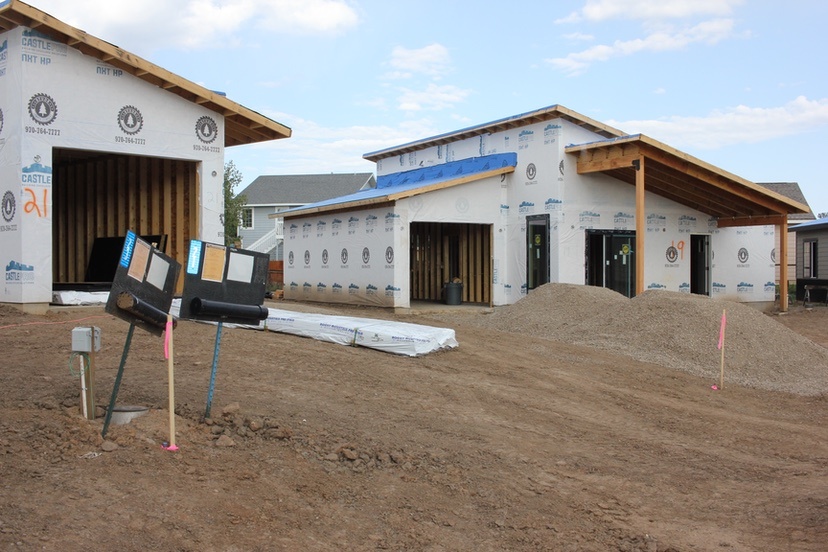
The CDC homes are being built by local construction company BWD Construction, and cost $340,000 and up, prices that most working households in Pagosa Springs cannot afford.
We might ask why homes like this cost $340,000. They are smaller that the older home Clarissa and I purchased in 1994 for $129,000 but cost almost three times as much.
Wages in Pagosa Springs have not tripled since 1994… but the average listing price of a home in Pagosa Springs is now $700,000, according to Zillow.com. Median home values (not listing prices) are about $550,000 as of 2026.
How can we understand this situation?
Here’s a detail from the Archuleta County zoning map. Brown indicates national forest and Southern Ute tribal lands. Dark green indicates “Agricultural Ranching”. Bright green is “Agricultural Estate”. Lavender is Pagosa Lakes Property Owners Association subdivisions and other “planned unit developments”. Orange is the Town of Pagosa Springs.

About 85% of the Pagosa Springs population live outside the Town of Pagosa Springs, where development is controlled by property owners associations or by Archuleta County land use regulations. More than half of those non-town households live within the Pagosa Lakes Property Owners Association subdivisions.
Another large chunk live in Aspen Springs, free from property owner association regulations but controlled by Archuleta County land use regulations.
Historically, the implicit goals of local property owners associations and the Archuleta County government are similar. To preserve the status quo and keep our community’s housing as expensive and profitable as possible.
For example, this statement in the Pagosa Lakes Property Owners Association (PLPOA) 2020 Strategic Plan:
It is critically important that owners are fully aware of the purpose of the Association and why one buys into such. The key factor is to protect property values by creating community guidelines by which all stakeholders operate. These governing criteria are what keeps communities like PLPOA aesthetically pleasing, focused on desired amenities and maintaining and enhancing property values…
How do you protect property values?
Primarily, by making affordable housing in your neighborhood illegal, or impractical.
I came across an interesting video the other day, showing President Donald Trump speaking at a recent Cabinet meeting.
We can’t be surprised by these comments. This has been the central goal of federal housing policy for decades: to drive up home prices and ensure that wealthy people can get even wealthier as their property value appreciates.
In 2024, the house that Clarissa and I bought in 1994 for $129,000 was valued by our County Assessor (for property tax purposes) at $650,000. We live in an historic downtown neighborhood where the homes were once affordable for working families like ours. If you bought into this neighborhood prior to about 1999, you’ve probably seen your property now become unaffordable for a newly-arrived family, unless they’re retired, with a substantial pension.
According to the Colorado State Demographers Office, Archuleta County lost population between 2023 and 2024.
I assume those were departing workers who can no longer afford to live here.
Is there something we can do about this?
Bill Hudson began sharing his opinions in the Pagosa Daily Post in 2004 and can't seem to break the habit. He claims that, in Pagosa Springs, opinions are like pickup trucks: everybody has one.