

Drawing: A detail from the 2004 “Conceptual Master Plan for the Preservation, Renewal and Revitalization of Historic Downtown Pagosa Springs”
A couple of weeks ago, I wrote about an interview that took place at the Davos conference center between a couple of intellectuals: historian and author Yuval Noah Harari, and Nikhil Kamath, co-founder of Zerodha, “India’s leading brokerage platform and trading community” during which Dr. Harari made an interesting observation about the current moment. He belongs to a school of historians who believe that human society is held together primarily by shared stories.
Apparently, it’s less important whether the stories are “true”. It’s more important that the stories are “shared”.
I’m thinking this morning about how the stories are shared. Are they written, and meant to be read? Or are they mostly spoken… and shared on social media, TV, radio, film…?
I understand President George Washington gave the first ‘State of the Union’ address to Congress in January, 1790. The address, to the gathered Congress — the Senate and the House of Representatives — began like this:
“I embrace with great satisfaction the opportunity which now presents itself, of congratulating you upon the present favorable prospects of our public affairs…”
The favorable prospects included “the concord, peace, and plenty with which we are blessed” which were, he said, “circumstances auspicious in an eminent degree to our national prosperity.” Perhaps even more important, he noted, was the recent ratification of the U.S. Constitution by the state of North Carolina, the twelfth state to ratify that guiding document.
The spoken address totaled 1,089 words — about the same number of words as are included in today’s editorial installment. For comparison purposes, the recent State of the Union address delivered by President Donald Trump on February 24 ran on for 10,599 words. Like Washington’s address, President Trump’s speech began with a comment about “favorable prospects…”
“Speaker Johnson, Vice President Vance, first lady of the United States, second lady of the United States, members of Congress and my fellow Americans, our nation is back: Bigger, better, richer and stronger than ever before…”
President Washington delivered total of eight spoken reports to Congress, and his successor, President John Adams, addressed Congress four times during his four years in office.
But our third President, Thomas Jefferson, felt that these prominent public addresses ran the risk of making the Chief Executive appear too much like a monarch — and if there was one thing Jefferson feared, it was the U.S. President being perceived as the King. So Jefferson altered the tradition by sending the Congress an annual written report, instead of making a speech. This new tradition lasted until 1913, when President Woodrow Wilson began once again delivering the annual message to Congress as a spoken address.
Would President Wilson have accomplished more… with a written report?
Here in Pagosa Springs, a group of local activists gathered in 2004 to create a new online news outlet: the Pagosa Daily Post. It was understood that the stories would be written rather than delivered as spoken podcasts, or videos. The era of podcasts and online videos was a ways off, in the future… and the written format has remained the choice 20 years later.
The first Daily Post stories were posted on December 1, 2026, and the ‘front page’ included several stories about a November presentation by the Community Vision Council — a private task force funded by, and appointed by, a relative newcomer to Pagosa: developer David Brown. Mr. Brown had made his millions converting orchards into shining new buildings with massive parking lots in California’s Silicon Valley. He installed his family at the Bootjack Ranch near the foot of Wolf Creek Pass and set out with a plan to convert downtown Pagosa Springs into a thriving tourist resort.
He assembled a small ‘council’ of Pagosa movers-and-shakers and hired a California architectural firm to redesign Pagosa Springs. The result was a “Conceptual Master Plan” for our historic downtown. You can download the Introduction here.
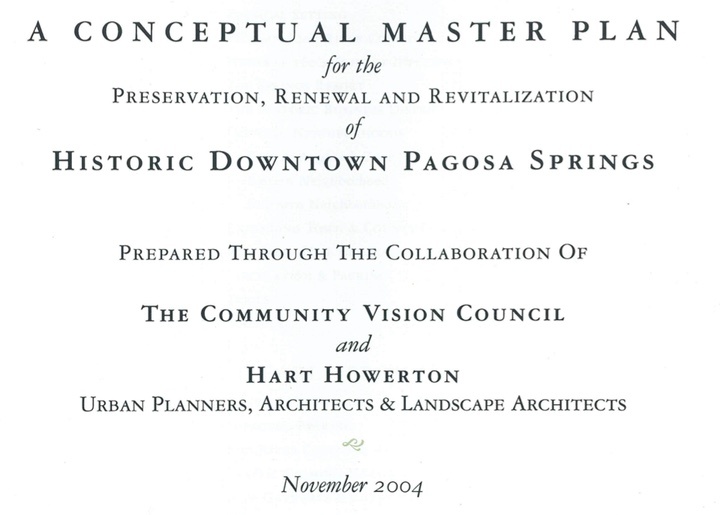
Mr. Brown then began purchasing some of the older properties facing on Highway 160 and tearing down the buildings, with the obvious intention of erecting more attractive buildings in the future. His Master Plan was adopted by the Town of Pagosa Springs, but he passed away before the plan could come to fruition — leaving numerous vacant lots facing on Highway 160 which remain vacant to this day.
Needless to say, not everyone was thrilled by Mr. Brown’s intention to re-make downtown Pagosa according to his personal tastes.
What strikes me as fascinating, is the extent to which Mr. Brown’s 2004 vision — although not “shared” by most people living in downtown Pagosa Springs — has remained a guiding document for the Town government. For example, this sketch below:

When this drawing was made in 2004, no footbridge was planned at First Street, and no trail existed heading south from First Street along the San Juan River. The trail along the river now exists, and the Town is designing a pedestrian bridge to cross the river at this exact location. These ‘improvements’ — we were told — would make the downtown more attractive to tourists.
This is not the only concept from the 2004 “Conceptual Plan” that the Town has implemented. Among the concepts from this plan that have been realized:
- Reconstruction of the 400 block of Lewis Street as a potential “Festival Street”
- New overlook platform across the river from the Chamber office
- Pedestrian bridge at 6th Street and development of wetlands ponds nearby
- Pedestrian bridge at Town Park
- Creation of Mary Fisher Park
- Artificial whitewater features in the San Juan River
- Lodging on South 5th Street overlooking the river
Curiously, the expensive planning effort funded by Mr. Brown is focused almost entirely on business and tourist resort development, and said little or nothing about where the workers — who would keep this revitalized economy going — would live.
As a result, the Town of Pagosa Springs spent the past 20 years focused on funding better ways to serve tourists… and paying little attention to a growing housing crisis…