
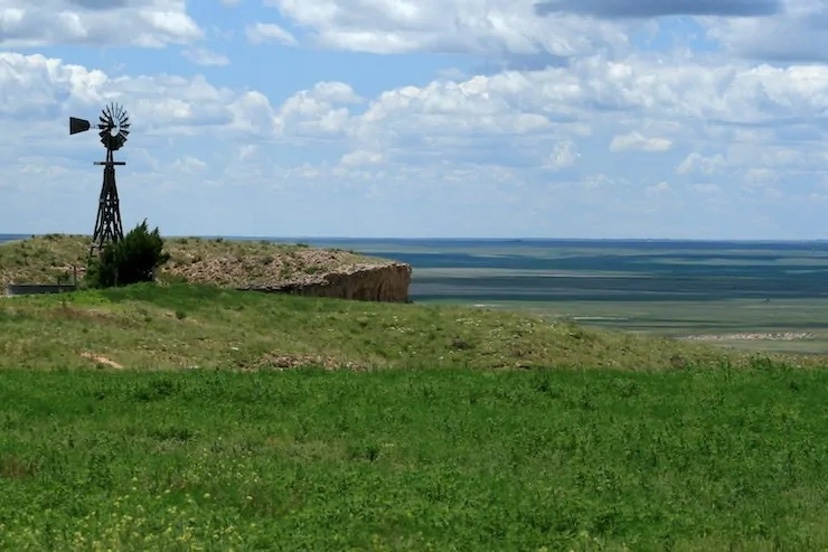
Photo/Don Best, looking south from the Peetz Table toward the area of the potential data center.
This story by Allen Best appeared on BigPivots.com on December 16, 2025. We are sharing it in two parts.
A data center that may soon be formally proposed in northeastern Colorado shocks me in its potential demand for electricity. A behemoth.
The data center may require up to two gigawatts of electricity, according to what is being said in Sterling, which is about 130 miles northeast of Denver.
To put that into perspective, Colorado Springs Utilities needed a little more than one gigawatt to meet its peak summer demand in July 2024. Tri-State Generation and Transmission, which provides power to 39 mostly rural electrical cooperatives spread across four states, including Colorado, has a peak demand of 2.5 gigawatts.
Wheat farms and grazing lands dominate the landscape where this center would go. Wheat land goes for $900 to $1,000 an acre, grazing lands maybe $800. Total capital investment, according to one speaker at a recent meeting, would be $15 billion.
I have thin but distinct roots in that area. In 1890, my grandfather was born in a sod house there on land homesteaded by his parents three years before. Those homesteading Riekes tried farming but soon turned to grazing cattle on the short-grass prairie in what they called the Kenesaw Valley, seen in the background in the above-photo. Within 15 years, they had moved to Sterling. My great-grandfather was elected county treasurer, I am guessing because he was a graduate of a business college in Illinois.
My grandparents — she was a Schmidt, similarly born of recent German immigrants — worked a farm irrigated by water from the South Platte River and grazed cattle on the prairie. My grandfather was elected a county commissioner four times, in the 1930s and again in the 1960s.
Since the late 1960s, when my grandparents sold their farm, Logan County’s population has strayed little from 20,000. Sterling has a junior college and, beginning in 1999, a prison.
On the county’s northern tier, an area along the Nebraska border called the Peetz Table, six to eight wind farms have been built since 2007, and Xcel Energy has indicated it may want to add more wind-generating capacity. The existing wind projects boost the county’s tax base by about $2.5 million annually.
“It’s not huge, but it’s nice,” says County Commissioner Mike Brownell.
Might this data center bring a new era of prosperity and modest population growth? And how real is this?
Granite Renewables began visiting with Logan County officials in late summer and early fall. The New York-based company says on its website that it develops project sites for “co-located data centers.” Having renewables on-site matters greatly. So does having access to natural gas and connections to the broader grid. This site seems to check the boxes.
“By combining the affordability of renewables and grid power with the reliability and redundancy of modular gas units, we deliver a secure energy supply as an improvement to centralized infrastructure,” the company says on its website.
It also offers these key words: resilience, sustainability, and energy independence.
Batteries are a component of Granite’s mission. At its website, the company says that from 2022 to 2024 it originated and developed a portfolio of eight projects in the Midwest that totaled 2.7 gigawatts of alternating current capacity.
Oddly, Google searches produce no mentions of the company save for the company’s website. But many of the companies mentioned in data center stories are not exactly household names.
Logan County in October declared a moratorium on data centers and battery storage as well as solar and wind development. They want to get regulations in place that protect the county’s best interests. Like nearly all of Colorado, the county has no data centers today.
The county’s planning commission has now recommended regulations covering data centers and battery storage to the county commissioners, who are scheduled to review the recommendations on January 6.
In Sterling, however, officials talk about 4,000 acres. Much of that land would presumably be used for solar farms along with battery storage and the hyperscale data center or centers. He also declined to identify the precise site, although the Sterling Journal-Advocate in an October report said it would be 21 miles northwest of Sterling. That would put it 8 to 10 miles from the Nebraska border and within a horse ride of where my ancestors broke the prairie sod.
Why in such a place?
Why this site in particular? By urban standards, Sterling itself is a very small town. But this site is far away from Sterling’s porchlights.
Wheat-growing land is typically cheap, making ample land available for renewable energy to develop along with proximity to gas supplies. Major gas lines lie parallel to Interstate 80, located within 30 miles in nearby Nebraska. And, of course, there would be few neighbors.
The Logan County commissioners, when I talked with them, also posed the idea of imported power, conceivably coal- or gas-generated power from Wyoming. How might that play with Colorado’s goals for emission reductions? We didn’t talk about it.
Colorado lags many other states in data centers, particularly Virginia and Texas but also next-door Wyoming. This lag causes angst among the utilities and economic boosters, who think Colorado needs to get in on the next big thing. A conference partially devoted to that quest was held Dec. 12 in Denver at the International Brotherhood of Electrical Workers headquarters. Electrical utilities were well represented on the several panels in this new alliance that challenges Colorado’s greenhouse gas goals.
Colorado already has many data centers but very few that fall under the heading of hyperscale. Definitions vary, but a building the size of a football field and with demand for 100 megawatts of electricity would make a data center hyperscale. In metropolitan Denver, the QTS project near I-70 and E-470 falls in that category. More now seem to be coming, mostly on the metropolitan area’s fringes, such as along Interstate 76.
Tri-State Generation and Transmission, though, sees a new future, a clear interest in rural areas, as chief executive Duane Highley told Big Pivots in early October. Tri-State provides electricity to Highland Electric, the cooperative that serves rural Logan County. Tri-State hopes to secure approval from the Federal Energy Regulatory Commission of an electrical rate attractive to data centers. It was rejected on procedural grounds in October but Tri-State plans to reapply in February.
Cheyenne has become home to many data centers. The National Center for Atmospheric Research installed what it called a supercomputer there in 2012 called Yellowstone. That raised eyebrows in Boulder, home base for NCAR. Yellowstone was replaced by an even more powerful computer in 2018.
Microsoft and Meta and other companies have more recently arrived in Wyoming. They mostly rank as hyperscale. More yet are arriving. In October, for example, Related Companies broke ground on a data center with an expected investment of $1.2 billion. A key client for the project will be New Jersey-based CoreWeave, which specializes in providing cloud-based graphics, explained the Wyoming Eagle Tribune.
Far larger is the 1.8-gigawatt artificial intelligence data center being built by digital-infrastructure company Crusoe. That, reported the Cowboy State Daily after the July groundbreaking, will make it the largest yet in Wyoming. That’s just a little smaller than the 2 gigawatts being discussed in Logan County. Crusoe’s data center at Cheyenne, though, is talking about the potential to scale up to 10 gigawatts. For comparison, Xcel Energy in its Colorado operations expects a demand of 8.6 gigawatts peak demand.
Crusoe’s operation is to be powered by natural gas and to have a carbon capture component. Wyoming has no greenhouse gas reduction targets, but Cheyenne lies just 17 miles from the Colorado border.
“A race is on right now to build out artificial intelligence data centers all over the country and the world. That makes this moment a generational opportunity. But the state faces challenges when it comes to fully capitalizing on that opportunity,” observed the Cowboy State Daily.
Allen Best publishes the e-journal Big Pivots, which chronicles the energy transition in Colorado and beyond.