
Ensuring sufficient water supplies in the American West has been, historically, a challenge. The average annual rainfall in Colorado, for example, is around 17 inches. Compare that to Arkansas (50 inches) and Georgia (50 inches) and Ohio (36 inches) and we can appreciate the classic Western aphorism: “Whiskey is for drinking; water is for fighting.”
The seven states that divert water from the Colorado River — Colorado, Wyoming, New Mexico, Utah, Nevada, Arizona and California — have been fighting for several years now about how to allocate that water, now that the 1922 Colorado River Compact agreement no longer seems functionally appropriate.
Which is to say that, generally speaking, agreements from the past, related to water, may no longer be functionally appropriate in the American West. Instead, we may be in for a period of fighting, not only between ranchers and oil companies and municipal water districts, but also between individual government agencies.
When we consider water resources in the Upper San Juan River watershed, one particular agreement is currently subject to a legal battle. In 2008, the Pagosa Area Water and Sanitation District (PAWSD) entered into an arrangement with the San Juan Water Conservancy District (SJWCD) to jointly purchase a 660-acre ranch north of downtown Pagosa Springs, as the site for a planned 35,000-acre-foot reservoir. Based on municipal water demand in Archuleta County in 2008, this would have been sufficient water storage for a community of about 160,000 residents…
…nearly twice the current size of Santa Fe, New Mexico (90,000)… and considerably more than the population of Boulder, Colorado (104,000).
That agreement was modified in 2010 when the Colorado Supreme Court rejected the water rights application as “speculative”. A stipulated settlement set the maximum reservoir size at 11,000 acre-feet.
The two water districts again modified their agreement in 2016, when PAWSD granted SJWCD twenty years to find a new partner to help fund the project. PAWSD had determined, four years earlier, that the Dry Gulch Reservoir project was neither feasible nor prudent as a source of municipal water storage.
But the SJWCD Board continued to believe an 11,000-acre-foot reservoir was both feasible and prudent.
The two districts are now fighting in court to determine whether PAWSD has the right to sell the ranch to a potential purchaser who has expressed a willingness to help fund a community reservoir, while also relieving PAWSD customers of about $10.2 million in financial debt.
SJWCD, as a joint tenant of the Running Iron Ranch, has refused to allow the sale.
Perhaps the two districts need a new agreement?
Disclosure: I currently serve on the PAWSD Board of Directors, but this editorial reflects only my own opinions, and not necessarily the options of the PAWSD Board as a whole, or the PAWSD staff.
Let’s take a look at the section from the 2016 agreement mentioned yesterday in Part Two:
…As Project leader, the SJWCD, in consultation with the CWCB and PAWSD, shall:
4.5.2.2. have the authority to use its best efforts, given the resources available, to take steps and actions to move the Project forward, including to attempt to acquire land necessary for the Project pool basin or to facilitate a land exchange with the U.S. Forest Service or others, pursuant to Paragraph 4.5.3 below; and
4.5.2.2. promote and develop additional Project stakeholders; and
4.5.2.3. take the lead on future water court proceedings in applications for reasonable diligence and other measures reasonable and appropriate to proceed with the Project; and
4.5.2.4. provide day-to-day management and Project facilitation as needed.
The agreement grants SJWCD the authority to do several important things… given the resources available.
First of all, SJWCD is to use its best efforts to “acquire land necessary for the Project pool basin…”
If you look at the SJWCD map of the project, you will notice that the planned Dry Gulch Reservoir does not fit on the Running Iron Ranch, but rather, extends onto property owned by the U.S. Forest Service (San Juan National Forest) and by the Laverty family. Those non-Ranch properties are mark in purple.
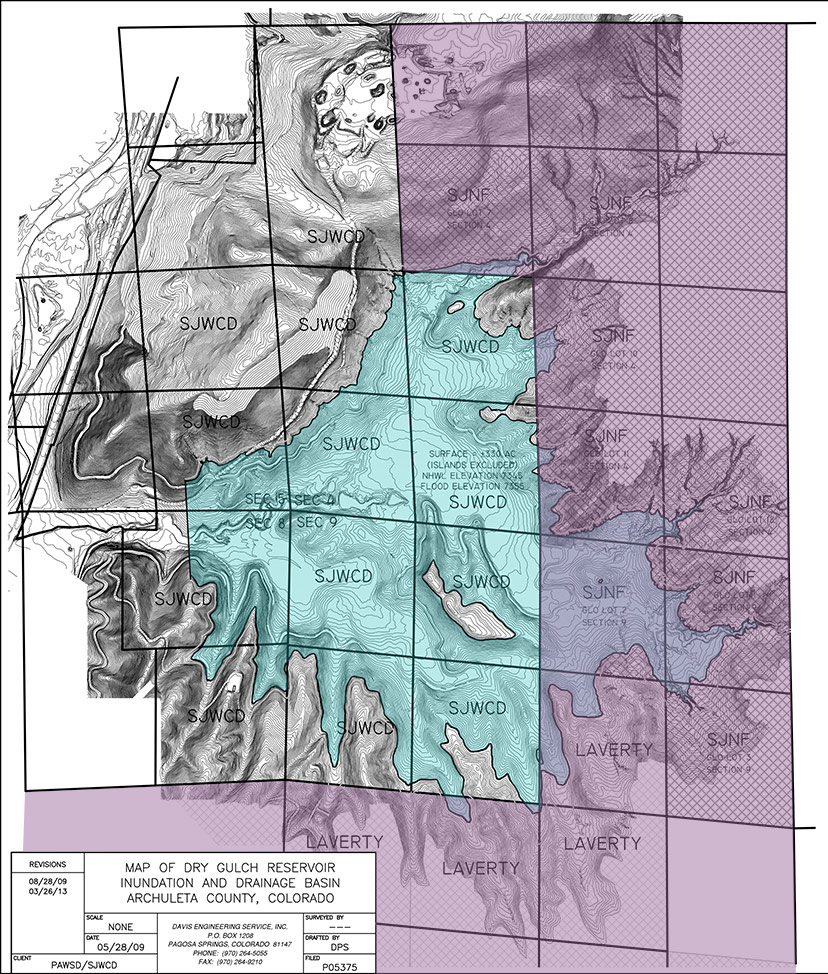
The fact that the Project does not fit on the Running Iron Ranch has been well recognized since 2007. So one of the primary jobs for which SJWCD was authorized in 2016 was to acquire the remaining necessary land to accommodate the Project.
Since 2016, SJWCD has spent hundreds of thousands of taxpayer dollars on legal fees and engineering reports related to the Project… but has still not acquired the land necessary.
This strikes me — and perhaps you too, dear reader — as slightly crazy. Somewhat similar to a family spending hundreds of thousands of dollars to have a mansion designed by an architect, when they don’t own the necessary land on which to build the mansion.
This curious behavior by SJWCD may help folks understand why the PAWSD Board has determined that the Dry Gulch Reservoir Project is nether feasible nor prudent.
Also, we might note this part of the agreement:
…As Project leader, the SJWCD, in consultation with the CWCB and PAWSD, shall:
PAWSD owns a 90% interest in the Running Iron Ranch. Nothing can happen on the Ranch without the approval of the PAWSD Board.
One might think, then, that the SJWCD Board would be religious about consulting with the PAWSD Board — and with CWCB (Colorado Water Conservation Board) — as they make decisions related to the Dry Gulch Reservoir project. As required by the 2016 agreement.
I don’t know if the SJWCD Board has consulted with CWCB since 2016. I would certainly hope so.
But as far as I know — having served continuously on either the SJWCD Board or on the PAWSD Board over the past 7 years — the SJWCD Board has never once sought a confirmation from the PAWSD Board, related to the design of the Project.