
Based on the agenda description, I had expected the December 9 report to the Archuleta Board of County Commissioners, by La Plata Electric Association CEO Chris Hansen and LPEA Board President Nicole Pitcher, to be relatively non-controversial, like most of the reports I hear delivered to the BOCC.
But the fact that the Commission meeting room already had a full audience by the time I arrived, should have been a warning that a controversy was at hand. And if I had noticed Jack and Rosemary Barrett sitting in the front row of the audience, I might have put two and two together.
The Barretts own a 10-acre parcel that they purchased in 2005 from Betty Farrow, just a few hundred yards west of where Highway 160 crosses the Piedra River. The property included a house built in 1959. A high-voltage 69 kVolt (69,000 Volt) power line runs through the property. Mr. Hansen had mentioned, during his presentation, that LPEA intends to upgrade that line to 115 kV — to better serve Archuleta County customers, he explained.
But after “several years” of negotiating with the Barretts and visits to the property by LPEA staff, LPEA has failed to come to an agreement about the placement of the proposed power line upgrade. Apparently, LPEA’s preferred route comes very close to the Barretts’ house.
The existing 69 kV line also crosses near the house. Reportedly, that power line was in place before the house was built.
Last summer, the Barretts began communicating with the Archuleta BOCC in hopes that the commissioners could help bring about a resolution to the conflict, which appears headed for District Court.
On October 14, LPEA filed a condemnation petition against the Barretts, and that threat was discussed at a BOCC work session on October 21. According to a story by Clayton Chaney in the Pagosa Springs SUN, the petition states:
Petitioner has determined that acquisition of the Easement is necessary for the uses stated herein and has approved by Board Resolution No. 2024-15 dated November 20, 2024, acquisition of the Easement through the exercise of eminent domain.
At that work session, Commissioner John Ranson stated that LPEA “couldn’t find” the recorded easements that allowed the existing 69 kV line to cross the property. He also expressed frustration with LPEA’s responsiveness. Commissioner Veronica Medina also complained about LPEA’s lack of prompt communication.
“I don’t want this to be an easy process for LPEA to do this,” she stated.
Mr. Ranson described the situation as a “classic example of a big entity trying to take advantage of people.”
This may be one way to describe the situation, except that the “big entity” is a membership co-op, owned by the LPEA customers of Archuleta and La Plata counties. An alternate description would be “a classic example of a private property owner standing in the way of necessary public infrastructure meant to serve all of Archuleta County.”
However, during the December 9 work session, we heard CEO Hansen describe two alternate routes that would move the power line away from the Barretts’ house. One route would cross the highway and travel through an adjacent vacant property, owned by “GMK Ranch LLC” (according to the County Assessor’s map.) The Barretts had testified at an earlier meeting that this neighboring property owner is willing to grant an easement for the power line, and the neighbor actually prefers this route.
According to CEO Hansen, LPEA is willing to adopt this alternate route — but it would cost an estimated $300,000 additional to accommodate the Barretts’ preference.
Who would pay this estimated $300,000 cost? LPEA believes the Barretts ought to pay it.
Chris Hansen:
“Let’s assume that number is right. About $300,000. To move from our existing easement to a new path, that change is the responsibility of the property owner who wants the change. Because we always start with our existing easement, which in this case we’ve had since 1953 — that line as been there since 1953 — and that’s our starting point. Now, if we need to change the route because of a new building, or whatever it might be, or in a case where they desire it not be on their property, that is the responsibility of the member.
“We don’t ‘socialize’ that cost across all of the membership.”
A second ‘alternate route’ would involve directing the high voltage line through the adjacent property.
Commissioner Ranson invited Mr. Barrett to comment on the issue. Mr. Barrett made it clear that the ‘second alternative’ — through the neighbors’ property — was not acceptable to the neighbor. He also offered several reasons for diverting the lines and poles to the opposite side of the highway, but gave no indication that he and his wife were willing to pay the estimated $300,000 to make that happen.
Mr. Barrett:
“It’s not the pretty picture that was painted by Chris this morning.
“Nor was it a pretty picture, that Amanda Anderson was quoted in the news article, form the last time we were talking with you about this.”
In a November 12 email to the SUN, LPEA Strategic Communications Officer Amanda Anderson wrote:
LPEA has been communicating with the Barretts for several years to secure the easement needed for this project. We are saddened that multiple years of trying to find a mutually beneficial solution have not resulted in a voluntary agreement.
After extensive discussions and multiple offers, LPEA filed a petition for condemnation on October 14, 2025, to acquire the necessary easement under Colorado law. The case is currently moving through the standard legal process.
So here we were, on December 9, with the LPEA leadership sitting across the table from Commissioners Warren Brown and John Ranson, with Commissioner Veronica Medina on a Zoom call… and an opportunity to discuss this challenging situation.
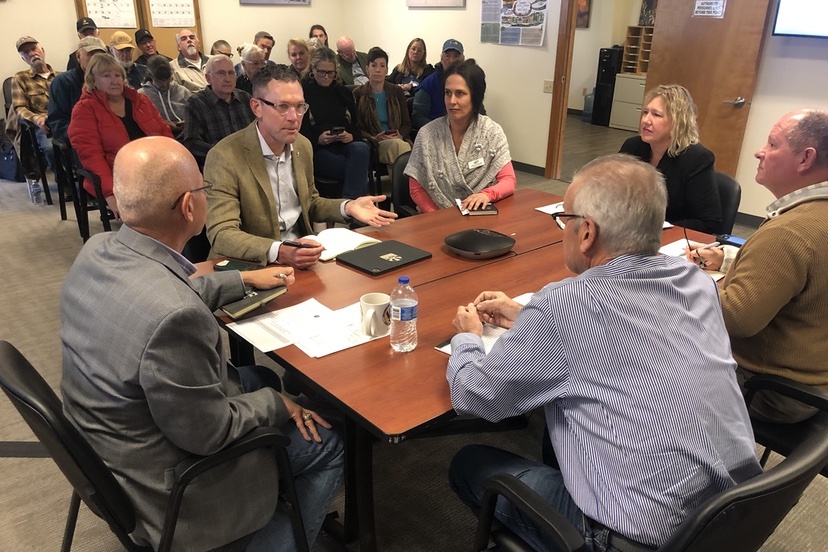
Commissioner Warren Brown, who was chairing the meeting, noted that public testimony was not typically allowed during BOCC work session, and then he asked his fellow commissioners if they would like to hear a few comments from the packed audience.
Yes, they did want to hear from their constituents.
As we heard during audience comments, Jack Barrett is a Navy veteran, which perhaps helps explain the numerous local citizens who had attended the meeting to show their concern about his predicament, and some of whom are themselves veterans.
So let’s hear a few of those comments.