
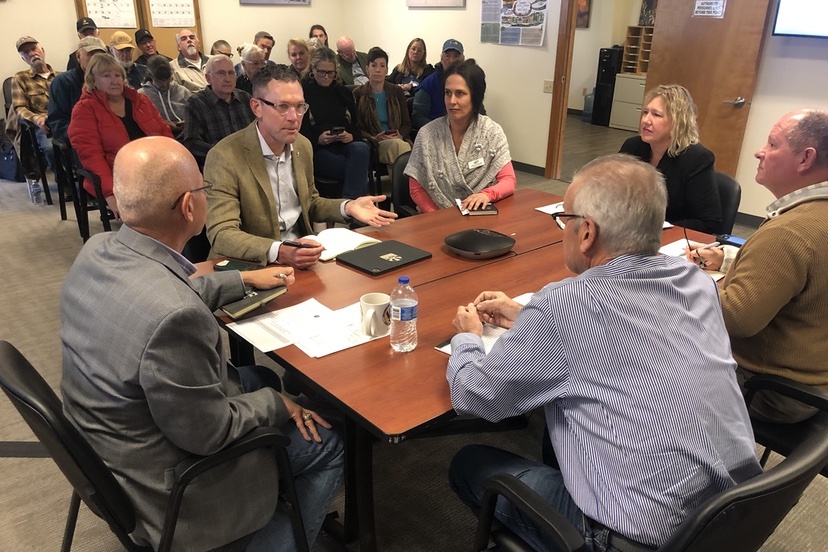
Photo: From far left, clockwise, Archuleta County Manager Longinos Gonzalez, LPEA CEO Chris Hansen, LPEA Board President Nicole Pitcher, County Attorney Cathleen Giovanini, Commissioner Warren Brown, Commissioner John Ranson; December 9, 2025.
La Plata Electric Association CEO Chris Hansen and LPEA Board President Nicole Pitcher sat down with the Archuleta Board of County Commissioners — Warren Brown, John Ranson and County staff (with Commissioner Veronica Medina attending via Zoom) — with the purported aim of sharing a report on LPEA projects in Archuleta County.
At least, that’s what was indicated on the work session agenda. The presentation began with CEO Hansen talking about the impressive upgrades that LPEA is making to the electric infrastructure in Archuleta County.
I didn’t fully understand why the audience was packed with older men and women. The only members of the public who typically attend BOCC work sessions are SUN reporter Clayton Chaney, local activist Lee Stopher, and myself. But this audience looked like a Vets 4 Vets meeting.
As it turned out, maybe it was indeed a Vets 4 Vets meeting, of sorts.
CEO Hansen noted that the LPEA team for this presentation included the Association’s legal counsel, Graham Smith, standing at the back of the room. In case legal questions arose.
As it turned out, legal questions did arise, but attorney Smith’s expertise was not sought.
Mr. Hansen briefly gave a brief overview of the new substation planned for Trujillo Road, and of the installation of new high voltage lines to be installed between Bayfield and Pagosa Springs. He stated that the new lines would improve reliability of service to Pagosa in case of damage from falling trees or wildfire. The high voltage lines are slated to pass through 25 large properties, and Mr. Hansen stated that easement agreements have been reached with 15 of those property owners.
As it turned out, it was exactly this new power line that was of interest to the gathered audience, and in particular, two of the audience members who are among the 25 property owners who will be affected by the high voltage upgrade, and who are among the 10 owners who have not yet reached an agreement with LPEA.
As a bit of background, LPEA is a non-profit cooperative association “owned” by the customers it serves. The customers elect the Board of Directors, and whenever the Association turns a yearly “profit” the excess is distributed to the membership. About 25 percent of the members live in Archuleta County; the remaining 75 percent live in La Plata County.
The job LPEA was formed to do — to deliver electricity to homes, schools, businesses and governments — is not exactly a political job. But “electricity” has become a political issue. Maybe it always was a political issue? At any rate, lately the politics have become more interesting, with people on the left of the political spectrum generally favoring a transition to renewable energy, and people on the right of the political spectrum generally favoring a more conservative approach, with continued reliance on fossil fuels — coal, oil, natural gas.
The lack of political agreement is centered on financial and environmental concerns.
Overall, La Plata County’s LPEA membership tends towards the left of the political spectrum. That’s 75% of LPEA membership. Archuleta County membership tends to be more conservative. In general.
The LPEA Board has taken a huge step, recently, to head in the “renewable energy” direction, by voting to leave the Tri-State Generation and Transmission cooperative, the four-state association of rural electric cooperatives that’s been providing wholesale electricity to LPEA for the past 50 years. (Don’t quote me on that duration.)
From the Tri-State Annual Report for 2024 (which you can download here.)
Focused on Our Path Forward
The value of Tri-State membership is unrivaled. Together with our members, we are focused on our mission, cooperative business model and future, delivering the reliable, affordable, flexible and responsible power and services that help rural communities thrive.
Here we have the key issues that member-owned electric cooperatives are currently facing. Is the electricity reliable? Generation from fossil fuels tends to be more reliable than from wind or solar. Even hydroelectricity is looking less reliable these days, with Lake Mead and Lake Powell at very low levels.
Another reliability issue relates to the fragility of long transmission lines. When your electricity is generated locally — perhaps from your own rooftop solar array — the issue of reliability looks different than when your electricity is coming from Kansas.
Is the electricity affordable? Generation from fossil fuels — the backbone of Tri-State’s generation capacity — was once more affordable that wind and solar. But that seems to have changed. From SmartEnergy.com:
Once seen as a pricey luxury, renewable energy is now often the lowest-cost power source on the grid. According to the International Renewable Energy Agency, the cost of utility-scale solar has dropped 88% since 2010, and wind is down nearly 70%.
Quick comparison (average cost per megawatt-hour in 2023):
- Wind: $30–$40
- Utility-scale solar: $25–$35
- Natural gas: $45–$70
- Coal: $70–$120
Winner: Renewables — more stable, less expensive over time.
Tri-State claims that they will be generating 70% of their electricity from “clean sources” by 2030.
And we have the “responsibility” issue. Is our electricity use contributing to ‘climate change’? Another common political disagreement.
The LPEA Board elected in March 2024 to pay about $210 million to buy out the contract with Tri-State… to become independent and able to buy wholesale electricity from the lowest-cost, most reliable sources. That decision appears to be the subject of a lawsuit filed by eight LPEA members, claiming that the decision to exit Tri-State should have been subject to a membership vote.
Despite the lower cost of renewable energy, many electricity suppliers are increasing costs to customers.
In November, the LPEA Board unanimously approved the cooperative’s 2026 budget, which includes no rate increase for members, even as Tri-State is implementing a rate hike that would have increased the average LPEA member’s bill $9 per month starting in January.
But these issues — reliability, affordability, responsibility — were not foremost on the minds of certain people who attended the December 9 BOCC work session. The central concern was an easement across a property owned by a couple of Archuleta County residents.
Was LPEA serving its members… at the expense of this local couple?