
After running through most of her Powerpoint slides at a November 18 presentation to the Archuleta Board of County Commissioners, Leah Ballard, Executive Director of Habitat for Humanity of Archuleta County, arrived at her “ask”. A request for financial support.
When non-profit organizations make presentations to the BOCC, they are most often seeking financial support out of the County’s $45 million budget. The commissioners sometimes agree to provide that support, and sometimes, do not.
Before we get to the “ask”, we can look at some of the information provided by Ms. Ballard, helping to explain the housing situation here in Archuleta County, and why Habitat decided to try and build 15 homes in 5 years, to serve workforce families.
First, this chart, from the Habitat Powerpoint presentation, copied from the Archuleta County Housing Needs Assessment, 2025 on page 84:
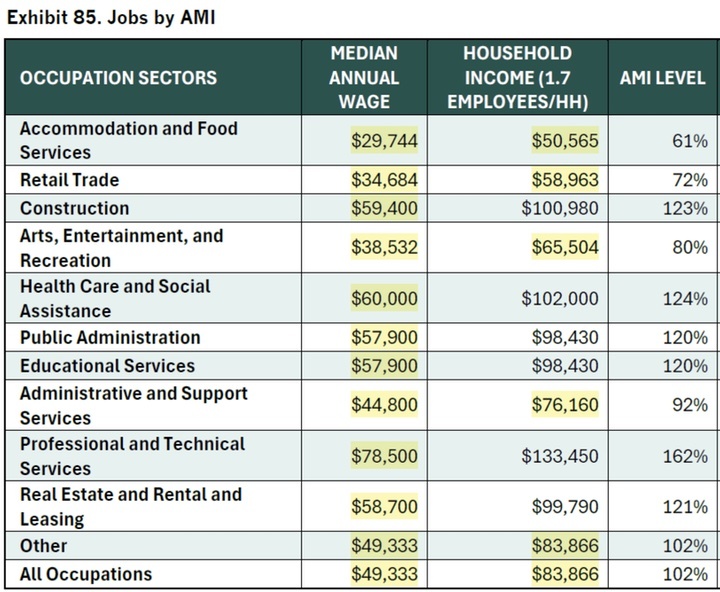
We’re looking at the job categories created by the federal government Bureau of Labor Statistics, and the estimated family income when the family includes two adults, one working full-time and one working 3/4 time, at the same type of job. Two restaurant workers, for example, or two school teachers, or two construction workers, etc.
The “AMI Level” is the typical earnings as a percentage of the Area Median Income.
The numbers in that chart are ‘averages’, of course, and ‘estimates’. But they are based on federal income tax information, so we can assume at least an underpinning of reality.
We might note the difference in family income between workers in “Accommodations and Food Services” (two workers earning a total of $50,565 per year) and “Public Administration” (two workers earning a total of $98,430 per year). This suggests that, essentially, our government workers are earning twice as much as the workers in our restaurant and lodging industries.
Twice as much. Let that sink in.
For people employed in retail trade, the disparity with government workers is similar, though not quite as dramatic.
Although this chart doesn’t tell us how many of our local workers are employed in “Accommodations and Food Services” and “Retail Trade” compared to “Public Administration”… Region 9 Economic Development District has supplied those numbers in the past.
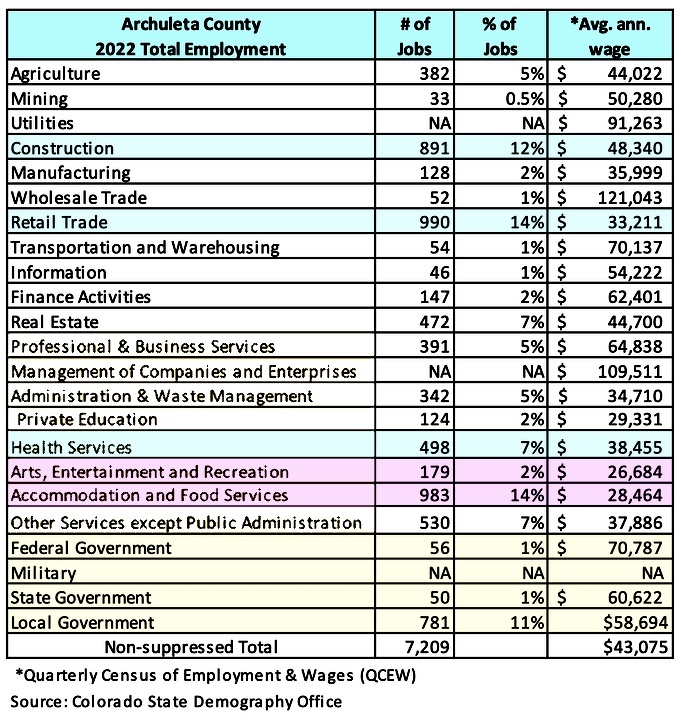
In Archuleta County, about 900 people have relatively high-paying jobs in government.
About 1,980 have relatively low-paying jobs in “Accommodations” and “Retail”.
Many families in Archuleta County struggle to pay $2,000 a month rent — a typical rental rate here — or a $2,000 monthly mortgage for a typical home in Pagosa Lakes. Even fewer have the necessary $75,000 to provide as a down payment on a home mortgage.
Single-parent families often struggle even more, for obvious reasons.
Habitat for Humanity has been building homes for struggling families for about 30 years, but up until 2022, they were building just one house per year. Next year, they are planning to build four homes. “That’s going to be a stretch,” Ms. Ballard admitted, “but I think we’re up for it.”
Habitat participated in a recent work session led by Colorado housing consultant Jennifer Kermode, where several Pagosa government and non-profit leaders discussed deed-restrictions and the best ways to incentivize workforce housing.
Ms. Ballard, addressing the BOCC on November 18:
“You guys were in those work sessions, too. And Ms. Kermode said, over and over again, that nobody is building for 80% AMI. Nobody can build for 80% of AMI. Well, we can. And we do. And the family’s mortgage payment is 30% of the gross monthly income. That’s the definition of an affordable homeownership program. And we have ‘net zero’ roof-top solar panels…”
Those panels can save a family $300 a month of electricity costs in an all-electric home.
“So we can pull this off… with donations of the land, and donations from our subcontractors. We have awesome support from the community.”
This unusual achievement of serving families, earning 80% AMI and below, is possible in part because of generous donations of vacant tax-lien properties by the BOCC.
A vacant parcel is a wonderful thing to own, if you’re planning to build a house. But it comes with strings attached. Financial strings. A vacant parcel in Pagosa Lakes, for example, owes annual property taxes, PLPOA association fees, and PAWSD water and sewer availability fees.
Ms. Ballard summarized the burden of these “holding costs” at her November 18 presentation.
Land holding costs
Habitat Archuleta currently owns $657,000 worth of vacant land! The vast majority of these parcels were donated by the BOCC to develop workforce home ownership opportunities.
2022 – six parcels owed $5,170
2023 – twenty parcels owed $15,369
2024 – twenty-six parcels owed $25,698 (less $5,028 reimbursed)
2025 – twenty-three parcels owed $28,233 (less $11,592 waived)
est 2026 – twenty parcels owed $23,386 (less $8,552 waived)
Habitat is looking forward to adding four more homes in 2026, and selling them at a remarkably reasonable price, to families earning 80% AMI or lower.
As we saw in the chart provided to the BOCC on November 18, these families are not likely to include two adults both working in our public school, or in our local hospital, or in real estate, or in construction, or in local government.
Such families might be called (and often are called) “The Missing Middle”. That is to say, middle-class families that earn too much to qualify for government-subsidized housing through tax programs like the federal Low-Income Housing Tax Credit (LIHTC) program, or for mortgages through USDA Rural Development.
When the Town of Pagosa Springs and the Archuleta County government funded a Housing Needs Assessment last year, as required by a new Colorado state law, it include this chart, also copied into Ms. Ballard’s Powerpoint slide presentation:
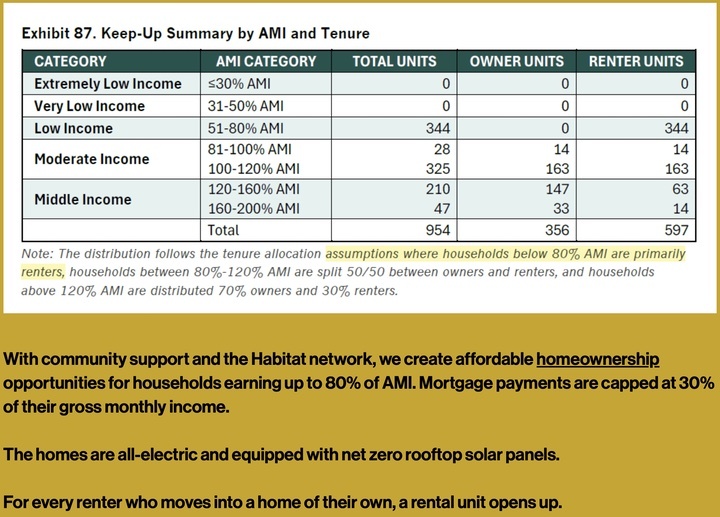
There are many interesting concepts implied by this slide. We will discuss them tomorrow in Part Four.
But to begin the discussion, we can look at the “AMI” segment in most serious need of help. “Low Income, 51-80% AMI”. An estimated need for 344 new homes in that price range.
Exactly the segment of our workforce being addressed by Habitat for Humanity.
And by no one else.