
This story by Allen Best appeared on BigPivots.com on November 13, 2025. We are sharing it in two parts.
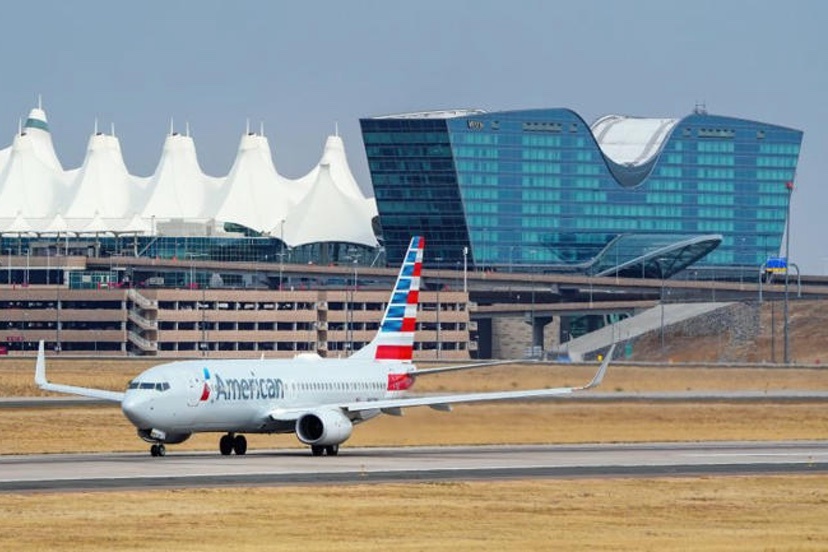
Denver International Airport, which proclaims itself the largest economic hub west of the Mississippi River, has begun investigating whether it can generate its own electricity to meet accelerating needs in the next 20 years.
In doing so, it would lessen, or conceivably end, dependence on its current supplier, Xcel Energy.
In January, the airport plans to formally post a request for information. It hopes to get proposals for everything from nuclear to geothermal to solar to… well… that is the purpose of this request. The airport, which is owned by the City of Denver, wants to gather ideas, including new ones.
The airport now uses 45 megawatts of electricity, but it sees potential future need for 300 to 400 megawatts of electrical generation.
This projected need for 300 to 400 megawatts compares with the peak demand of 295 megawatts of Holy Cross Energy, which provides electricity for the Vail and Aspen areas. Platte River Power Authority has peak demand of 707 megawatts from its four member municipalities along the northern Front Range. Those four cities have a combined population of about 360,000 people.
Projected passenger numbers provide one measure of expanded needs. The airport was designed for 50 million annual passengers but in 2024 accommodated 82.3 million. It expects 120 million passengers by 2045, when the airport will celebrate a half-century of operations.
Other components of air traffic — most immediately air taxis that use the airport — will want more electricity, likely in the next decade. Air cargo will also expand.
At a community meeting on November 5, Phil Washington, the chief executive, also said that DIA is working with a financial firm to help determine how sites within the airport complex can be developed with “horizontal infrastructure,” meaning water and sewer, fiber and other necessities. That includes electricity.
DIA is currently focused on developing 1,500 acres, primarily along Peña Boulevard. This is among 16,000-plus acres of non-aviation land available for compatible commercial development. Data centers have also been mentioned as a possibility.
Vehicle electrification is part of broad market trend, but this also fits in with Denver’s aspirations: it aims to be carbon-neutral in energy by 2040. DIA aims to be the greenest airport in the world.
Denver’s green ambitions would seem to rule out new natural gas plants, as were deployed by the Pittsburg airport in 2021 in an effort to create greater self-sufficiency. In theory, carbon capture and sequestration could be used with natural gas generation. In practice, the economics remain daunting.
Why does DIA think it needs to look beyond Xcel Energy? Phil Washington, the chief executive, explained the reasoning somewhat obliquely at a community outreach meeting on November 5.
“We’re thinking about energy capacity because we feel like … we are concerned that we are building at a rate where supply will be an issue.”
This, Washington took pains to say, is “no knock on any specific or particular energy provider; we love them all — but we love the one that we know best.” The one that it would know best is presumably the one it controls.
Later, after several more assertions about supply worries, the Q&A part of the meeting arrived. I asked what seemed to me to be an elephant-sized question in the room:
“What is the evidence that your current provider will be unable to provide the power you need?” I asked.
“I don’t have any evidence,” Washington replied. “We have been working with Xcel Energy. So I don’t have any evidence. We’re doing this because we want to be sure that we have power. That’s the only answer I can give.”
The meeting, the third in the outreach series, was held at the Westin hotel adjacent to the airport terminal. A buffet was part of the evening. The hotel’s green chili was excellent, but I also decided a sandwich was in order. I wasn’t wearing glasses. What I thought was going to be a “roast beef sandwich” turned out to be, once I had sat down at my seat, a “red beet sandwich.”
That was a first for me.
As for the buffet, it was part of DIA’s outreach after an abortive effort last summer to solicit bids about potential nuclear energy at the airport.
Small modular reactors?
DIA announced in August that it planned to spend $1.25 million for a study that would examine the potential to build a small modular reactor somewhere on the airport’s property. It has 53 square miles, the second most of any airport in the world.
“Denver leads with bold ideas, and our vision for the future of our airport is no exception,” said Denver Mayor Mike Johnston in the news release posted on August 6.
“SMRs are gaining traction as a clean energy source for their potential to offer a safe, more scalable and potentially cost-effective approach to generating nuclear power,” the announcement added. It went on to explain that nuclear could provide 24/7 baseload generation to complement renewable energy.
This announcement produced pushback from a Denver City Council member, and two weeks later the airport quietly shelved the proposed study.
The technology has momentum. Last summer, the Nuclear Energy Agency reported that $15 billion in public and private financing has been invested in the technology. Around the world, 74 designs are being pursued. Renewables have very strong legs, but something more — storage technologies or firm baseload — is needed.
In July, Canary Media explained the attraction to this technology: “With SMRs, the thinking goes, relatively smaller plants can be plopped down wherever energy is needed in the world, with factory-fabricated components used to cut down on supply chain and construction costs.”
But, after 50 years of development, the world currently has only two SMRs, one in China and the other in Russia. The Chinese, however, may be bending the cost curve.
Bryan Hannegan, the chief executive of Holy Cross Energy, told a forum on Tuesday evening that he’s open to nuclear.
“We’ve been running small modular reactors in our Navy all around the world for decades with nary a mishap, at least one that we know of,” he told the Empower Hour, a monthly session sponsored by the Boulder-based Empower Our Future.
“There’s every reason to think that it should be something that’s possible. And yet, every time we try to build a new nuclear reactor, whether it’s a large one like Vogel, or a small one like the one that was planned at the Idaho National Lab, the costs get out of control, the timeline slips.”
Hannegan said that costs rise and then utilities escape. That is what happened at NuScale’s small modular reactor project at Idaho National Laboratory in 2023. NuScale raised the target price for power from the SMR to $89 per megawatt-hour from $58. The Utah Associated Municipal Power Systems then pulled out.
“This is one where I’m not really willing to stick my neck out and be the first adopter. That being said, there’s perhaps a spot in the portfolio at some point if the community wants it, and that’s a big if…”
Allen Best publishes the e-journal Big Pivots, which chronicles the energy transition in Colorado and beyond.