
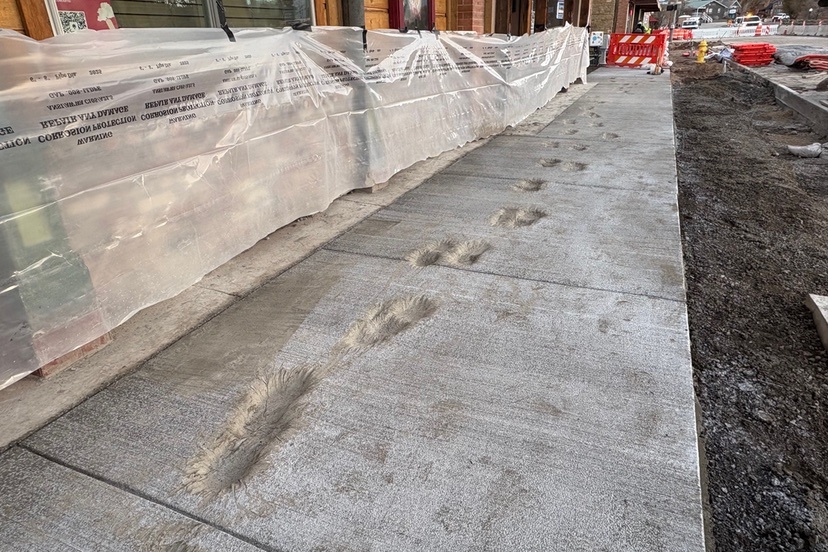
Photos courtesy Colorado Department of Transportation.
Sometime overnight between Tuesday, November 11, and the early hours of Wednesday, November 12, individuals entered the active construction zone along the 400 block of U.S. 160 and walked through newly poured concrete sidewalk in front of the Liberty Theatre and Galles Real Estate…
— from a Colorado Department of Transportation (CDOT) press release, November 12, 2025.
The construction team working for WW Clyde has been pouring new sidewalks in downtown Pagosa Springs, as part of the two-year Highway 160 reconstruction project slated to be completed by late autumn of 2026. Many in the community have expressed their hopes that a two-year project doesn’t become a three-year project, as happened with the McCabe Bridge project a few years ago.
It hardly helps matters when individuals purposely choose to vandalize freshly poured sidewalks.
“This act of vandalism is not a harmless prank — it’s a costly setback,” said CDOT Regional Program Engineer Kevin Curry. “The damage to the newly poured sidewalk will require full removal and replacement, adding unnecessary expense and delay to the project.”
The estimated cost of repairs exceeds $10,000, including demolition, replacement, and additional labor. Crews will now have to remove the damaged concrete and repour the affected section, diverting time and resources from other planned work.
To minimize the lack of access to businesses fronting Highway 160 while the sidewalks are poured, CDOT has specified a special quick-drying concrete for the sidewalks.
A photo sent out by CDOT seemingly indicates a correlation between the damaged sidewalk and the movies currently showing at the Liberty Theater.
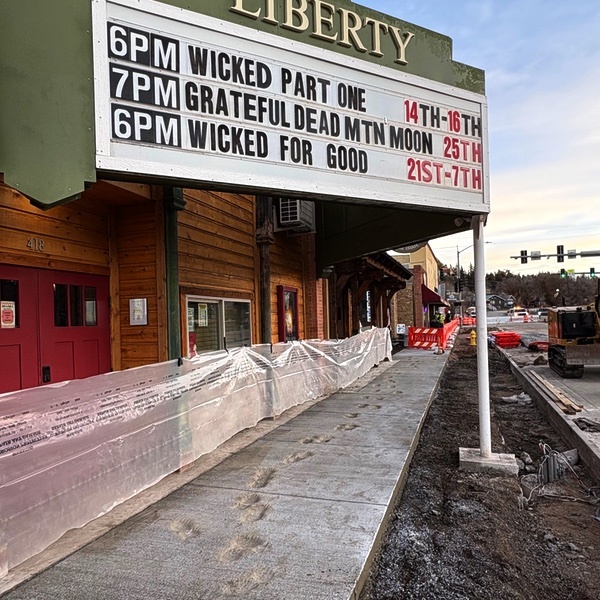
This morning, I’m thinking of some different analogies for “walking in wet cement”.
The Pagosa Area Water and Sanitation District — PAWSD — held a public meeting yesterday afternoon, attended by a handful of customers. The main topics for discussion:
3. Discussion Regarding Draft 2026 Budget
4. Consideration of 2026 Water and Wastewater Affordable Housing Surcharges
5. Consideration of Employment Agreement for District Manager Position – Andrew Connor
6. Update Regarding Water Loss Efforts
Disclosure: I currently serve as a volunteer member of the PAWSD Board of Directors, but this editorial reflects only my own opinions, and not necessarily the opinions of the PAWSD Board or staff.
At the start of the meeting, the Board agreed to modify the agenda and discuss the “2026 Water and Wastewater Affordable Housing Surcharges” first, before diving into the 2026 Budget discussion. PAWSD has been charging customers a small “surcharge” for their water service and sewer service, to help “balance” the budget when the Board decides to waive certain development fees for deed-restricted workforce housing projects. Those waivers totaled about $1.0 million in 2024, and about $76,000 in 2025… and appear as “losses” to the District in past budgets… only partly covered by the “surcharges”.
The analogy to wet cement being: once a government puts a tax or a fee in place, it typically stays there forever.
So it’s perhaps interesting that at yesterday’s PAWSD meeting, the five directors — Gene Tautges, Alex Boehmer, Glenn Walsh, Bruce Jones and myself — unanimously agreed to eliminate the monthly surcharges.
The reasons for eliminating the fees varied among the Directors. Mr. Walsh has long argued that the waivers do not actually “cost” the District any money, because certain workforce housing projects in Archuleta County cannot afford the current $25,000-per-unit fees and simply will not happen unless PAWSD waives those fees. Once built, however, the new homes begin paying regular monthly water and sewer fees, which benefits the District.
Other Directors have disliked the surcharges for other philosophical reasons.
The removal of the housing surcharge potentially reflects a related intention, on the part of the Board, to cease giving waivers for workforce housing projects. But that remains to be seen.
Staff was directed to prepare a resolution that will officially remove the surcharge from customer bills in 2026.
The Board then moved on to the budget discussion, asking questions and making suggestions prior to the final budget approval in December.
PAWSD maintains three funds in its budget. The General Fund is funded largely through property taxes and basically covers the cost of the Administrative staff. Expenses for 2026 total about $1.7 million in the draft budget, slightly higher than the $1.4 million spent in 2024. (I’m comparing to 2024 because 2025 is still ‘in progress’.)
The Water Fund is financed mainly through monthly fees, to provide water service throughout most of Archuleta County. Expenses for 2026 total about $12.1 million in the draft budget. This is a huge drop from the $29.4 million spent in 2024.
The Wastewater Fund provides sewer service mainly to the Pagosa Lakes area and to the Town of Pagosa Springs. Expenses total about $10.4 million in the 2026 draft budget. This is a huge increase from 2024, when PAWSD spent $4.2 million for this service.
You can download the PAWSD draft budget here.
The Board was not completely comfortable with the draft budget, so we might see additional adjustments in December.
At yesterday’s meeting, the Board also approved an employment agreement with Andy Connor as the new District Manager. Mr. Connor later gave a summary of the District’s efforts to locate and repair water leaks. Those leaks typically result in substantial loss of treated drinking water before it reaches customer faucets, generally fluctuating between about 20% and 40% of the treated water.
Daily Post readers may have been following the difficult negotiations taking place among the seven states and the dozens of sovereign Tribes that divert water from the Colorado River. The San Juan River and its tributaries are part of that Colorado River system, and it’s not clear if those negotiations will eventually impact the way PAWSD allocates water to customers, or the way agricultural users in Archuleta County are allocated irrigation water.
The cement is not yet dry.
The PAWSD Board meeting wasn’t the only meeting I attended this week, however. More on Monday.