
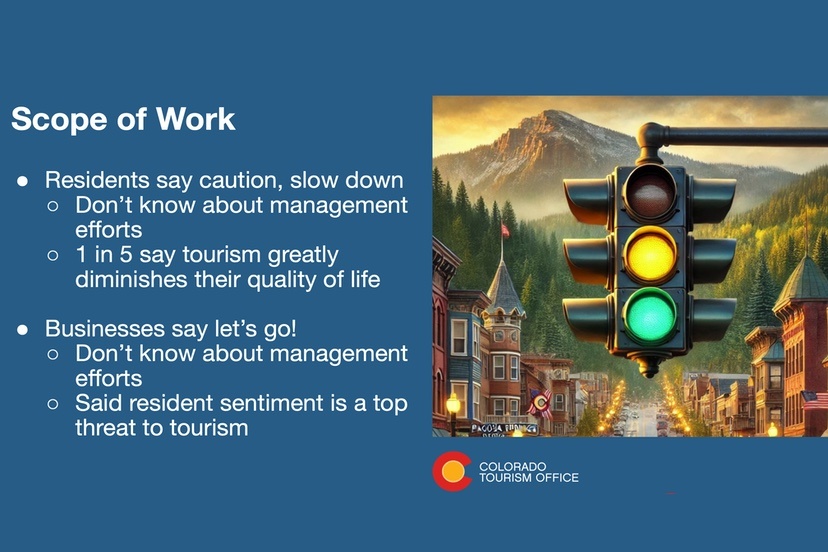
In the Powerpoint slide shown above taken from the Pagosa Springs Tourism Department’s “Destination Master Plan”, we note that in a recent survey, many Archuleta County residents said they wanted our local governments to refrain from attempts to increase tourism. One in five respondents felt that the existing tourism industry “greatly diminishes” their quality of life.
But our Town and County governments continue to collect Lodgers Tax from tourists. How best to serve the entire community with that revenue?
Other Colorado counties have been looking at ways to use Lodgers Tax to address other pressing needs, such as housing and child care, instead of spending every dollar to market tourism.
Prior to 2022, county governments in Colorado could collect a Lodgers Tax of no more than 2%, and they were required to spend the collected revenues on tourism marketing. In 2022, the Colorado legislature expanded the allowable uses, so county revenues to be used to benefit housing efforts and child care, as well as for tourism marketing.
Then, this year, the legislature changed the law again, to allow county governments to increase the Lodgers Tax to a maximum of 6% — with voter approval — and to use the revenues for additional community needs, including roads and public safety, also with voter approval.
Several Colorado counties took these ideas to their voters at this year’s November 4 election. Six counties increased their Lodgers Tax or created a new Lodgers Tax. Two counties rejected proposed increases.
Ouray county voters created a new 6% Lodgers Tax, to be used “to support our local workforce, quality of life, environmental health, and public safety…” Uses can include housing and child care.
Eagle County voters increased the existing tax from 2% to 4%, to support child care, public safety and emergency services.
Gilpin County voters approved an increase from 2% to 6%, for housing, child care, and public infrastructure.
Hinsdale County voters also tripled their tax to 6%, for child care, emergency medical services, search and rescue services.
Park County voters tripled their Lodgers Tax to 6% for roads, public safety, emergency services and tourism marketing.
Routt County voters likewise tripled their tax to 6%, for roads, public safety, and tourism promotion.
Voters in Chaffee County and in Custer County rejected proposed tax increases.
I mention these communities because the Archuleta Board of County Commissioners are also considering a future Lodgers Tax increase vote. The BOCC held two ‘public listening sessions’ last summer to hear from the public about that idea. (Within the town limits, the Town government independently collects a 4.9% Lodgers tax, but the County does not collect its tax.)
The attendance at the listening sessions was rather poor.

It was obvious by the second listening session that two of the commissioners wanted to wait until 2026 before putting a proposed increase before the voters here. What was less clear was how an increase might be used, if it were approved.
Last year, the County collected about $500,000 with a 1.9% Lodgers Tax. Assuming a stable tourism market, a voter-approved increase to 6% might generate a total of $1.5 million.
But we do not appear to have a stable tourism market at the moment, if you listen to the reports from the Pagosa Lodgers Association LLC.
On the other hand, if you look at the reports generated by the Pagosa Springs Area Tourism Board, the tourism market currently seems fairly healthy, and growing, based on Lodgers Tax collections in 2025.
Why two different stories? I guess there are always two sides to every story.
We’ve been sharing some quotes in this editorial series, taken from various discussions, concerning a proposal by County Commissioner John Ranson that the Pagosa Lodgers Association LLC should be provided annual subsidies by the Archuleta County government.
The Tourism Board — which currently benefits from 100% of the Archuleta County Lodgers Tax revenues and uses it for marketing and advertising — did not know about the discussions between the BOCC and the Lodgers Association until the topic was brought up at the November 5 Tourism Board meeting… by Lodgers Association member Sarah Mashue, who sits on the Tourism Board as the Association’s representative.
“I want to note that the Lodgers Association met with the County Commissioners this morning. We had a County Commissioner reach out to the Association, wanting to know if the Association would be interested in receiving funding from the County and how those might be utilized…” She noted that the Association Board met with the BOCC that very morning to discuss ideas.
Tourism Director Jennie Green mentioned that, according to the discussion, any such funding might possibly be diverted from the allocation currently provided to the Tourism Board.
Tourism Board member Shane Price:
“So the Lodgers Tax would go to the Lodgers Association?”
County Commissioner John Ranson, who sits on the Tourism Board:
“Depending on what they come up with, and what we come up with. We’re just interested if any kind of funding will help them with marketing. And I’ve said this before in this room, I believe strongly that two organizations doing marketing would be a good thing for this community. Increased sales tax, increase tourism tax. I think it’s a real positive.”
I must assume that Commissioner Ranson is not terribly familiar with the findings shared in the “Destination Master Plan”, indicating that our overall community doesn’t feel quite so “positive” about ever-increasing tourism, regardless of whatever sales tax the County might collect as a result.
We all know that too much of a good thing is not a good thing.
Needless to say, the Tourism Board discussion felt somewhat awkward, and not exactly “friendly”.
Bill Hudson began sharing his opinions in the Pagosa Daily Post in 2004 and can't seem to break the habit. He claims that, in Pagosa Springs, opinions are like pickup trucks: everybody has one.