
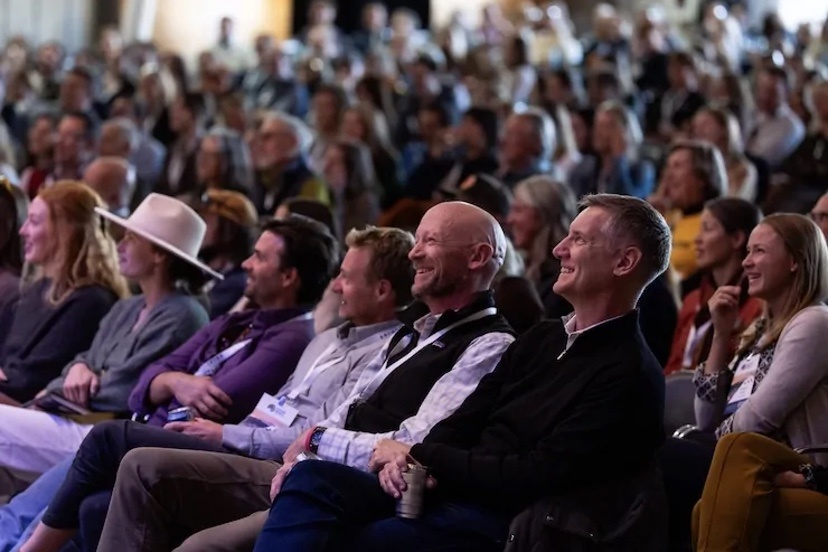
Photo: Park City’s Luke Cartin, second from right in the front row, was a driving force behind creation of Mountain Towns 2030. Jos Kusumoto Photograph.
This story by Allen Best appeared on BigPivots.com on October 20, 2025. We are sharing it in two parts.
More than 600 people attended the Mountain Towns 2030 Conference, held October 6-8 in Breckenridge with an impressive lineup of speakers. Afterward, I sent questions to Chris Steinkamp, the Boulder-based director of Mountain Towns 2030.
1) At your annual conference held this year in Breckenridge in early October, you had more than 600 registrants.
The majority of attendees came from Colorado and the Intermountain West, but we also welcomed participants from California, Washington, West Virginia, Vermont, Massachusetts, and more.
The Summit has grown steadily from about 250 attendees in 2019 to over 600 this year. Represented were 61 mountain communities and 37 ski resorts.
Our reach continues to grow, due not only to positive word of mouth but also to strong alliances with the National Ski Areas Association, Ski Area Management magazine and corporate partners Alterra Mountain Company, Vail Resorts, Boyne Resorts, and POWDR. These partners see these Summits as a unique opportunity to engage local resorts in the broader climate conversation while strengthening connections with their local communities.
Alaska Airlines also sponsored a scholarship program that brought community leaders to the Summit from California and Washington. These partnerships have been instrumental in growing both the size and impact of the summit.
2) What is the origin story for Mountain Towns 2030? How did it come together?
MT2030 was founded in 2019 in Park City, led by Mayor Andy Beerman, Ski Butlers founder Bryn Carey, local climate activist Eyee Hsu, and Luke Cartin, the sustainability manager for Park City Municipal.
Park City had just established a citywide goal of net-zero emissions of greenhouse gases by 2030, but they realized that real impact would only come if other mountain towns could do the same. By leveraging all the data and insights that Park City had, they could help other communities move quicker, driving systems-level change.
3) Why mountain towns? Why not Front Range cities, for example. Or some other unifying theme?
Mountain communities are truly on the front lines of climate change. With devastating wildfires, warmer and wetter winters, droughts happening all year — climate is a material threat to the future of our communities, our local economies, and our way of life. There is so much at stake. Every mountain community, regardless of location, is feeling the same pressure and generally deploying the same solutions. It’s a shared threat amongst us and a powerful unifying force.
4) What kind of cross-over is there between the ski industry and Mountain Towns 2030?
You can’t have a conversation about climate change in a ski town without the resort being involved. We’re focused on bringing all the key community stakeholders together (elected officials, municipal sustainability teams, resorts, local businesses and nonprofits) to share ideas, best practices, data and resources and without a doubt, the ski industry is critical part of that.
5) Mountain ski-based resort towns tend to be at the front edge of innovation — and sometimes problems, too. On the flip side, they tend to be risk takers. I was in Vail in the mid-1990s when Vail rolled the dice on what was called the first modern roundabout as a solution to its perplexing traffic situation at what was then called the four-way stop. I saw 45-minute waits during Christmas week. There were many prophecies of great disaster. Instead, it was an instant success. This roundabout was the first of its type in Colorado. Soon, they were omnipresent in Colorado and beyond. People visited Vail and saw how well that roundabout worked. Are there areas where you are seeing innovation in ski towns in response to the climate challenge?
A great example is the deployment of thermal energy networks. Several mountain communities are innovating with new system designs, financing and business models, and proving that this zero-carbon technology can succeed in various unique environments. The shared data and lessons from these projects are helping accelerate adoption in other towns and larger urban areas.
We know what to do. The solutions we need are not only available but proven. It’s just a matter of how quickly can we get it done?
6) How much overlap is there between Mountain Towns 2030 and the Colorado Association of Ski Towns — which also has membership from ski towns in Wyoming, Utah and Idaho?
Quite a bit. CAST has been a close partner of ours since MT2030’s launch in 2019. Elected officials are a critical part of our work. Many CAST members see great value in the conversations happening at the MT2030 Summit and I think we’ve introduced some new communities to the valuable CAST network. Therefore, we’ve made it a priority to coordinate closely with CAST so that our events are held consecutively, in the same venue, allowing mayors and other leaders to travel once for both gatherings. It’s worked well for both organizations.
7) Tell us about the underwriting and sponsorships of your conferences? Has that been a hard sell?
It’s not a hard sell. If it was, I’m not sure they’d be the right partner for us. Given this alignment, we work hard to make sure that corporate partners are an integral part of the Summit vs being just “sponsors.”
Several dozens sessions were devoted to everything form mitigatoin of metahen form the coal mines near Carbondale to the geothermal.
8) Is there an advocacy role for your organization in the state or federal levels?
Yes, absolutely. Elected officials and ski resort leaders have immense influence; with real, economic accounts of how climate change is impacting their communities and businesses. As constituents, they’re the best lobbyists, and the economic message they’re delivering is powerful for lawmakers to hear, from both sides of the aisle. Their unified voices have been missing in DC so we’re planning a lobby trip in spring 2026 to take these stories to Capitol Hill.
9) Again, I wonder about results. Are there other examples of collaboration and progress resulting from Mountain Towns 2030?
Yes, many. The Summit is designed to make those actionable, personal connections. For example, we have a ton of casual networking time built into the agenda, and work sessions are led by community peers so that the content is presented in a context that’s highly relevant and actionable with a personal connection for future conversations. If we can just share the successes from peer communities and enable those personal connections, good things happen.
Leaving the 2019 Summit, leaders from the Town of Breckenridge decided to push forward with an ambitious net-zero climate action and new housing development plan. A town council member who hadn’t previously prioritized climate action attended last week’s Summit and returned to her council meeting inspired, saying they all need to do more. Eagle, Colo., passed a net-zero resolution after the 2022 Summit, followed by Jackson, Wyo., Ridgway, Colo., and several others. We have dozens of anecdotal success stories that came from the content and personal connections made at the Summit.
10) Two years ago, at your conference in Vail, you had Jane Goodall. This year you had Bill McKibben speak — along with some other names that are nationally known, at least to those of us deeply engaged in the energy transition. What does it take to persuade speakers to travel to some mountain town in the West?
We always aim to bring in speakers who not only inspire but also deliver valuable, actionable insights to our audience. Having Bill McKibben join us in Breckenridge this year accomplished both.
Sure, coming to a beautiful mountain community in the fall is an easier sell than coming to an airport hotel conference, but the speakers we seek out are genuinely invested in this mission.
Also, the Summit has also earned a reputation as a well-run event and very different than a typical conference. Our attention to detail is a big reason our attendees return year after year and why so many speakers choose to come and stay for the week, to be part of the full experience.
11) Any tweaks for Mountain Towns 2030 that you might want to share?
We’re turning our focus to building out year-round programming. There’s tremendous value in bringing mountain community leaders together more than just once a year, so we’re planning a series of one-day regional events to foster ongoing collaboration and momentum. We’re also already gearing up for the 2026 Summit in Sun Valley, Idaho.
Allen Best publishes the e-journal Big Pivots, which chronicles the energy transition in Colorado and beyond.