
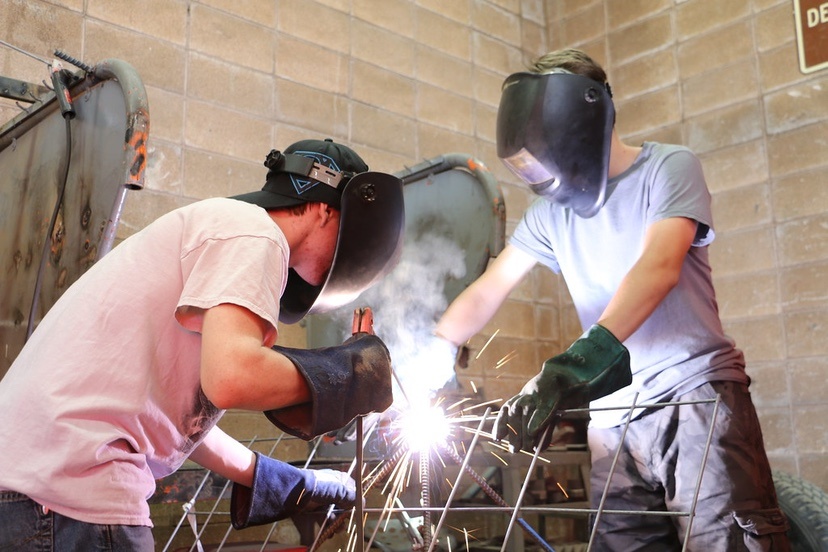
As the rural-retirement-tourist-destination of Pagosa Springs struggles to keep its economy on an even keel during the ongoing storms of financial and political uncertainty…
…the non-profit corporation known as ‘Build Pagosa’ managed on Tuesday evening to move an eight-year effort closer to the finish line, by getting a unanimous vote from the Archuleta School District 9ASD) Board of Education to help fund architectural and engineering design work, estimated at $420,000, for what might be a $6 million CTE facility on the grounds of the Pagosa Springs High School.
“CTE” meaning “Career and Technical Education”… training for high school age students in building trades, health care careers, culinary careers, and possibly other types of practical, non-college-oriented learning.
From the BuildPagosa.org website:
Economic Facts
- The Colorado economy is experiencing a skills gap.
- In southwest Colorado, approximately 57% of high school graduates from rural districts, including Archuleta County, do NOT enroll in college directly after graduation.
- Students choose community colleges for various reasons including affordability, proximity to home, and the pursuit of vocational or technical certifications. About 21% of southwest Colorado graduates attend 2-year institutions, or community colleges.
- Nearly 81% of dropouts say relevant, real-world learning opportunities would have kept them in high school.
- CTE programs offer crucial industry credentials that high schoolers can begin earning even before graduation, often through concurrent enrollment programs.
College is not for everyone, but a career with a liveable wage should be.
Let’s consider that last sentence.
“College is not for everyone, but a career with a liveable wage should be.”
Back in the 1990s, the Archuleta School District adopted the same ambitious goal being adopted by many American school districts: that every high school graduate would be college-ready. Educators had easy access to statistics showing that college graduates — although entering the job market later than their non-college peers — earned a higher total income over their lifetimes. On average.
A natural conclusion from that data: High schools should make every effort to send all graduates off to college, if possible. An unattainable goal, of course, but a goal nevertheless.
This is a perfect example of making decisions based on one important piece of data, and ignoring all other important pieces of data.
As part of that goal, ASD essentially stopped offering most of the “practical” trades-based programs that had been part of American high school offerings dating back to the early 1900s. Instead, the District designed its high school program to prepare all students for college.
The results, of this effort by American high schools to focus almost exclusively on academics and forego practical career-based education, were many.
For example, from the Build Pagosa website:
The gap between educational skills training available in rural Southwest Colorado and the urgent needs of our labor force is vast. In Archuleta County and beyond, Build Pagosa is bridging that gap and creating economic opportunities across the region by providing the facilities, equipment, and instructional resources for evidence-informed Career & Technical Education (CTE). Founded in 2017, we work through regional partnerships with education, industry, and community organizations to invest in high-impact CTE programs and connect students from a wide socioeconomic spectrum with employers to fill dignified, living-wage jobs. Our work amplifies the impact of community partners by bringing together education and industry.
We note the word “vast” used in describing the gap between our labor needs in southwest Colorado and the skills being taught in our public schools.
But the lack of skilled tradespeople in Colorado is not the only negative result from three decades of focusing on a college-based future.
1. Student debt among Americans who attended college has grown by more than 600% since 2003, and is now estimated at about $1.8 Trillion. According to TheCollegeInvestor.comAverage Federal Student Loan Debt Per Borrower is around $37,000. This debt burden among former college students often prevents them from qualifying for home loans, and causes them to delay marriage and children.
2. In spite of the effort to prepare all students for college, only about 65% of Colorado’s high school graduates enroll in college, and only about half of those that enroll successfully graduate from college within four years. This suggests that more than two-thirds of high school graduates do not obtain a college degree within four years after their high school graduation. This further suggests that an education system focused mainly on college preparation is failing to prepare a majority of its students for meaningful employment.
3. The mix of school districts focused mainly on college preparation, and the convenient access to student loans, has helped drive up the cost of a college education. In 1963, the average cost of tuition and fees for four years of college (adjusted for inflation) was about $19,600. By 2022, the cost had grown to $112,000.
While these disturbing changes were taking place in student debt and college expenses, and while a gap steadily grew in the community’s labor force, the Archuleta School District was reassessing the needs of its students, and determined that CTE — Career and Technical Education — should be an essential part of the high school curriculum. This same reassessment was also taking place at the state level, within the Colorado Department of Education (CDE).
From the CDE website:
CDE’s Postsecondary Workforce Readiness team partners with Colorado Community College System (CCCS) to provide support and resources for K-12 CTE programs. Whether or not you have a CTE program in your school, there are helpful resources for work-based learning available here.
- 276,290 students (K-12) are enrolled in CTE programs in 401 high schools
- 74,776 students are enrolled in 18 community college CTE programs
Expanding pathways from high school to postsecondary opportunities is essential for preparing students for success after high school. CTE programs help students develop the knowledge, skills, and abilities necessary to be postsecondary and workforce ready.
CDE defines six ‘career clusters’ that fit the definition of CTE.
- Agriculture, Natural Resources, and Energy
- Engineering, Technology, and Media Arts
- Skilled Trades and Technical Sciences
- Business, Marketing, Entrepreneurship, Finance, and Public Administration
- Hospitality, Human Services, and Education
- Health Science, Criminal Justice, and Public Safety

Here in Pagosa Springs, the volunteer board at Build Pagosa determined that some of our key local industries — building trades, health care, and hospitality — are seriously struggling to attract skilled younger workers as older professionals retired.
Could a partnership with the High School address these labor problems?