

Photo: A crane setting modular homes for Habitat for Humanity of Archuleta County, summer, 2023.
The meeting of the Pagosa Area Water and Sanitation District (PAWSD) Board of Directors yesterday — Monday, September 15 — was friendly and cooperative. The agenda concerned just one item: choosing finalists for the PAWSD District Manager position.
The current PAWSD Manager, Justin Ramsey, plans to retire within the next four or five months, and he gave the Board notice of his intentions earlier this year. At yesterday’s meeting, the Board voted unanimously to announce two finalists for the position: Andrew Connor, the current Operations Manager at PAWSD, and Dillon Cottingham, currently Mechanical Engineer with the Las Vegas Valley Water District. Colorado law requires special districts to give two week’s public notice of any finalists for the district’s chief executive officer position, prior making an offer of employment to any of the finalists. That waiting period gives the public an opportunity to comment on the candidates.
PAWSD customers and the general public are encouraged to contact the PAWSD Board with any concerns they might have about these two finalists. The Board can be reached through the current District Manager, Justin Ramsey, at justin@PAWSD.org
The Monday meeting was not the sad and confusing. It was, as noted, friendly and cooperative.
The sad and confusing meeting happened a few days earlier, on Thursday, September 11.
Maybe I should have expected it to feel that way, it being 9/11 and all.
I can’t speak for the numerous audience members who attended — the meeting featured a standing-room-only audience — but I’d be willing to bet that nearly everyone at the meeting left feeling sad and confused, as a result of certain Board decisions that evening.
Disclosure: I currently serve as a volunteer board member for PAWSD, but this editorial reflects only my own opinions, and not necessarily those of the PAWSD Board or PAWSD staff.
The items on the Thursday meeting agenda that generated the feelings of discouragement:
6. Consideration of Request for Reimbursement of 2025 Capital Investment Fees – Habitat for Humanity
7. Consideration of Request for Waiver of 2025 Capital Investment Fees – Pagosa Springs CDC
8. Consideration of Request for Reimbursement of 2024 Capital Investment Fees – OH Pagosa, LLC
We note that all of these agenda items concerned requests for the waiver or reimbursement of “Capital Investment Fees” in support of workforce housing projects.
The PAWSD Capital Investment Fees (CIFs) are part of a long-standing district policy that requires “growth pay for growth”. When a new development wants to hook up to the existing PAWSD water and/or wastewater systems — a house or commercial building or apartment complex or subdivision — this puts additional demands on the system. Even though the impact of a single house might seem negligible, the overall impact of population growth and commercial growth ultimately demands system upgrades, and the CIF has been calculated to allow growth to help pay for those future upgrades and improvements.
The general idea is that existing customers are not expected to pay the costs of system expansion.
One such system expansion is currently in the final stages of completion on Snowball Road. The new $44 million Snowball Water Treatment Plant — one of the largest capital projects in Archuleta County history — will replace the old Snowball plant, which struggles to produce sufficient drinking water for the eastern part of the PAWSD district — so-called District 2.
The new plant will be capable to producing triple the amount of drinking water. In this case, the existing plant needed to be replaced regardless of ‘growth’, but the new, larger plant will serve the community far into the future, as expected growth puts increasing demands on the system. Additionally, the new plant will ultimately be able to provide water supply redundancy, should the water from Fourmile Creek — that feeds the uptown Lake Hatcher Treatment Plant — become polluted during a wildfire, or be otherwise negatively affected.
The cost of the new Snowball Plant will be spread over 30 years of bond payments. (Part of the cost was covered by state grants.)
Another PAWSD upgrade is taking place on Lyn Avenue, at the Vista Wastewater Treatment Plant. When the Town of Pagosa Springs built a seven-mile sewer pipeline from Yamaguchi Park to the Vista Plant, the added effluent pushed PAWSD over a “one million gallons per day” limit, and the Colorado Department of Public Health and Environment demanded that PAWSD upgrade the plant to reduce the release of ammonia and phosphorus.
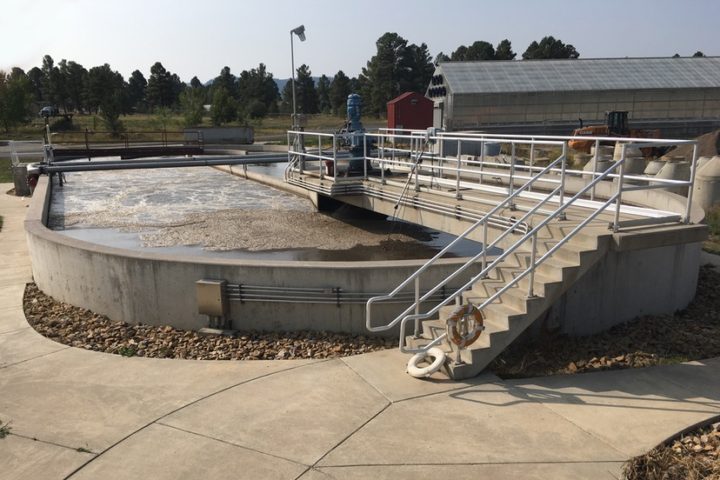
The upgrades will cost PAWSD wastewater customers — including the Town customers — about $10 million. A recent rate study predicted that this additional expense was going to help drive the PAWSD wastewater system finances into the “red”… eventually producing a deficit fund balance of perhaps negative $20 million.
Colorado governments are prohibited from having negative fund balances.
As the PAWSD Board and staff scrambled to address this financial situation, the rate study suggested significant increases to customers’ monthly bills, and an even more massive increase in the water and wastewater CIFs for new construction.
The water CIF for a new home increased from $5,363 to $9,227… a 72% increase…
…and the wastewater CIF has increased from $1,179 to $16,168… a 1,270% increase. Together, the CIF now amounts to more than $25,000.
All the while this financial juggling was happening at PAWSD, the Archuleta Board of County Commissioners were developing new policies to support workforce housing.
Considering that the community was — and still is — in the midst of housing crisis, the new policies made a certain kind of sense. One of the policies led the BOCC to donate dozens of tax lien properties in the Pagosa Trails and Chris Mountain subdivisions to Habitat for Humanity and to the Pagosa Springs CDC (Community Development Corporation), for the construction of deed-restricted workforce housing, in the form of single family homes. Other BOCC actions included grant application support and funding for a new Housing Needs Study.
Last year, the CDC contracted with BWD Construction to build ten ‘affordable’ homes, and Habitat purchased three ‘affordable’ modular homes and installed them with the help of volunteer labor. The CDC also obtained a $1.9 million grant to improve substandard infrastructure in Trails and Chris Mountain, two of the more ‘affordable’ neighborhoods served by PAWSD.
PAWSD had been waiving its water and wastewater CIF for Habitat for several years, back when the total fees amounted to about $6,500. But the CIF had been greatly increased in 2024, and the waivers now amounted to over $25,000 per house. The 2024 Habitat and CDC homes would not qualify as ‘affordable’ unless the CIF fees were waived.
To make matters even more interesting, a 50-unit ‘affordable’ apartment complex near Walmart called Timberline also came to PAWSD looking for CIF waivers.
The CIF waivers for all these projects? About $800,000.
Ouch.