
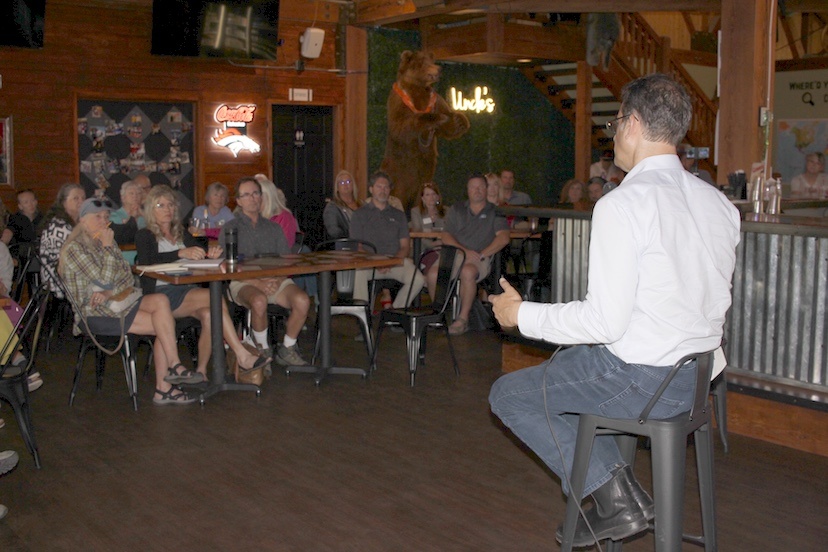
The afternoon of September 10.
I grabbed the first empty chair I came across, which happened to be next to Alex Boehmer, who serves with me as a volunteer Pagosa Area Water and Sanitation District (PAWSD) board member. Alex wondered if I was planning to ask the Attorney General any questions (I wasn’t) and told me he planned to ask AG Weiser his opinion of Regulation 31 — a somewhat draconian wastewater treatment regulation that would cost rural communities like Pagosa millions of dollars if it eventually gets implemented. (Alex did indeed ask that question.)
A few minutes later, Colorado Attorney General Phil Weiser arrived at Uncle’s Bar and Social Club, on Talisman Drive, with a couple of staff members… and settled himself on a metal stool, microphone in hand, to hear from the gathered audience.
He began by mentioning two acts of gun violence that had taken place earlier that day.
A shooting incident at Evergreen High School in Jefferson County, about 35 miles southwest of Denver, and the murder of Charlie Kirk, conservative political activist and co-founder of Turning Point USA.
He didn’t yet have details, he said, to report about the Evergreen shooting. (We later learned that the shooter died of self-inflicted injuries, and two other students were wounded.) He also reported that Charlie Kirk had been shot and killed that day, while speaking to students at Utah Valley University.
A rough morning for America, during a rough period for America.
“I want to start with what is heavy on my heart. Not one, but two tragic shootings today… the Evergreen shooting is close to home, but the other is of national significance. As most people here know, I think, Charlie Kirk has been killed in a shooting.
He referred to the shootings as “a call to turn down the temperature in America.”
“We the People use our voices — speech — to settle differences. I’m a big believer that if you don’t like someone’s point of view, someone’s speech, the right response is more speech. The right response is never violence.
“We’ve got to hold on to this republic, and that means that we learn to listen, and govern ourselves without resorting to violence…”
He mentioned his time working for U.S. Supreme Court Justice Ruth Bader Ginsberg, and witnessing first-hand her relationship with Antonin Scalia — two justices with very different political agendas, who were also great friends. How did they manage to get along?
“She would say, ‘Well, we like similar things, and neither of us are afraid of a good argument.’ They both believed that steel sharpens steel.
“Charlie Kirk wasn’t afraid of a good argument. Charlie Kirk believed in dialogue, and in showing up. And it’s tragic…”
At Evergreen High, and at Utah Valley University.
“There’s obviously a lot of reflection that all of us will do. A lot of hurting, in the Kirk family, and in Evergreen right now. And that’s heavy on my mind.
“I’m sure it is, on yours as well.
“I’m truly here because I want to listen and hear what’s on your mind. This is a series of conversations that I’ve had, dating back to when I was first running for Attorney General… Let me leave it there for now, and open up the conversation for people’s comments, suggestions, questions…”
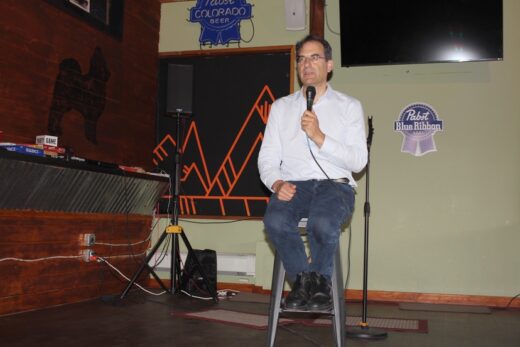
Mr. Weiser is term-limited as Colorado Attorney General, but apparently wants to stay active in state politics. He has declared his candidacy for Governor in 2026, and, reportedly, his campaign has thus far raised more than $3 million.
From his campaign website, dated July 2, 2025:
Today, Attorney General Phil Weiser’s campaign for Governor of Colorado announced that it has raised more than $3 million since announcing in January, with nearly $2.5 million cash on hand. In the second quarter ending June 30, 2025, the campaign raised over $1 million.
Weiser’s total donations come from more than 7,600 individual donors across 56 Colorado counties, and includes $46,000 in non-monetary in-kind contributions. Over 85% of donations are from Coloradans.
The campaign does not accept contributions from corporate political action committees (PACs).
Many of the questions and comments from the audience were obviously aimed at “Candidate for Governor Weiser” rather than at “Current Attorney General Weiser”.
What would he do about this or that situation, if he were elected? Mr. Weiser did his best to keep his answers focused on his current work as Attorney General, but that wasn’t always possible.
First comment:
“I am so frustrated with all that we are doing — writing letters, writing our representatives — and all I get from the political people is ‘Donate to my cause, donate to my cause’.
“What’s being done with the money I’m donating? What else can I be doing?”
AG Weiser summarized several ways citizens can become more involved. He also made several references to David and Goliath.
In my opinion, the depth of involvement a citizen is willing to engage in, is highly dependent upon that person’s willingness to be disappointed, repeatedly.
I say this from personal experience. How many times are you willing to be let down by your elected officials? Disregarded? Ignored? Because that’s what happens 90% of the time. Maybe 99% of the time.
Your representative might nod their head like they are listening to you. Don’t believe it. They have their own agenda, and you probably play no part in it.
You have to set your sights on the possibility you will be heard 1% of the time.
That said, I appreciated AG Weiser’s willingness to invite any and all questions and comments, and to make an effort to respond thoughtfully to each one.
We’ll listen to a few more of the audience questions and comments, in Part Two.
And we’ll hear a few of AG Weiser’s responses.