
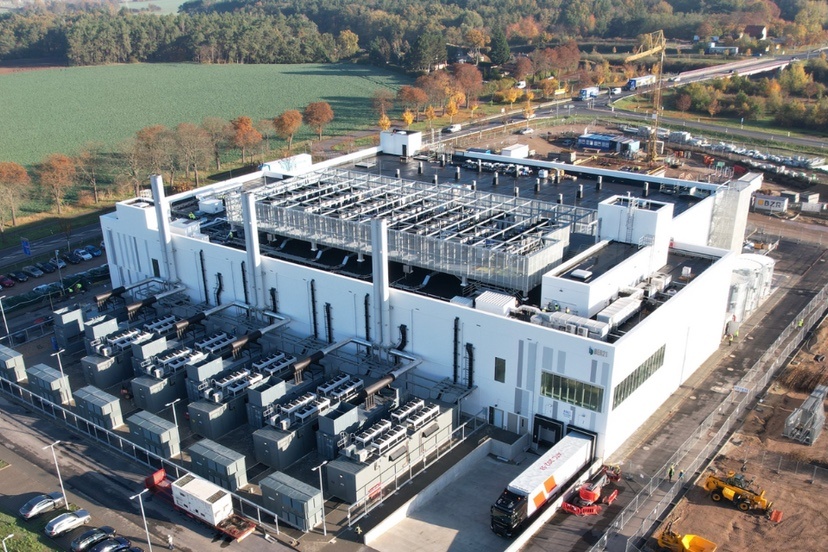
Photo: Typical data center. A large data center requires over 100 megawatts of electricity, enough to power around 80,000 U.S. households.
This story by Allen Best appeared on BigPivots.com on September 3, 2025. We are sharing it in three parts.
Might Trump intercede in Colorado energy matters, ordering that the coal keeps burning in Pueblo until Xcel commissions a nuclear or gas plant?
Trump’s actions in his second term have ceased to surprise. His executive order under authority of section 202(c) of the Federal Power Act that coal plants remain operating has succeeded in limited cases.
Canary Media reported that the Trump administration last week extended two emergency orders that fossil fuel plants in Pennsylvania and Michigan continue operations. Both had been scheduled to close in May. A Grid Strategies study promoted by several national environmental groups concluded that the forced continued burning of coal could cost consumers $3 – $6 billion.
Pueblo County’s saber rattling was couched in terms of grid reliability. How important are coal plants? The PUC has made no finding in the context of Pueblo. However, the PUC commissioners addressed this issue of grid reliability very directly in a decision issued on August 26 if narrowly in regard to plans by Tri-State Generation and Transmission regarding one unit at Craig Generating Station.
“Craig Unit 1 is not required for reliability or resource adequacy purposes based on the record in this ERP (electric resource plan). Every portfolio that Tri-State modeled assumes that Craig Unit 1 retires at the end of 2025 and does not provide any energy or capacity after 2025. At the same time, Tri-State convincingly concludes that every portfolio meets all reliability metrics and is reliable.”
“Perhaps this (PUC) Commission is biased against Pueblo because it voted for President Trump twice,” wrote Frances Koncilja, a former PUC commissioner who grew up in Pueblo. “Perhaps this Commission has decided that it will not consider the construction of new gas plants in Pueblo or any other community. Perhaps this Commission has decided that it will not even consider innovative technologies such as advanced nuclear, for coal communities. Perhaps the Commission had decided that only the voices of the environmental organizations will be considered.”
What exactly is just transition?
Koncilja’s rhetoric is raw, over the top. But with the acid removed, she asks a legitimate question: What constitutes just transition for Pueblo?
In 2019, when specifying 80% greenhouse gas emissions reductions by 2030 from the power sector, Colorado legislators also clearly said that communities dependent economically on coal extraction and combustion should not be left alone to figure out their futures. In HB19-1314, they ordered a “Just Transition from Coal-based Electrical Energy Economy.”
In Hayden on Aug. 20, Wade Buchanan, who runs the state’s just transition office, spoke at a conference devoted to geothermal. The conference was held at the Yampa Valley Regional Airport, which lies a mile or two west of the Hayden Generating Station. Across the road from the airport lies a new business park. Heating for the businesses is to be provided by ground-source heat pumps. They can provide cooling, too, and it would have been useful that day. Temperatures topped 90 degrees even as smoke from fires near Meeker smothered the Yampa Valley, for a time obscuring Bears Ears, the mountain north of Hayden.
Wells were being drilled and trenches dug for the geothermal-heated business park. Amazon was said to be one of the future tenants. Hayden is gearing up for a post-coal future.
Buchanan wondered if any of the 120 attendees had been given a name by their parents they just didn’t like? That was the case with the just transition office, he said. “It doesn’t communicate. Folks don’t know what it means. It comes across as confusing or pejorative.”
With the soon-to-be-closed Hayden Generating Station in the distance, work is underway in Hayden to create a business park whose buildings will be heated (and cooled, if necessary) by ground-source heat pumps, i.e. geothermal. Photo/Allen Best
In her PUC filing, Koncilja described the $165 million that Xcel has promised to pay in property taxes in the decade after Comanche 3 closes in 2030 as a “pittance.” As for the report she helped assemble two years ago, she complained that the PUC commissioners and staff members had discussed community benefits for less than 15 minutes during their 17-plus hours of deliberations. As for the report she helped prepare that called for nuclear, there was just one passing mention.
Koncilja appeared to also be the lead author on a July 17 filing that reviewed the long-term jobs, salaries and property taxes of the various energy possibilities for Pueblo. A combined-cycle gas plant with carbon capture came out second best with 20 to 25 jobs paying $80,000to $120,000 annually and delivering $16.5 million in property taxes. Nuclear, of course, had more of everything: 200 to 300 long-term jobs and property tax payments of $95 million annually.
That same filing jabbed at environmental groups. “Their real goals seem to be to stop any new gas generation, and the workers of Comanche and the Pueblo community are collateral damage,” said the filing by Pueblo, the city, and Pueblo County.
Leslie Glustrom, a constant presence at the PUC as well as the inaugural rollout of the nuclear report in Pueblo in February 2024, accused Koncilja of the political equivalent of trying to get a billion-dollar gift in the form of a nuclear power plant, she said in an interview.
“Given that we have much lower-cost options and options that all complement the flexible nature of 21st century resources, it should have been obvious to former Commissioner Koncilja that she was holding out false hope for the Pueblo community.”
Might nuclear someday become cost competitive (and with solutions for wastes)? Maybe. Xcel professes to think it will become viable in around 2035. So does Tri-State Generation and Transmission’s Duane Highley. And Mark Gabriel of United Power believes it will be an answer — if the federal government fully becomes engaged.
(For the record, the nuclear industry has received great amounts of subsidies over the years, and the Inflation Reduction Act of the Biden era added more. Chuck Kutscher, who trained as a nuclear engineer before moving into renewables, sees little future for nuclear, as he explained to an audience in April).
In the near term, though, Colorado utilities have been placing bets on renewables shored up with natural gas…
Allen Best publishes the e-journal Big Pivots, which chronicles the energy transition in Colorado and beyond.