
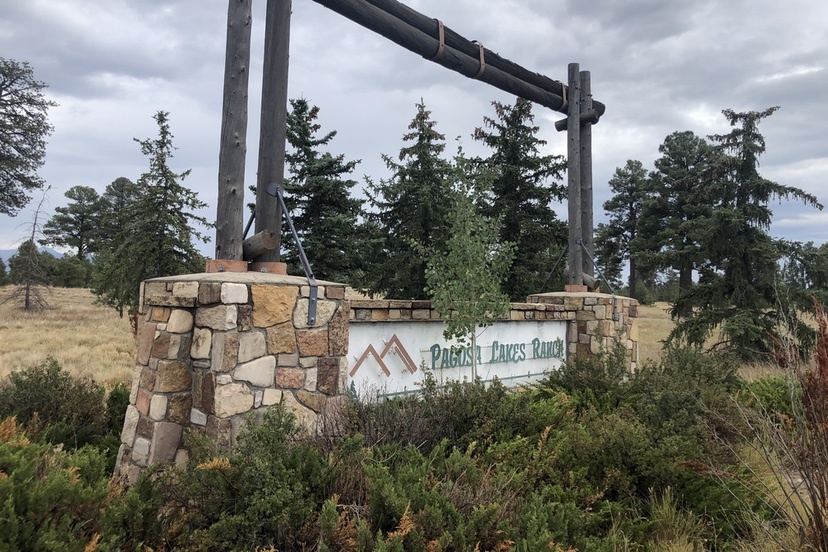
Photo: ‘Pagosa Lakes Ranch’ at the corner of Highway 160 and South Pagosa Boulevard.
Back in the early 1990s, the Town of Pagosa Springs felt threatened by a petition campaign taking place in the Pagosa Lakes area, where almost all of the new homes in the community were being built, and where — eventually — 75% of the community would be living…
…And where most of the new commercial development was taking place.
This petition was a threat to the viability of the traditional Pagosa Springs downtown, four miles to the east. The ‘uptown’ activists were proposing a new municipality, including much of the Pagosa Lakes area.
The Town leadership cleverly put a stop to this effort by annexing nearly all the commercially-viable vacant land on either side of Highway 160, thus depriving any future municipality of the potential sales tax revenues necessary to run a municipal government. The result was a Town government that serves mainly the historic downtown, at the expense of most of the community’s population.
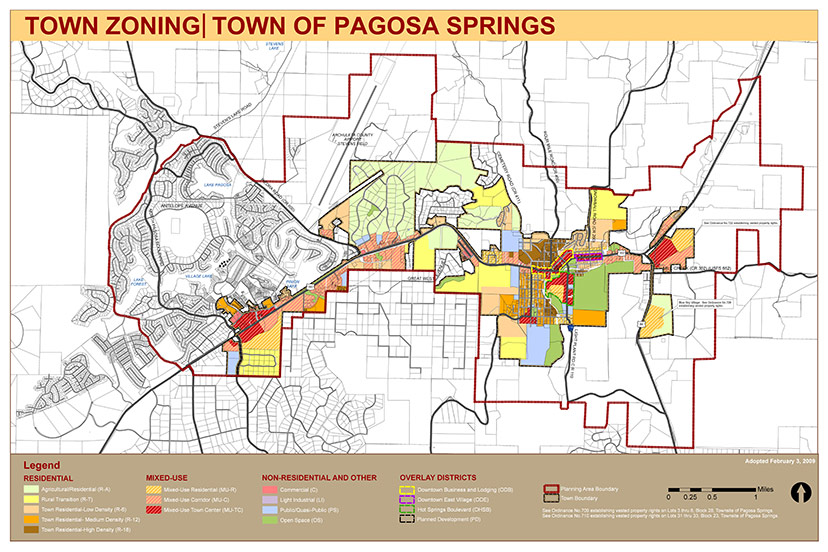
In the following map, the colored areas are within the town limits. The vast majority of residential neighborhoods west of downtown are outside the municipal boundaries.
Around the same time, developer Tom Grant was creating the uptown City Market shopping center. (Pagosa had a City Market downtown, where the Natural Grocers is now located,)
Mr. Grant also had ideas about another commercial/residential development on the opposite side of Highway 160, on a 100-acre parcel.
‘Pagosa Lakes Ranch.’
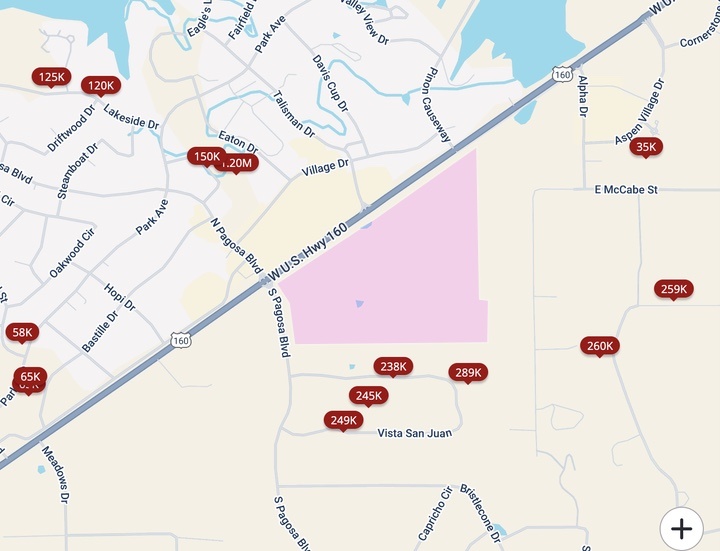
According to the County Assessor’s website, developer Tom Grant purchased the 100-acre parcel in 1992 for $610,000. It sold to Thomas and Margie Smith in 2003 for $3 million. Mr. Grant had already developed the City Market shopping center, so maybe he didn’t have the energy left to create another commercial development. It’s no small matter to develop 100 acres without going bankrupt.
A Pagosa realtor told me the current asking price for the parcel is $7 million, but the property is not shown in a search for vacant land on Zillow.com. Nearby vacant parcels range in price from $35,000 to $1.2 million.
We have an generally accepted belief — and it’s nothing more than a shared belief — that a person has the ‘right’ to develop property they’ve purchased or inherited. But we also generally accept the idea that we live in a community, and that the people in the community surrounding a vacant parcel have certain rights. Those community rights, within the Pagosa Springs town limits, are codified in the Town’s Land Use and Development Code, which is available online, here.
Many years ago, the Town government decided that commercial development ought to be kept separate from residential development, and that “dense residential development” ought o be kept at a distance from “low density residential”. So the Planning Department wrote zoning rules to keep us from suffering the inconvenience of living next to people doing business or next to people with a different lifestyle and income.
This wasn’t the way Pagosa Springs originally built out, of course. Back in the day, it was assumed that businesses wanted to be close to residential neighborhoods, for the simple convenience of their customers. Pagosa Springs also assumed that various types of people could live in the same neighborhood. In my downtown neighborhood, I live within five blocks — that is, easy walking distance — to:
A grocery store
Several clothing retailers
A shoe store
A movie theater
Numerous restaurants
A school
A public library
Two banks
Three hot springs establishments
Two government offices
A photographer’s studio
Barbers and hairdressers
Several coffee shops
A couple of ski rental businesses
Three municipal parks
Several real estate offices
A bookstore…
And hundreds of neighbors, who can all access these same amenities on foot, if they so desire.
Then the Town government and the County government decided that this type of pedestrian-friendly community was unacceptable, and strict codes and zoning regulations were written to prevent such development from taking place.
But about 15 years ago, the Town government started looking at what these codes were actually producing, and the cost to the community in terms of its damaged social fabric… and the zoning rules were altered to allow “mixed uses”. We could say this was a step backwards, towards the way cities and town naturally developed before the invention of planning departments and zoning regulations.
Or we could call it a step forward. Take your choice.
The zoning of the 100-acre parcel discussed by architect Brad Ash last month — the proposed site for the ‘Pagosa West’ subdivision — currently includes three different zoning districts:
Mixed-Use Town Center
Mixed Use Corridor
Mixed Use Residential
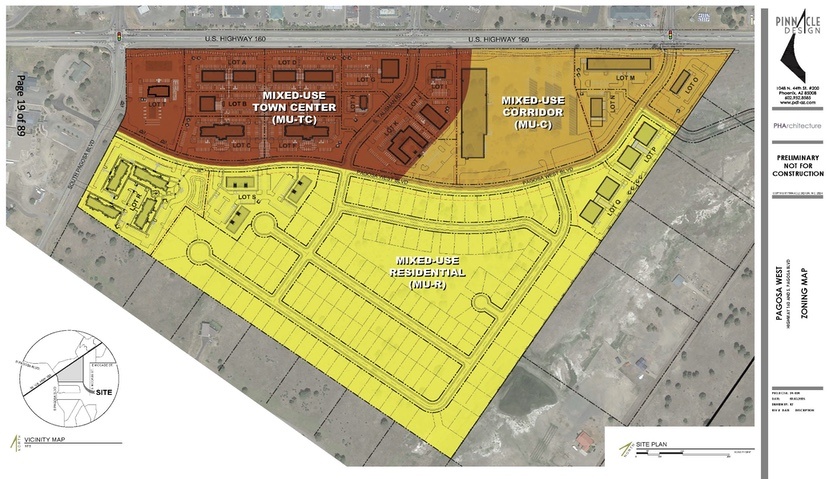
All three of these districts allow for both residential and commercial development. The apparent intention is to allow for the type of social variety and pedestrian access that exists in a few of our Pagosa neighborhoods, such as Downtown, Aspen Village, and the area around City Market.
We don’t want to allow a future developer to build out willy-nilly, but we do want to allow “mixed uses”.
From the Town Land Use and Development Code:3.3.1. GENERAL PURPOSES OF ALL MIXED-USE DISTRICTS
The mixed-use districts are established to:
A. Promote higher-density residential development near and within downtown and commercial centers, and other areas as appropriate;
B. Concentrate higher-intensity commercial and office employment growth efficiently in and around the downtown and other centers of community activity;
C. Encourage mixed-use redevelopment, conversion, and reuse of aging and underutilized structures and areas, and increase the efficient use of available commercial land in the Town;
D. Create pedestrian-oriented environments that encourage transit use and pedestrian access…
For example, Mixed Use Town Center zoning is intended to encourage “predominantly vertical with some horizontal mixed-use in a pedestrian-friendly environment that is not dominated by one (1) land use or housing type.”
The zoning of the Pagosa Lakes Ranch was an apparent attempt by the Town to repair a dysfuntional development style that’s obvious all across Archuleta County… a style that has made all of us dependent on cars, roads, streets, and highways.
One particular highway reconstruction is currently threatening to kill off our downtown business community.