
11%
The decline in tourism to Las Vegas this year, with visitor numbers, convention attendance and hotel occupancy all down. The drop comes amid a broader decline in international travel to the U.S. and is seen as a potential signal of a weakening economy.
— Governing Magazine, August 12, 2025, citing Las Vegas Convention and Visitors Authority data.
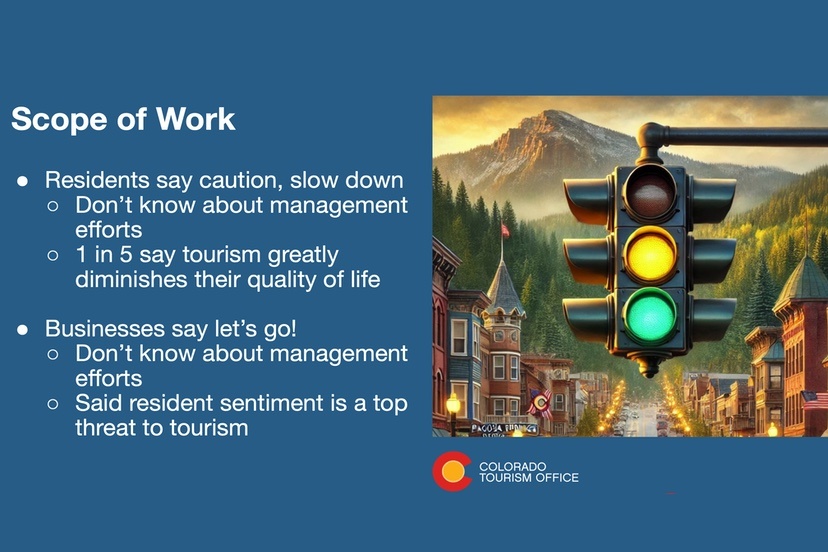
The image at the top of this page is taken from the Pagosa Springs Destination Master Plan, showing an unusual signal light, with the “green light” and the “yellow light” both lit at the same moment. Apparently, 1 out of 5 local residents feel that tourism “greatly diminishes their quality of life”. But local businesses apparently want more tourists.
I wonder how many locals feel that tourism “somewhat diminishes their quality of life”. By driving up housing costs, for example? And restaurant prices?
Time to slow the traffic? Or give the full “green light”?
Today, we continue our discussion of the August 6 joint meeting between the Pagosa Springs Area Tourism Board, the Pagosa Springs Town Council, and the Archuleta Board of County Commissioners, to discuss the Tourism Board process for developing its 2026 budget. Since the explosion of Pagosa tourism during the COVID crisis, the Tourism Board has been funded to the tune of about $1.5 million a year, collected through Town Lodging Tax and County Lodging Taxes.
That’s about triple the amount of Lodging Tax revenues provided to the Tourism Board in 2013, for example. Not many government boards have tripled their budgets over the past 12 years.
Unfortunately, the Tourism Board doesn’t have accurate data to assure anyone that the expenditure of $1.5 million per year is actually generating more tourism. The key data used in other tourist destinations — such as Las Vegas, Nevada — is “visitor numbers”, “convention attendance”, and “hotel occupancy”. The Pagosa Springs Tourism Board doesn’t have access to those key data points, partly because our local lodging establishments have consistently refused to provide occupancy and average daily rate data.
The Tourism Board uses mainly “Lodging Tax revenue” as a data point — but Lodging Tax revenue can easily increase without any increase in visitation, if the lodging industry simply increases their room rates.
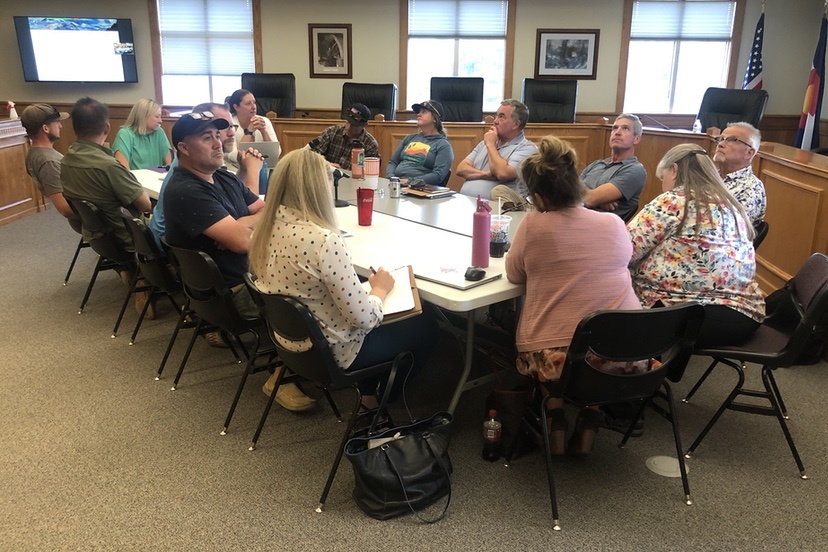
The photo below shows the August 6 joint meeting between the Tourism Board, the Town Council, and the Board of County Commissioners, viewing on various video screens a presentation by Tourism Director Jennie Green, showing possible budget amounts for 2026.
Recognizing that “government budget season” is upon us.
One topic of discussion concerned the suggestion, by certain Town Council members and Town staff, that a chunk of the 2026 Lodging Tax revenue be directed towards the cost of municipal repairs and upgrades currently taking place during the CDOT reconstruction of Highway 160 through downtown. Those Town expenditures are estimated to cost around $7.7 million, and the Town does not have that total amount of money sitting around.
Perhaps some of the Lodging Tax revenue could be used?
Legally, the County can use its share of the Lodging Tax revenues — about $500,000 annually — for only one purpose: tourism marketing. The BOCC could allow the voters to change the allocation, to allow County Lodging Tax to be spent on other community needs, but two of our commissioners seem reluctant to put that option on the November ballot.
The Town Council, meanwhile, can legally spend its share — about $1 million per year — on anything even vaguely related to “tourism”. Certainly, repairs to the downtown would qualify? Over the past couple of decades, downtown Pagosa has transformed itself into a district of gift shops, restaurants, and real estate offices, aimed primarily at serving tourists.
Here’s Town Council member Mat deGraaf, referring to the portion of the Tourism budget typically earmarked for “infrastructure”.
“I would personally like to see [the Town] take as much of that ‘infrastructure’ money as possible. This highway project is huge, and we just need help. Right? And I see the Tourism finds as a big place to help out. And that would be temporary. This year and next year, and maybe a third year… whatever…
“But I see us taking that money.”
Town Council member Brooks Lindner:
“I would agree with that too. To me, it seems like an obvious choice, to allocate the funds for… I mean, once the tourists get here… and the place is a mess, they’re not going to have a great experience, and they’re not going to want to come back. So in my mind, it’s really valuable for the tourist experience, for our downtown to be functioning and as beautiful as possible.
“And as Mat said, we need all the help we can get, at this point.”
Mr. deGraaf addressed a question from Tourism Board member Shane Prince:
“You ask if you should continue to carry the torch, to support local businesses [in general]. I think, absolutely. That is the foundation of your charge, to have a healthy community that people want to return to. And we’re in an odd place, I think, in our evolution, our growth, where we have… and we’ve been this way for a while… where we don’t have the infrastructure to support the amount of people that we’re seeing at peak times.
“So we still have these ebbs and flows. Nobody wants to wait an hour and a half for a table at Kip’s Grill, right? We all want to eat at Kip’s…
“I think the Tourism Board has actively worked to be a good partner and steward of that money.
“It’s not hard, in a tourist town, that almost anything could be linked back to tourism…”
Council member deGraaf mentions “a healthy community that people want to return to.”
But how about, “a healthy community that people want to live in”?
And that they can actually afford to live in?

At what point should the tourism light turn “red”?