
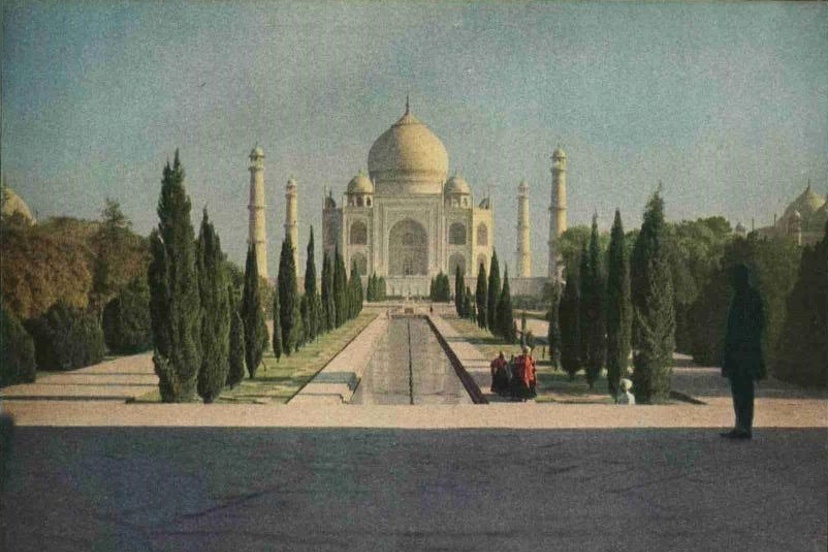
Photo: Color photograph of the Taj Mahal by Helen Messinger Murdoch, as published in The National Geographic Magazine, March 1921
I’ve been slowly making my way through Alasdair MacIntyre’s 1999 book, Dependent Rational Animals, wherein he addresses — from a philosopher’s perspective — the idea that human beings have typical animal needs, are dependent on one another, and are also rational, and that we’ve developed a system of ‘virtues’ to can lead us, rationally, to the best possible outcomes. I’ve been reading a few pages each evening just before bedtime.
I’m currently on page 95, and he hasn’t yet convinced me that human beings are rational.
The Pagosa Springs Area Tourism Board met with the Pagosa Springs Town Council and two Archuleta County commissioners on Wednesday, August 6, to discuss plans for the 2026 Tourism Board budget. This year, the Town Council directed about $1 million to the Tourism Board, collected through the Town’s 4.9% Lodging Tax. The Board of County Commissioners provided the Tourism Board with about $500,000 from the County’s 1.9% Lodging Tax.
So when considering 2026 government budgets, we could feasibly ask, “How can a $1.5 million annual allocation best benefit the people of Pagosa Springs and Archuleta County?”
That wasn’t exactly how the question was phrased at last week’s joint meeting, because nearly everyone in the room seemed to have arrived bearing the belief that “more tourism” will benefit the people living in Pagosa Springs.
But I still think it’s a question worth asking. “How can we best benefit our community?”
Even is some people wish we wouldn’t ask that question.
A decade ago, National Geographic Magazine travel editor Leslie Trew Magraw published an article entitled, ‘Is Tourism Destroying the World?’
Her story appeared in April 2013, approximately 125 years after the magazine’s inaugural issue was published in September 1888.
 I found this concept intriguing — tourism, destroying the world — because the National Geographic Magazine is probably the publication most responsible for creating a widespread fascination with exotic locations — here in the U.S. and around the world — and thus, in an indirect way, for encouraging the growth of global tourism industry.
Yes, Pagosa Springs has been mentioned in National Geographic, in 2011 and again in 2024. And in a few other travel magazines. Travel + Leisure, for example. The Boutique Adventurer. Luxury Travel. Travel Lemming. AAA Magazine.
Apparently, in 2013, certain people were concerned that tourism might be destroying the world. The National Geographic Magazine article is an interview by Ms. Magraw with author
Elizabeth Becker is an award-winning author and journalist who has covered national and international affairs for The New York Times, worked as Senior Foreign Editor at National Public Radio, and as a foreign correspondent for the Washington Post. The National Geographic interview suggests that she had spent five year researching the explosive growth of the global tourism industry during the 21st century.
One of the questions in the Magraw/Becker interview:
Magraw: With more than a billion people traveling each year, how can we see the world without destroying it?
Becker: That is the essential question. Countries are figuring out how to protect their destinations in quiet, non-offensive ways. They control the number of hotel beds, the number of flights to and from a country, the number of tour buses allowed… Most countries are heavily promoting off-season travel as the most obvious way to control crowds…
…The toughest problem is breaking the habit of politicians being too close to the industry to the detriment of their country. Money talks in tourism as in any other big business…
The Pagosa Springs Area Tourism Board switched its focus during COVID, and stopped marketing Pagosa as a summer destination, because we’d all had quite enough of the hour-long waits to get a restaurant table. But at last Wednesday’s joint meeting, some of the business representatives seemed to be questioning that approach — even though Lodging Tax collections this year are nearly as high as during the tourism explosion of 2021.

Another interesting bit of conversation in the Magraw/Becker interview:
Magraw: Which country can you point to as a model for sustainable tourism?
Becker: One of the more ambitious is France, which is aiming for sustainability in the whole country. The key, I think, is that the French never fully bought in to the modern obsession with tourist over-development. They have been nurturing their own culture and landscape, cities, and villages for decades. Since they have tied their economy to tourism, they have applied a precise and country-wide approach that mostly works.
All relevant ministries are involved, including culture, commerce, agriculture, sports, and transportation. Planning is bottom up, beginning with locals at destinations who decide what they want to promote and how they want to improve. The French obsession with protecting their culture… has worked in their favor.
The planning and bureaucracy required to make this work would try the patience of many governments…
So, while we’re talking about governments, and patience being tried, let’s listen to some of the discussion at the August 6 meeting.
As mentioned, the reason for the meeting was to discuss the Tourism Board budget for 2026. Traditionally, the 9-member Tourism Board and staff have estimated the total Lodging Tax they expected to receive from the Town and County, allocated amounts for staff, marketing, event support, data collection, and ‘infrastructure’, and handed the budget to the Town Council and BOCC, who’ve basically rubber-stamped the allocations.
This year might be different. More about that later.
That said, the Tourism Board could theoretically be described as “planning from the bottom up, beginning with locals…” to use the terms Ms. Becker applied to the country of France.
But the locals we begin with, here in Pagosa, are not necessarily representative of the whole community. Six of the nine members are directly involved in lodging, hospitality, or tourism retail; two are government officials; and one represents the real estate industry.
What industries and demographics are not represented? Let’s count the missing community stakeholders.
Construction, manufacturing, communications, education, health care, agriculture, retail, arts & culture, youth activities, information services, churches, caretakers, retirees, working families, nonprofits, road maintenance, disaster mitigation, bookkeeping, legal services, automotive services…
These populations, services and businesses are intentionally not represented, and cannot be represented, because the BOCC and the Town Council limited the representation on the Tourism Board to tourism related businesses.
This helps explain why pretty much everyone arrived at the August 6 meeting believing that the very best future for Archuleta County involves “more tourism”.