
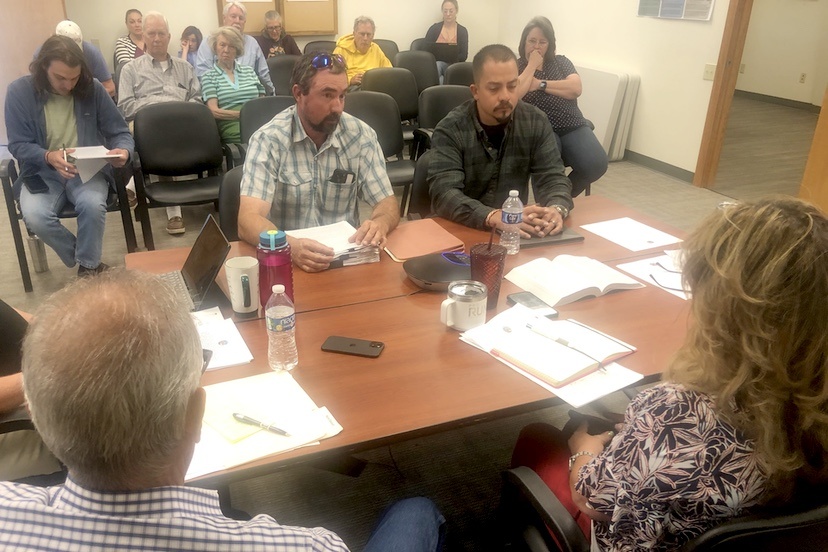
Photo: Eric McRae and Mike Torres making a presentation to the Archuleta Board of County Commissioners on June 10, 2025, regarding Road & Bridge promises and obligations as stated in various resolutions and legal documents.
At a lightly-attended meeting of the Archuleta County Road & Bridge Advisory Committee, R&B Manager Eric McRae and Public Works Director Mike Torres outlined the work completed by the Archuleta County Road & Bridge Department through the end of July, 2025
Mr. McRae then moved on to the second agenda item.
Discoveries.
Presumably with the help of other people in County government, Mr. McRae has been digging into the BOCC resolutions and other legal documents that have been recorded since the 1970s, and that have defined the County’s presumed obligations regarding maintenance of neighborhood subdivision roads.
Mr. McRae had shared his research with the BOCC back in June, displaying a pile of documents related to Road & Bridge promises and obligations. At that same work session, County Manager Jack Harper invited Mr. McRae to share his thoughts about the existing tax burden on businesses and residents.
Mr. McRae:
“I know that, roughly, every household contributes between $30 and $60 out of their taxes towards the roads. So a misconception I hear quite often, ‘My taxes have doubled…’ We get a lot of those comments.”
Indeed, property taxes greatly increased in Pagosa Springs in 2023, but the lion’s share of the increase went to the Colorado Department of Education. Property tax increases for the Archuleta County government are tightly restricted by Colorado’s TABOR Amendment, so relatively little of the recent tax reveneus have accrued to the County government.
Mr. McRae: “The truth is, those tax dollars are spread thin between all of the [County] departments. Residents chip in between $30 and $50 towards their roads.”
He is talking here, of course, about the residents who do not live in existing metro districts. Several Archuleta County subdivisions have formed metro districts to maintain their neighborhood roads, funded through an additional property tax mill levy, but none of the Pagosa Lakes subdivisions have yet done so.
Theoretically, the subdivision neighborhoods that have never formed their own metro districts could do so at any time, and that would allow each metro district to elect a board of directors, contract for road maintenance, and maintain their own neighborhoods roads at whatever level of service the residents choose.
These residents would also, however, need to pay an additional property tax mill levy, just like the residents living in Pagosa’s existing metro districts do.
At the July 28 Advisory Committee meeting, Mr. McRae repeated the story of his research into past documents and promises.
“We are still in the discovery phase of these resolutions… and every time we think we have the final piece of the puzzle, there’s a piece that opens up another missing puzzle piece. So we are inching near our final discoveries, and I am hoping for the day we can finally say, ‘We know it all’.
“But right now, we’re going to continue doing the best we can for everybody. We’re not cutting anyone off.
“We are encouraging subdivisions to begin talks, and begin establishing their associations, to inch towards their own maintenance.”
I understood Mr. McRae to be referring to ‘establishing their metro districts’ rather than ‘their associations’. Metro districts, as government entities, are legally allowed to collect property taxes, while ‘associations’ cannot levy property taxes.
Also, the neighborhoods in question mainly belong to an association already: the Pagosa Lakes Property Owners Association.
Mr. McRae:
“Fact is, we cannot maintain neighborhood roads [adequately.] Even if the roads seem fine at the end of the day, they are not going to receive any better service next year than they received last year.
“So we’re encouraging them to go with what we know, as of right now. And right now, it’s possible we will discover we’re maintaining roads we’re not supposed to maintain. We can’t say for certain, until another discovery opens up another discovery…
“We’re not sure what the next discovery is going to hold.”
Part of the problem is a lack of organizational ‘memory’. Back in 2005 — to pick a random date — many of the employees working for Road & Bridge had been with the department for many years, some even for decades. Those knowledgeable employees have since retired, and as with much of the County, the new employees do not fully know the community’s history.
Mr. McRae, for example, has been on the job for less than two years.
“We’re going to prioritize the very best we can, but we are encouraging subdivisions to begin talks in establishing their [metro districts], so that they are ready — in the case that we stop maintaining secondary roads…
“Some folks have already been getting ready to maintain their own roads. They’re open to the idea that we’re short-staffed. But unfortunately, we don’t yet have final discoveries. We are working on it.”
An interesting statement from the BOCC’s interim attorney Lance Ingalls, back in June:
“In general, because [county governments] are immune from liability for roadways, they also get with that — based on the case law — the discretion to determine what level of maintenance is appropriate on any roadway. And it’s common that counties have more road needs than they have budget to meet those needs.
“But it’s pretty clear in the case law on governmental immunity, that counties have the discretion to chose what level of maintenance is appropriate, and even to choose not to maintain — if that’s appropriate under the specific circumstances.
“And especially if you have budget limitations, and not everything that could be maintained, can in fact be maintained — those are decisions that a county simply has to make. You have to establish your priorities and do the best you can with what you’ve got. But you do have the discretion to maintain, and with that, you have the discretion not to maintain…”
Attorney Ingalls seems to be saying that old promises and resolutions may not be the final word on road maintenance, when R&B determines that it can no longer to afford to maintain this or that road.