
I wrote yesterday in my editorial, ‘Disappointing Numbers at a BOCC Listening Session, Part Two’ that a voter-approved increase in the Archuleta County Lodging Tax could generate perhaps $1 million per year for various community needs, but two of our County commissioners — Warren Brown and John Ranson — indicated that they didn’t want to put such a measure in front of the voters until November 2026 at the earliest.
These same two commissioners indicated that, if they decided to put the proposal on the 2026 ballot, they would likely want to specify that the money would be used for road maintenance… and not other community needs. I suggested in my editorial yesterday that adding $1 million annually to the Archuleta County R&B budget would be insufficient, and that the only practical way for Archuleta County to catch up on deferred road maintenance is by convincing our Pagosa Lakes neighborhoods to form metro districts, and take over the maintenance of their own neighborhood roads.
At any rate, I found it to be something of a pleasant coincidence, that the same day I posted that editorial, the County Road & Bridge Advisory Committee held a regularly scheduled meeting at the County Admin offices.
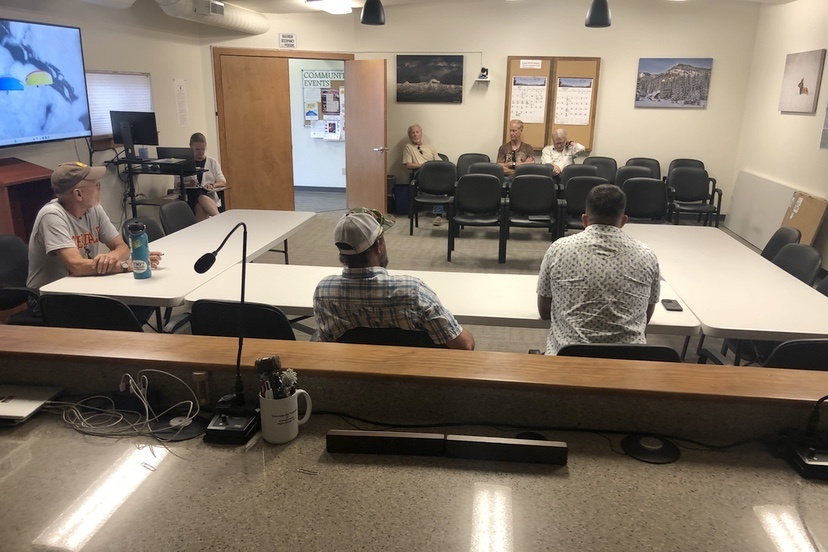
Four members of the public showed up to hear, and hopefully participate in, the conversation. (That number includes myself.)
Unfortunately, only one volunteer member of the Advisory Committee showed up: Randall Davis, a gentleman who, as a long-time bus driver for the School District, is quite familiar with our local road conditions.
According to County Road & Bridge Manager Eric McRae, who ultimately handled most of the meeting presentation, the “quorum” for the Committee would have been “five members”, which implies that the full committee consists of nine members. Also in attendance was Public Works Director Mike Torres, but I wasn’t clear if County staff were considered “members” of the Committee.
My experience with public boards and committees is that a quorum of members is required in order to conduct a meeting, and without a quorum the meeting is simply adjourned. But Mr. McRae and Mr. Torres carried on with the meeting, as if the lack of a quorum was unimportant.
The main conversation consisted of two parts: an overview of recent R&B achievements and activities, and a discussion about which roads the County is ultimately required to maintain. The meeting began, however, with an invitation to make public comment.
The three other members of the public (beside myself) were property owners from the far end of Mill Creek Road, and to hear their story, it sounded like portions of Mill Creek Road are ‘washboarded’ to the point of being nearly impassable. One issue with Mill Creek Road is that much of the road belongs to the Forest Service, which currently has only a minimal amount of funding to pay for road maintenance. Mr. McRae noted that the R&B crews blade the Forest Service segment “maybe four to six times a year” although the Forest Service reimburses the County for only two of those treatments. He also stated that the County does culvert maintenance on the FS portion of Mill Creek Road, even though that’s technically a Forest Service responsibility.
“We don’t want to leave you up there, abandoned, but you need to bear with us. You live on a Forest Service road. So that has some challenges for the people who live up there, because of the agreement with the Forest Service…
“They’re struggling for funding. That’s typically what we’re told. We’ve had discussions with them about increasing their contribution to cover the mag chloride, and that’s been a difficult conversation in itself.”
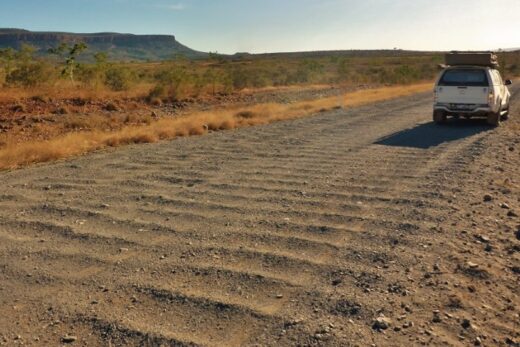
Washboarded gravel roads are a common problem in rural communities like ours. Washboarding occurs in dry, granular road material with repeated traffic traveling at speeds above 5 mph. Some studies have suggested that lighter vehicles cause more damage than heavy vehicles.
The word “dry” is important in this discussion, because the gravel placed on Archuleta County roads is typically a blend of gravel and clay. The job of the clay is act as a binding agent, but it can function properly only if the clay contains some level of moisture. County Road & Bridge contracts with a magnesium chloride provider to apply that chemical to gravel roads at certain times of year; the mag chloride attracts moisture from the air, and assists the clay in performing its binding function.
Dry weather is not friendly to gravel roads.
Mr. McRae explained that the County is planning to invest in bulk purchases of mag chloride and plans to train its crew to apply the chemical, hoping to reduce costs by bringing the process in-house. Public Works Director Torres noted that the mag chloride application process — which requires proper grading of the road by the County, prior to the application — occupies nearly the entire 17-person R&B crew for two to three months each spring and early summer.
One significant cost of gravel road maintenance is in obtaining the gravel-clay mixture itself, which the County is currently importing from near the New Mexico line, with trucking expense being a big price factor. Mr. McRae noted that, this year, the County will likely apply fresh gravel to only about 7 miles of road, out of 300 miles of gravel roads in the community.
R&B also maintains about 42 miles of paved roads.
About nine miles of paved roads have been “hot milled” this summer, with chip seal applied. Chip seal has also been applied to the roads within the Vista mobile home subdivision.
Mr. Torres:
“All of these [paving projects] were done in three months… our season starts essentially in May, so… it’s a lot to get done in three months. We’ve been doing a lot.
“And we just want everybody to know, we’re trying to get around to everyone’s concerns and address everyone’s complaints, but we’ve been going…”
Then Mr. McRae shifted gears, and started to address the second item on the agenda.
Discoveries.