
While having coffee with a friend one day, I was asked to give my assessment of “where Pagosa is headed over the next 10 or 15 years.”
I thought for a moment, and answered:
“Well, it all depends on the economy.”
Meaning, the national economy, or maybe even the global economy.
I suppose I’m not the only person who makes that assumption — that the future of Pagosa Springs will be determined, to a large degree, by forces beyond our poor ability to steer the community in this or that direction.
My friend was a little taken aback by my answer. And now that I’m thinking about it, maybe I should be taken aback as well. Am I so willing to concede control of our community to global forces?
There’s a old adage, made famous by House Speaker Thomas ‘Tip’ O’Neill, that “All politics is local.”
Less well understood, perhaps, is the idea that “All economies are local.”
Putting those two concepts together, we might conclude that “All local economies are tied to the local politics.” And vice versa.
We discussed, yesterday in Part Three, the following chart from Region 9 Economic Development District:
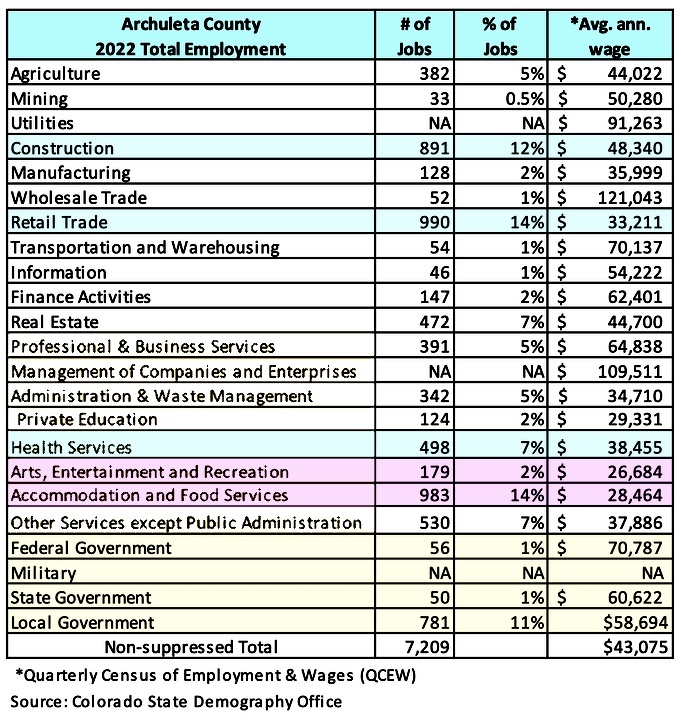
The pink-highlighted economic sectors are particularly important to Pagosa’s tourism industry. Motels, STRs, restaurants, various forms of entertainment and activities. About 1,162 jobs as of 2022.
Most of the tax-funded jobs in Archuleta County are included in the sectors highlighted in yellow. We can then add to that, the 300 jobs at the tax-funded Pagosa Springs Medical Center (from the Health Services sector)… and calculate that we have about 1,187 government jobs in our community.
Out of about 7,200 total jobs in the community. Give or take.
But the number of jobs is only part of the story.
If we take the average annual wage paid in ‘Accommodations and Food Services’ — $28,464 — and the average wage in the ‘Arts, Entertainment and Recreation’ sector — $26,684 — we can calculate that those two economic sectors, in 2022, paid out about $32.8 million in wages, available to be spent in the local economy.
If we take the average annual wages paid in our various government agencies — County, Town, PAWSD, Fire District, Pagosa Springs Medical Center, Forest Service, Judicial System, etc. — it appears that those employees received about $64.4 million in wages in 2022.
Available to be spent in the local economy.
According to this analysis of the Region 9 data, it would appear that local government has twice the impact on the local economy, in terms of wages paid out to employees.
But that’s not the whole story, of course. Tourism is often described, in economic development reports, as a “base industry”. From the Pagosa Springs Community Development Council website:
Base analysis distinguishes which industries are responsible for overall growth and change. Base industries produce exports or derive their sales or income directly from outside sources, or indirectly by providing supplies to export industries. These activities bring in outside dollars to circulate within the local economy…
The general idea is that, while some economic activities circulate dollars within the community, other activities — base industries — bring in “outside dollars” and thus, in theory at least, contribute to economic ‘growth’. Tourism is considered a base industry, for obvious reasons.
But… is government also a base industry?
For a deeper dive into “base industries” in southwest Colorado, you can download a 5-page report from Region 9 here.
We can easily assume that the taxes that support our local governments generally come from within the community. But according to Region 9, about 40% of the properties are owned by people with addresses outside Archuleta County. This suggests that property taxes are a significant source of “outside income” flowing into the community, collected and spent by our local governments.
Also, a significant number Pagosa residents work in Durango, or work “remotely”, thus bringing in “outside income” — a portion of which is collected as local taxes.
Additionally, the average age in Archuleta County is now 52 years. So we have a sizable influx of retirement pension income and investment income flowing into the community, and part of that is collected by local governments in taxes and fees.
To greatly simplify a complicated situation, local government in Pagosa Springs has aspects of a “base industry”, contributing not only more employment income to the economy than tourism, but also making infrastructure investments surpassing the capital investments made by local tourist businesses.
Estimated capital investments planned by our local governments over the next 5 years? $250 million? $300 million?
Estimated capital investments planned by the tourism industry over the next 5 years? Anything at all?
My question to myself, as I began this editorial series last week, was:
Which economic sector contributes the most to the vitality of the Pagosa Springs economy?
Certainly, they all contribute at some level. The construction industry, for example, provided about 891 jobs in 2022, at an average annual wage of $48,340. That suggests an economic input of $43 million.
The retail sector provided about 990 jobs, at an average wage of $33,211 per year. So, $32.9 million flowing into the Pagosa economy.
Which economic sector tops them all, in terms of wages inserted into the financial flow of the community?
Tourism? Maybe $32.8 million?
Government? Maybe $64.4 million?
Some residents might be happy if we reduced the cost of local government. Other residents might like to see a reduction in the number of tourists.
Either type of reduction would have effects on the community’s overall economy.
But still, would we be happier?