
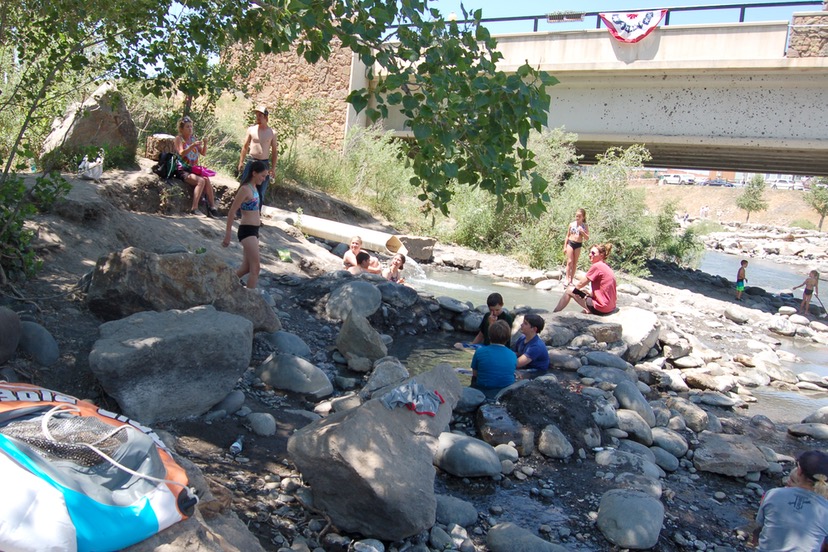
Photo: Tourists enjoying the San Juan River in 2020, during a global pandemic.
It’s an easy thing to be outraged, or encouraged — take your choice — by the edicts coming out of Washington DC since January.
Or since 2001, if you prefer a longer timeline.
Or even, since 1865, or since 1776. (Except, of course, Washington DC didn’t yet exist in 1776.)
But our Pagosa Daily Post editorials have typically focused, since we started publishing in 2004, on the challenges faced by the residents and businesses right here in Archuleta County, Colorado. Those challenges are tackled, on an individual basis, by households, commercial enterprises, associations and nonprofits…
…but also, collectively, by our local governments.
Local governments struggle with some of the same issues as the state and federal governments: allocation of limited resources, conflicting values and desires among the citizenry, the duty to operate with transparency in a competitive society, lack of reliable data and information… and also, to put it simply, human nature in general.
Additionally, local governments are dependent upon, and to some degree controlled by, state and federal policies and funding.
But local governments have one advantage not shared by state and federal governments. Our local elected and appointed officials drive on the same roads, attend the same churches, shop at the same stores, and send their children and grandchildren to the same schools as the rest of the community. In a very real sense, they inhabit the community they serve. They’re intimately familiar with the problems and potential of the town, because it’s their town.
The service flows in both directions. We serve our local governments by providing them with tax revenues, and with our neighborly advice and complaints, and in some cases, with donations of volunteer time and energy. The governments serve us by dealing with necessary tasks no one else is willing or able to tackle.
One of the tasks local governments typically take on is economic development, but it’s not always clear if they fully understand the local economy.
I’ve noted in this editorial series that local business and political leaders, here in Pagosa Springs, often classify our economy as a “tourism economy”. And of course, tourism is very much a part of the economy. But I’m willing to make a competing claim: that we have a “government economy”.
Here’s a chart from Region 9 Economic Development District, showing the top 10 employers in Archuleta County in 2023. I’ve colored the tourism-related businesses in pink:
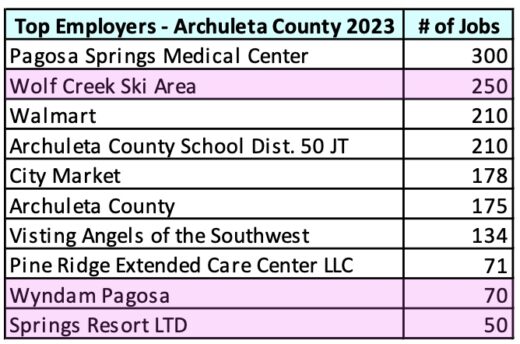
As with most displays of raw data, this chart doesn’t tell the whole story. For example, Wolf Creek Ski Area operates only six months of the year, and Wyndham and the Springs Resort are typically much more lively from June through August than they are for the rest of the year — and we might assume their number of employees varies with the demand. Nevertheless, we see a total of 370 employees in this chart.
Then we have another three top employers in the chart, shown below in yellow:
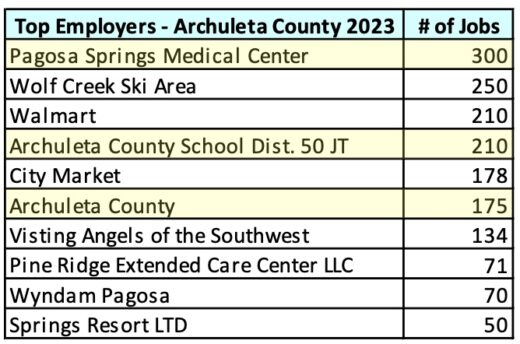
These are local, tax-supported governments that — unlike many tourism businesses — operate year ’round. (Yes, the School District employees have a three-month vacation every summer, but they still receive a monthly paycheck.) We can total the number of government employees in this chart: 685.
But that’s not the whole story, obviously. The chart above mentions only about 1,650 of the 7,200 jobs in the community, many of which have little to do with tourism or government.
Surely… there are more total people employed in the tourism industry than in local government? Right?
Here’s another Region 9 chart.
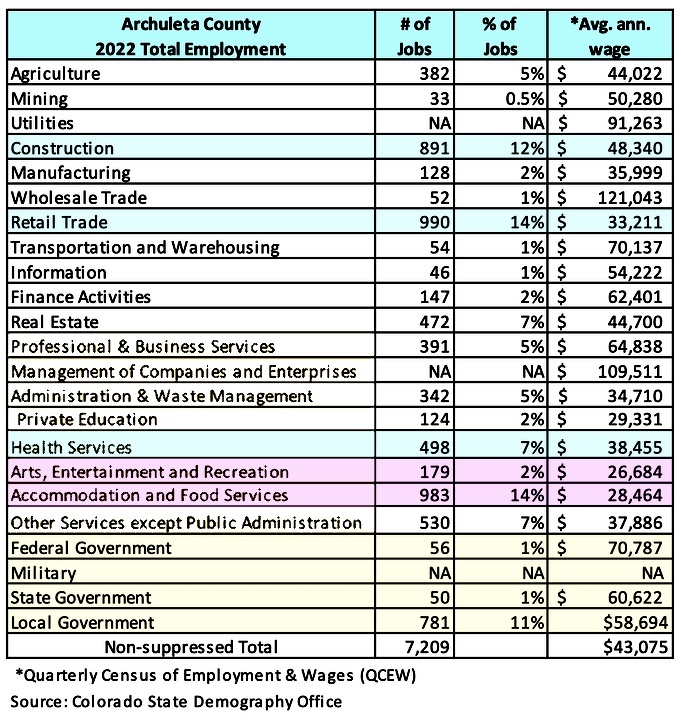
According to Region 9, the two main employment sectors that serve tourists —Arts, Entertainment and Recreation and Accommodation and Food Services — are shown in pink. A total of 1,162 jobs in 2022, out of 7,209 jobs.
But again, this data doesn’t tell the whole story, because local residents also enjoy the Arts, Entertainment and Recreation offered in Pagosa Springs… and local residents also patronize Food Services. So we can’t tell, from this chart, how many of those 1,162 jobs are generated by locals and how many are generated by tourists.
Yesterday in Part Two, we considered some estimates of tourism in Archuleta County. The Smart Growth report from 2017 estimated 375,000 visitors per year; the Placer report estimated that the average visit to Pagosa lasted less than 10 hours. The Lodgers Tax paid by tourists has increased by about 100% since 2017, so based on that data, last year, we possibly had as many as 750,000 visitors in 2023. Give or take. If we generously assume that the average visitor spent 24 hours in Pagosa Springs, and if we divide 750,000 by 365 days in a year, that would suggest that we had about 2,000 visitors per day, on average.
Much more than that, of course, in July, and much less than that in April or October. These are obviously rough estimates.
(Back in Part Two, I had suggested 1,000 visitors a day, on average. Then I checked the Lodging Tax growth since 2017.)
So on a typical day, on average, we might guess that Archuleta County businesses served 2,000 visitors and 14,500 residents. The visitor probably ate at a restaurant and visited an art galley; the local resident probably did not. So let’s assign all 1,162 jobs in Arts, Entertainment and Recreation, and Accommodation and Food Services — shown above in pink — to the tourist industry.
That’s not accurate, but it makes things simpler.
The 887 jobs shown in yellow are some of the government jobs — Archuleta County, Town of Pagosa Springs, Archuleta School District, Fire District, PAWSD, Forest Service, Court System, Ruby Sisson Library, and the various metro districts.
Then let’s add to that total, the 300 jobs at the tax-supported Pagosa Springs Medical Center, which are presumably included in “Health Services” (marked in blue). It would appear that we have about 1,162 tourism jobs — many of them, seasonal — and about 1,187 government jobs.
But that still doesn’t tell the whole story.