
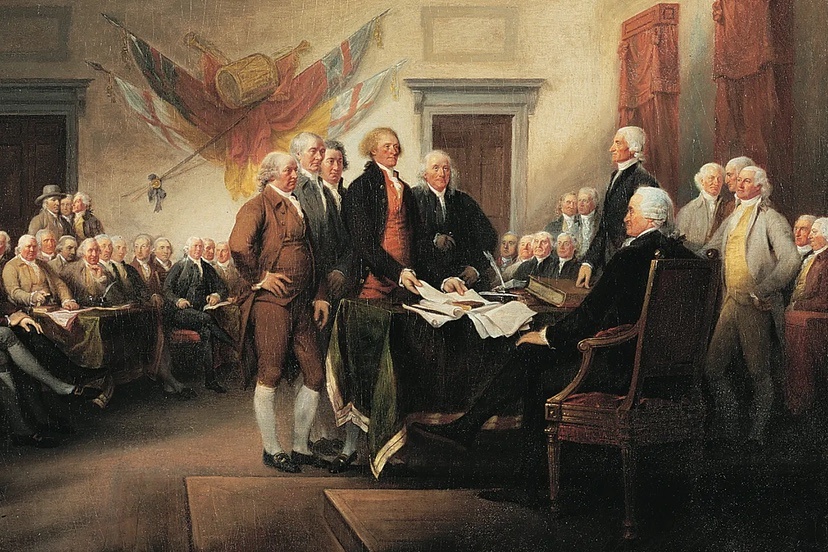
I mentioned yesterday, in Part One, that our Pagosa Springs Town Council and our Archuleta Board of County Commissioners begin their regular meetings with a recitation of the ‘Pledge of Allegiance’…
“…one nation, under God, indivisible, with liberty and justice for all.”
Yesterday, a number of government offices in Pagosa Springs were closed for the federal Juneteenth holiday, as were some businesses. So I’ve found myself thinking, this week, about certain values that some of us care about.
Liberty. Justice. Freedom.
Are these luxury items?
Or are they perhaps the most important values we can possibly hold onto?
Let’s dig into those questions, together.
Yesterday in Part One, we noted the proclamation posted on the White House website on June 17, addressing the anniversary of the Battle of Bunker Hill in 1775 — one of the first confrontations in the Revolutionary War between the European colonists and the British Army. Obviously, this particular battle took place prior to the adoption of the Declaration of Independence by the Continental Congress in 1776. The Declaration cited 27 types of alleged ‘Oppression’ perpetrated against the colonists by King George and his government and army, including the quartering of large bodies of armed troops, and protecting them, through mock trials, from punishment for any murders which they should commit among the colonists…
and…
…For cutting off our Trade with all parts of the world…
…For imposing Taxes on us without our Consent…
…For depriving us in many cases, of the benefit of Trial by Jury…
…For transporting us beyond Seas to be tried for pretended offences…
“In every stage of these Oppressions we have Petitioned for Redress in the most humble terms; Our repeated Petitions have been answered only by repeated injury. A Prince, whose character is thus marked by every act which may define a Tyrant, is unfit to be the ruler of a free people…”
Liberty, and justice. Essential rights the Continental Congress sought to protect. But how did they understand these terms?
According to my limited research, the American colonists drew a distinction between “natural liberty” — the freedom humans possess in ‘a state of nature’ — and “civil liberty” — the freedoms retained when entering into civil society. They believed civil government should protect, rather than diminish, essential freedoms.
They recognized various types of ‘liberty’.
Political liberty involved the right to participate in government through representation and consent. The rallying cry, “no taxation without representation”, embodied this principle.
Religious liberty meant freedom from religious persecution, and the right to worship according to one’s own conscience, although this freedom did not exist equally in all colonies in 1776.
Economic liberty defined property ownership as fundamental to independence and political participation, based partly on the belief that economic dependence led to political subservience. (In most states, a man without property had no right to vote in 1776. Nor did women have voting rights, nor did people living in slavery, nor did Native Americans.)
Legal liberty meant protection under established laws rather than arbitrary rule. The colonists insisted on traditional English rights like trial by jury, due process, and protection from unreasonable searches.
The colonists didn’t embrace ‘unlimited individual freedom’, but rather personal liberty within a framework of law, an accepted moral order, and ‘the common good’ of the community. This tension between individual rights and community obligations has continued to shape American political thought — and debate — well into the 21st century.
I attended the June 17 work session held by the Archuleta Board of County Commissioners, and witnessed a contentious debate between two neighboring property owners, directly related to the topics of liberty and justice.
According to the regulations adopted by the BOCC last year, the owner of a property in the Rural Residential zoning district can store only a certain number of ‘commercial’ vehicles on their property, and only if the commercial vehicles are used in a ‘home occupation’. A permit is required, apparently, to operate a home business in Archuleta County.
The Preuit family owns a 12-acre parcel in such a zoning district, and have been keeping commercial vehicles on their property — but have not obtained a ‘home occupation’ permit for the simple reason that they have not yet built a house on the property.
Local realtor Mike Knapp is one of Preuit’s neighbors, and he appeared at the June 17 work session to protest the movement of commercial vehicles to and from the property on a regular basis, in apparent violation of the County’s Land Use Regulations. Mr. Knapp expressed his opinion that the Land Use Regulations, as written, are failing to protect the ‘residential’ character of his ‘Rural Residential’ zoned neighborhood.
County Development Director Pam Flowers acknowledged the lack of a ‘home occupation’ permit for the Preuits, and explained that an agreement is being developed to ensure that the required home is constructed in the near future.
Mr. Preuit spoke in his own defense.
“As time has gone on, and regulations have changed, I’ve jumped through every hoop. Every time the County has come out, I’ve done everything they’ve asked of me. I had a building permit up until recently; the building was under construction. I have plans to build a home there. The more regulations… I mean, it’s costing the County more money!
“At some point, it’s infringing on everybody’s freedom…”
County Commissioner Veronica Medina gave some of her reasons for approving recent, more lenient changes to the Land Use Regulations, including the fact that the County government consistently fails to enforce its own regulations, due to lack of staff and lack of clear enforcement tools.
“I’m about less government. People should be allowed to use their property — within reason — how they want to use their property. I know some people don’t exactly like how other people use their property, whether it’s a short-term rental or people storing their vehicles.
“If I have 15 vehicles on my property — which I don’t — but if I do, those are my vehicles, that’s my property… I don’t want my neighbors to regulate what I’m doing. We live in America, right? I live in the [unicorporated] county, because I don’t want to be in the PLPOA; I don’t want to be in an HOA. I don’t want people telling me what I can and cannot do.
“My only thing: when it comes to safety and health, then that’s a problem. If they are causing safety concerns or health issues, absolutely, that’s when we need to step in and ensure everyone around us are safe and healthy.
“But if it’s not about health or safety, I think we, as the People, have the right to enjoy our property, like everybody else.
“I personally don’t want to change the regulations back to being more restrictive…”