

I’ve been reading a book by Joan Didion entitled ‘The White Album’ — a collection of thoughtful essays about life in America, written in the early 1970s — and the cover features a black-and-white photo of the author sitting in the driver’s seat, leaning on the door, with a half-smoked cigarette between her fingers. Based on the styling, the car appears to be of American manufacture, and the author has a look of despondency on her face, which aligns well with the content of the included essays.
The book has been sitting on my kitchen table this past week, and I can typically finish one of her essays in the time it takes me to eat my breakfast. A longer essay might continue through lunch.

I was just a happy-go-lucky kid in the early 1970s, so I was, at the time these essays were written, blissfully unaware of the ongoing social conflicts and disturbances that the author documents in her essays — the civil rights movement, the women’s movement, the Vietnam War, the vacuousness of Hollywood, the war on drugs, the challenges faced by women journalists. So the book has been providing a mirror on some of what I missed as an innocent kid.
It’s funny how you can look at a photo on the cover of a book, over the period of several days, and then suddenly notice the cigarette in the woman’s hand.
I smoked cigarettes for a couple of years, back when I was in college. I thought of smoking as a cool way to commit suicide, but slowly. But when I started dating Darlene, and our romance began to get serious, suicide seemed somehow less attractive. A woman can do that to a guy.
In the case of Ms. Didion, the cigarette looks to me like an unfiltered brand. A Camel unfiltered or a Lucky Strike. It’s a grainy black-and-white photo and there’s really no way to tell, but based Ms. Didion’s merciless, hard-as-nails treatment of American culture in her essays, I can’t imagine her smoking filtered cigarettes.
Certainly not Virginia Slims. It’s a grainy photo, but definitely not that grainy.
Of course, Ms. Didion had access to Virginia Slims in the 1970s, had she wanted to smoke them. Considering that they hit the market with a high-powered advertising splash in 1968.
“You just wait! Pretty soon we’ll be able to wear any bathing suit we want. Someday we’ll be able to vote. Someday we’ll be able to smoke just like a man. Someday we’ll even have our own cigarette…”
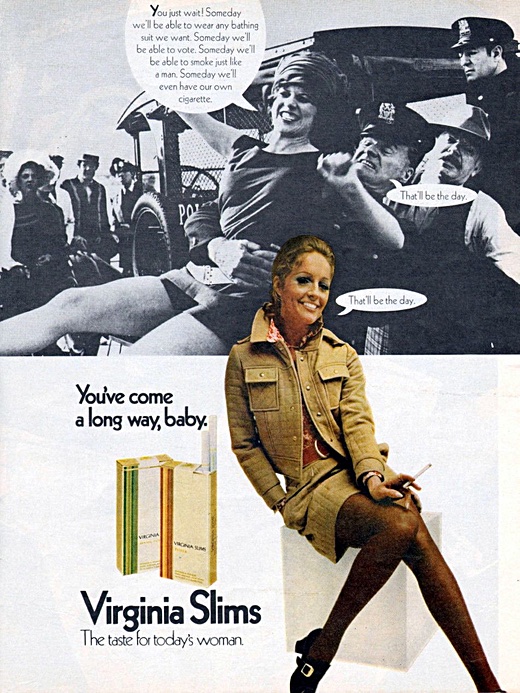
The woman being arrested for indecent exposure, in the magazine ad shown above, was absolutely correct. Women can now wear any bathing suit they want (within reason.) Women can vote. And they can smoke just like a man.
The most important of those abilities might be “voting”. (Yes, bathing suits and smoking are very important, but there’s a hierarchy to consider.)
And related to “voting” is “running for office and getting elected.”
Hattie Caraway was the first woman elected to the U.S. Senate, in 1932, representing Arkansas. Sixty-five women have served in the Senate throughout American history, and currently 27 women are serving in the Senate, the most women who have ever served in the Senate at the same time. That’s, like, slightly more than a quarter of the Senators.
A slightly larger percentage of state Governors, in 2027, will be women: 17 of the 50 governors. About 1-in-3.
It’s estimated that 64 million women voted in the 2026 midterms. Compared to 56 million men.
Clearly, among women, voting is now more popular than smoking.
What was not popular among women in 2026: data centers.
From an October 29 article by journalist Jessica Kutz on 19thNews.org:
Women have been at the forefront of a fast-growing, bipartisan backlash to data centers, packing local meetings, organizing protests and even running for office. Now, less than a week from Election Day, some are saying it’s reshaping how they plan to vote.
Half of Americans think data centers are affecting home energy costs, a perception that is adding to voters’ concerns around affordability ahead of the elections, according to a September survey by the nonpartisan Pew Research Center. In addition, more than half think data centers are bad for the environment, up from 39 percent in January.
It’s one of the few issues that has bypassed partisan polarization, and broken down by gender, the opposition is strongest among women. According to a Gallup poll from May, 55 percent of women said they strongly opposed data centers compared with 43 percent of men.
When we think about some of those numbers — 64 million women voting, compared to 56 million men — it’s pretty clear that women have the power to make this country into whatever they want it to be.
If what they want is to wear skimpy bathing suits and smoke slender filtered cigarettes, then that’s what they will have. But they could have a lot more. Theoretically.
Underrated writer Louis Cannon grew up in the vast American West, although his ex-wife, given the slightest opportunity, will deny that he ever grew up at all. You can read more stories on his Substack account.