
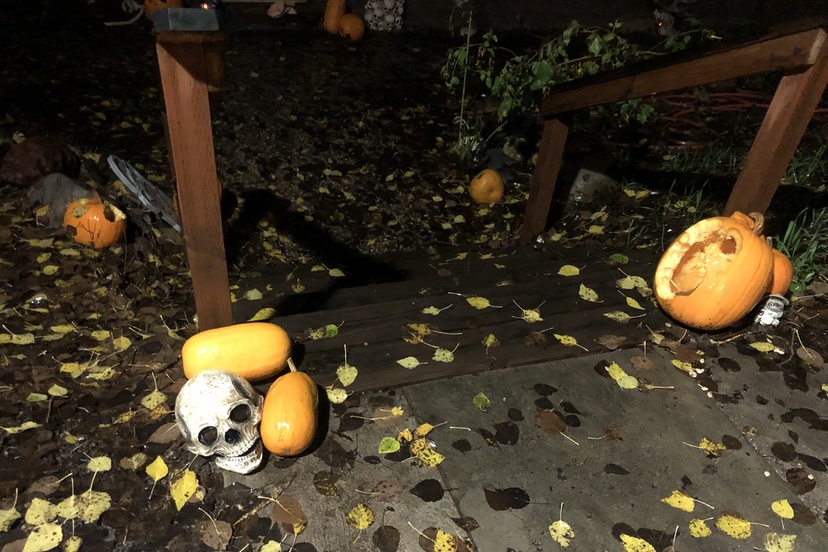
A scene on Lewis Street during a walk early Monday morning. A couple of the pumpkins had obviously been nibbled by downtown deer.
I found myself awake and unable to sleep at around 2:30am, the morning of November 2, 2026. Then I heard my little electric space heater kick on — as it does when my bedroom gets down to a certain temperature — and I understood that the electricity was still operating.
I could hear a light rain falling on the metal roof. Obviously, the atmosphere’s natural process of recycling of water vapor into precipitation was also still operating.
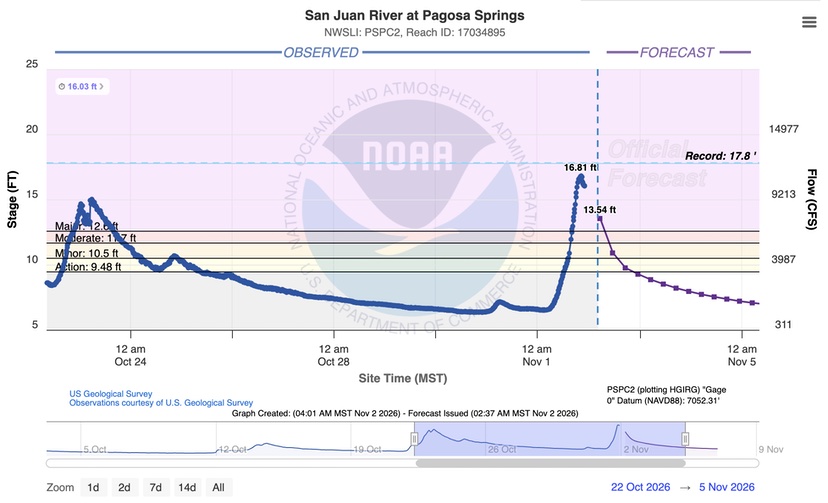
But how did our little downtown fare, through the night? I wondered. The predictions for the San Juan River, posted to the National Oceanic and Atmospheric Administration (NOAA) on Sunday, were warning of a record flood for the San Juan River through downtown Pagosa Springs on November 1.
21.91 feet at around midnight.
That was the prediction on Sunday. About four feet higher than the historic flood of 1911.

I had taken a walk from my house down to the Hot Springs Boulevard bridge and Town Park on Sunday, and while the river was definitely overflowing its banks, it did not seem any higher than a week ago, when it peaked at 15.5 feet.
But the sky was still raining. If the San Juan did indeed hit the predicted levels, I suspected one or both of the downtown vehicle bridges would be damaged.
After tossing and turning, and wondering if our bridges had been washed away by the flood, I hopped out of bed and fired up my computer to check the NOAA website.
As of 3am, the San Juan had apparently peaked at 16.8 feet. A foot below the record flood in 1911.
Well, since I couldn’t sleep… I decided to take a 3am walk downtown.
I first headed down Lewis Street to check on the 1st Street Bridge, as a light rain continued to fall. Needless to say, I didn’t see any traffic on Lewis Street, nor on Highway 160. Folks had taken the posted government advice and were sheltering at home.
The river was roaring under the 1st Street bridge, but the bridge itself looked to be in good shape. The area immediately south of the bridge, commonly called Cotton Hole Park, was completely under water.
I took 2nd Street down to Hermosa Street — the downtown neighborhood most at risk of flood damage, and a street where some of my friends and acquaintances live. The street was relatively dry, but littered with flood debris. Clearly, the flood had made its way down the street earlier in the night… and was continuing to flow into the street through one particularly low-lying river-front property.
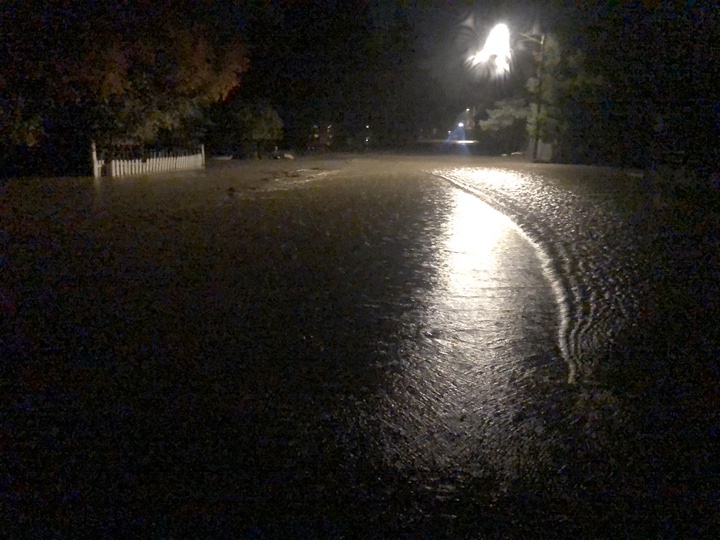
I turned back and returned to Highway 160 and walked west until I had a view of Town Park, which had become “Town Lake.” The lake seemed slightly larger, in the dim light, than it had been a week earlier following the October 23 flood. I suspected the park would be well-covered in mud after the water receded.
Thus, I found myself thinking about the Nile River.
The annual flooding of the Nile was a natural cycle first documented by the ancient Egyptians. The river’s predictability and annual deposits in the Nile Valley and Delta made for extraordinarily rich soil, enabling the Egyptians to build an empire on the basis of its enormous agricultural wealth and surpluses of cereals which could be stored or traded. Egyptians were one of the first groups of people to practice agriculture on a large scale.
By the time of Roman rule, Egypt was one of the most significant sources of wheat in the entire Roman Empire.
In modern Egypt, governments began building flood management infrastructure during the 19th century, continuing throughout the 20th century. In 1970, the annual flooding of the Nile ceased with the completion of the Aswan High Dam.
Does this have anything to do with a flood in Pagosa Springs? Probably not.
Arriving back home on Loma Street, I found the electricity still working, along with the Internet. But not the water. Pagosa Area Water and Sanitation District (PAWSD) had issued a warning on Sunday that there could be issues with water infrastructure downtown as a result of the San Juan flood.
As I post this editorial at 5:30 on Monday morning, the rain continues to rattle the roof.
How many days has it been raining? I’ve lost track.
Bill Hudson began sharing his opinions in the Pagosa Daily Post in 2004 and can't seem to break the habit. He claims that, in Pagosa Springs, opinions are like pickup trucks: everybody has one.